A 23-Year Documentary Audit of the Central Approval, Supreme Court Proceedings, Administrative Failures and the Road Ahead
By S. J. R. Kumar
3 September 2026
The Question That Cannot Be Allowed to Disappear
For more than two decades, one question has remained largely unanswered:
What happened to the land that the Government of India approved for the rehabilitation of Kerala’s landless Scheduled Tribes?
The figure is extraordinary:
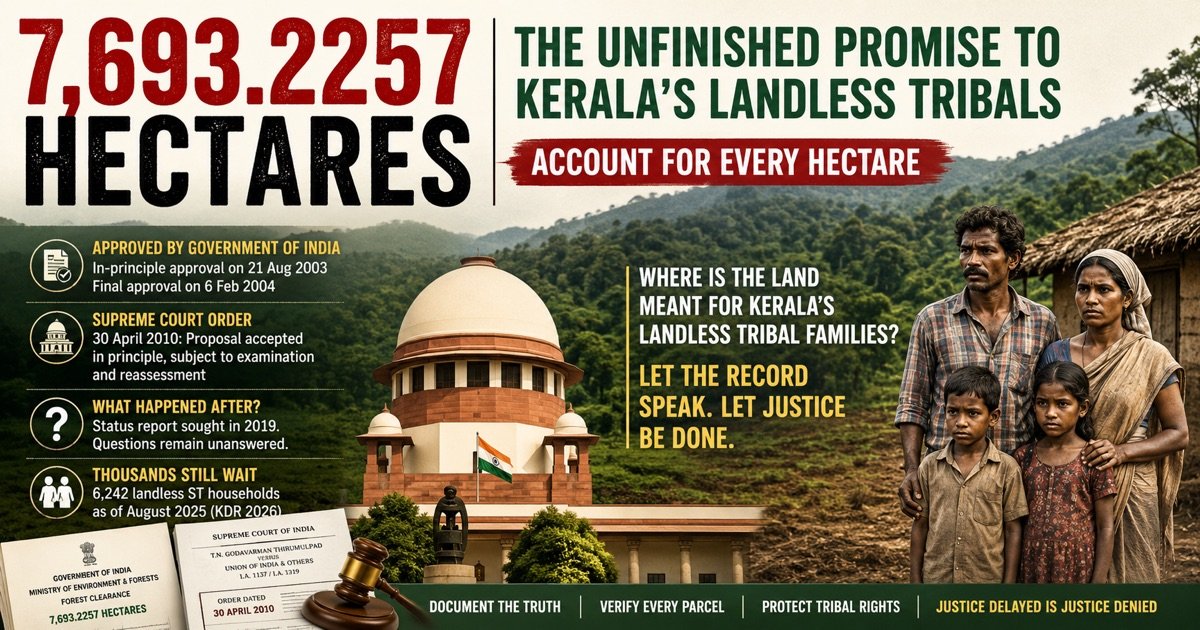
7,693.2257 hectares
That is approximately 19,000 acres.
This was not merely a political promise or an election announcement. It arose from a formal proposal of the Government of Kerala, consideration by the Government of India under the forest-conservation framework, subsequent proceedings before the Supreme Court of India, and continuing administrative processes.
Yet Kerala continues to have thousands of landless Scheduled Tribe families.
According to the Kerala Development Report 2026, the number of landless Scheduled Tribe households was 6,242 as of August 2025.
This raises a fundamental public-interest question:
If thousands of acres were identified and approved for tribal rehabilitation, where is that land today, how much was actually assigned, how much remains available, how much was diverted for other purposes, and why are tribal families still waiting for land?
This article examines the documentary record and proposes a practical accountability mechanism.
1. THE CENTRAL GOVERNMENT APPROVAL WAS REAL
The first point must be established beyond political argument.
In 2003, the Government of Kerala proposed the diversion of 12,196.1829 hectares of vested forest land for the resettlement of landless tribals.
Following discussions between the Government of Kerala and the Union Ministry of Environment and Forests, the Government of India agreed in principle to the diversion of 7,693.2257 hectares for the rehabilitation/resettlement of landless tribals in five districts.
The Union Government’s approval covered:
- Kasaragod
- Kannur
- Wayanad
- Palakkad
- Malappuram
A Lok Sabha answer dated 8 December 2003 officially confirmed that the Union Government had approved diversion of 7,693 hectares of vested forest land for the resettlement of landless tribals.
The detailed Central Government forest-clearance record gives the precise figure as:
7,693.2257 hectares
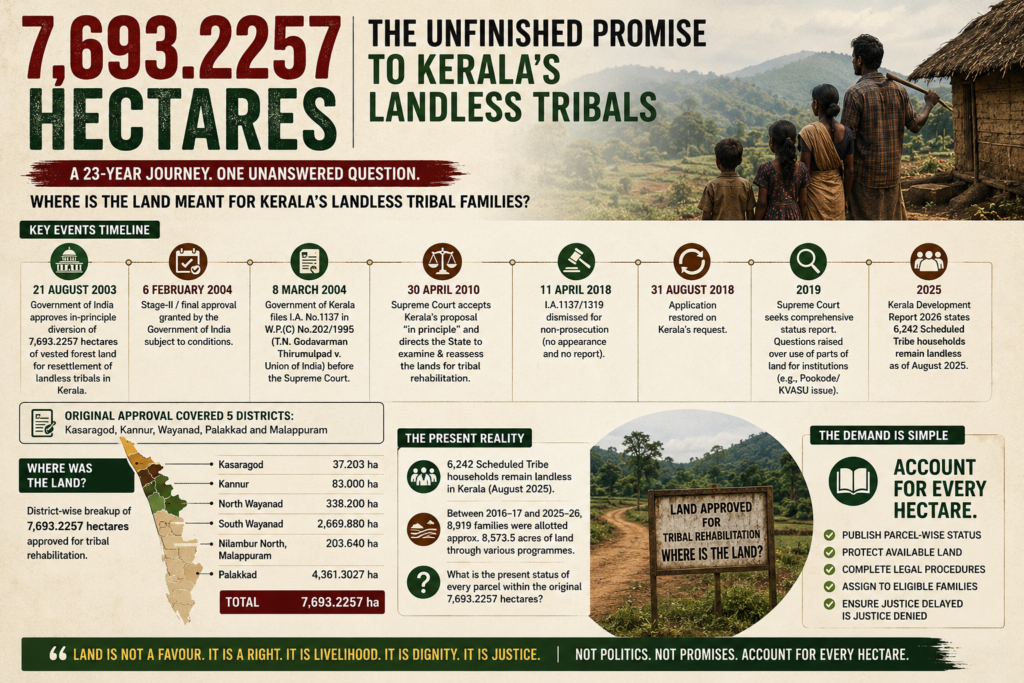
The in-principle approval was conveyed on 21 August 2003, followed by Stage-II/final approval on 6 February 2004, subject to specified conditions.
Therefore, the basic assertion that a substantial area of land was approved for tribal rehabilitation is documented fact.
2. WHERE WAS THE LAND?
The original Central Government approval covered the following areas:
| District / Forest Division | Area approved |
|---|---|
| Kasaragod | 37.203 ha |
| Kannur | 83.000 ha |
| North Wayanad | 338.200 ha |
| South Wayanad | 2,669.880 ha |
| Nilambur North, Malappuram | 203.640 ha |
| Palakkad | 4,361.3027 ha |
| TOTAL | 7,693.2257 ha |
The largest components were therefore in Palakkad and Wayanad. The official Central Government record provides this division-wise breakup.
This table should be the starting point for any serious investigation.
Not political speeches.
Not press conferences.
Not competing allegations.
The survey numbers and present status of each parcel.
3. WHAT DID THE SUPREME COURT HAVE TO DO WITH IT?
This is where the matter becomes particularly important.
The proceedings took place in the Supreme Court in:
T.N. Godavarman Thirumulpad v. Union of India & Others
W.P.(C) No. 202/1995
The State of Kerala filed I.A. No. 1137 in 2004.
The application related to the 7,693.2257 hectares and, among other things, sought exemption from payment of Net Present Value in connection with the diversion approved for rehabilitation of landless tribals.
The Central Empowered Committee subsequently submitted a report in I.A. No. 1319.
4. THE LANDMARK SUPREME COURT ORDER OF 30 APRIL 2010
There is considerable confusion surrounding the Supreme Court proceedings.
It is therefore important to state precisely what the Court actually ordered.
On 30 April 2010, the Supreme Court considered the CEC report concerning the land proposed to be allotted to tribals.
The Court recorded:
“In principle, the proposal put forward by the Kerala Government is accepted.”
The Court also recorded that the lands had originally been private forests which had vested in the Government under the Kerala Private Forests (Vesting and Assignment) Rules, 1974, and that the lands were proposed to be assigned for agricultural purposes under the Land Reforms framework.
The Court directed the concerned State department to examine the individual forest lands, assess the extent covered by the Forest Act and reassess the extent to be included in the proposal for rehabilitation of landless tribals.
The Court further recorded an assurance that occupants would not be permitted to cut timber trees on land assigned to tribals.
The question of Net Present Value was left open until after assignment.
The Court specifically described the exercise as a one-time exercise, not a precedent for Kerala or other States.
An important legal clarification
The 2010 order should not be misrepresented as an order directing the Government to immediately issue individual pattas to every landless tribal family for the entire 7,693.2257 hectares.
It did not do that.
Rather, the Court accepted the proposal in principle, required examination and reassessment of the land, and left the NPV question to be considered subsequently.
That distinction matters.
A credible public campaign must be built on what the Court actually ordered—not on an exaggerated interpretation.
5. WHAT HAPPENED AFTER 2010?
This is where the documentary trail becomes increasingly troubling.
The Supreme Court record indicates that the matter did not move with the urgency one would expect from a programme intended to rehabilitate landless tribal families.
By 2018, the application had apparently remained without further effective progress.
On 11 April 2018, the Supreme Court recorded:
“Neither there is any appearance on behalf of the applicant nor status report has been filed.”
The application was consequently dismissed for non-prosecution.
Kerala subsequently filed an application for restoration, and on 31 August 2018, restoration was allowed.
This is a critical administrative milestone.
A matter concerning thousands of hectares intended for landless Scheduled Tribes should never have been allowed to become procedurally dormant in this manner.
6. THE 2019 SUPREME COURT PROCEEDINGS RAISED FURTHER QUESTIONS
The matter returned to the Supreme Court in 2019.
On 19 August 2019, the Amicus Curiae brought to the Court’s attention an allegation that approximately 100 acres of land had been given to an institution under the guise of the Court’s order.
Importantly, the Court did not itself establish that allegation as true.
Instead, it directed the State to respond and called for a status report concerning the entire land covered by the order.
This distinction must be maintained.
The allegation is one matter.
The Court’s direction to obtain a comprehensive status report is another—and that direction is documented.
On 29 November 2019, the Supreme Court directed that a proper report be filed, supported by an affidavit of the Principal Secretary, Forests, and ordered the matter to be listed after four weeks.
The obvious question is:
What did that comprehensive status report ultimately reveal?
And equally importantly:
What happened after that?
7. THE POOKODE/KVASU ISSUE
One of the most significant examples requiring examination concerns land in Wayanad.
A Central Government inspection in 2014 examined land at Pookode in Wayanad in the context of allegations concerning the use of forest land for facilities associated with the Kerala Veterinary & Animal Sciences University.
The Central Government record noted that the relevant area was approximately 341 hectares, with recorded uses including:
- Priyadarshini Estate – 100 ha
- Kerala Veterinary & Animal Sciences University – 40 ha
- Navodaya School – 10 ha
- Model Residential School – 8 ha
Again, this does not mean that every one of these uses was unlawful.
But it unquestionably demonstrates why a parcel-by-parcel audit is necessary.
The issue eventually reached the National Green Tribunal and the Kerala High Court.
The NGT proceedings concerned the use of approximately 100 acres for KVASU. The land had been vested under the Kerala Private Forests (Vesting and Assignment) framework and was associated with the broader tribal-resettlement question.
More importantly, the Government of India’s Forest Advisory Committee subsequently considered the matter.
In a letter dated 31 October 2019, following consideration by the FAC, the Central Government required, among other things:
- identification and survey of the actual area broken up and required by KVASU;
- submission of a Forest Conservation Act proposal for the relevant forest land, including the circumstances in which it had been granted without the required clearance; and
- return of the remaining forest land to the Forest Department if it was not required for the purpose for which it had been diverted in 2004.
This is an extremely important documentary point.
It shows that the question of whether land approved for tribal rehabilitation was subsequently used for other purposes was not merely a political allegation.
It became a matter examined by the statutory forest-clearance machinery of the Government of India.
8. BUT WAS ALL 7,693.2257 HECTARES ACTUALLY SUITABLE?
This is another point on which public discussion often becomes misleading.
The answer is:
No—not necessarily.
A later assessment recorded that out of the original 7,693.2257 hectares:
- approximately 2,894.6191 hectares were found suitable by the Forest Department;
- approximately 876.993 hectares were found suitable by the Revenue Department.
The assessment also indicated that procedures in parts of Malappuram and Palakkad had not been completed, preventing a complete assessment.
Therefore, it would be inaccurate to simply say:
“The Centre gave Kerala 7,693 acres/hectares and Kerala has failed to distribute all of it.”
The documentary record is more complicated.
The proper question is:
What is the present status of every parcel within the original 7,693.2257-hectare proposal?
Each parcel should fall into a clearly identified category.
For example:
- Assigned to tribal beneficiaries
- Suitable but not yet assigned
- Under survey
- Unsuitable, with recorded reasons
- Forest land requiring further clearance
- Transferred to another department
- Used by an institution
- Returned to Forest Department
- Under litigation
- Encroached
- Reserved for another Government purpose
- Physically unavailable
- Otherwise disposed of
Until this exercise is completed, nobody can responsibly claim to know the complete answer.
9. THE PRESENT REALITY: TRIBAL LANDLESSNESS HAS NOT DISAPPEARED
This is perhaps the most powerful reason to reopen the issue.
Kerala has not solved the problem of landlessness among Scheduled Tribes.
The Kerala Development Report 2026 records that the number of landless Scheduled Tribe households declined from 10,748 in May 2016 to 6,242 in August 2025.
That reduction is significant and should be acknowledged.
Kerala has also implemented several land-distribution programmes.
Between 2016–17 and 2025–26, the State reports that approximately 8,573.5 acres were allotted to 8,919 families through various programmes, including Forest Rights Act titles, revenue/project/farm land, reserved forest land and land purchase schemes.
These achievements should not be ignored.
But they also do not answer the central question concerning the 7,693.2257-hectare proposal.
The two issues must be examined separately.
10. THE FOREST RIGHTS ACT IS ANOTHER ROUTE
The Forest Rights Act, 2006 provides a separate statutory framework for recognition of forest rights.
It covers, among other things, rights relating to self-cultivation and habitation and various community and traditional forest rights.
Implementation of the Act is primarily the responsibility of the State Governments, while the Ministry of Tribal Affairs monitors implementation.
Kerala has reported substantial progress under the Act.
As of 31 October 2025, the State had reported:
- 29,422 Individual Forest Rights titles
- 282 Community Rights titles
under the Forest Rights Act.
However:
FRA rights should not be confused with the separate 7,693.2257-hectare tribal rehabilitation proposal.
They are different legal and administrative pathways.
A serious land-rights campaign must track both—but must not merge them into one figure.
11. WHO IS RESPONSIBLE?
This question should be answered without partisan distortion.
The Government of Kerala and its administrative machinery have the primary responsibility for implementing a land-allocation programme within the State.
That involves coordination among departments and authorities dealing with:
- Scheduled Tribe Development
- Revenue
- Forests
- District Administration
- Land assignment
- Tribal rehabilitation
- Forest Rights Act implementation
The Union Government has important responsibilities concerning forest clearances, statutory compliance and monitoring, but actual identification, processing and assignment of eligible land to beneficiaries substantially depends upon the State machinery.
Therefore, responsibility cannot simply be attributed to one Chief Minister or one political party.
The responsibility is cumulative.
Successive governments have had opportunities to resolve the matter.
The administrative system has had even longer.
12. IS THIS “CPI(M)-CONGRESS-BJP ADJUSTMENT POLITICS”?
Political parties may make such allegations.
But a documentary investigation must go further than political rhetoric.
At present, the evidence reviewed for this report does not establish a formal CPI(M)-Congress-BJP arrangement to deprive tribal people of this land.
Making such an allegation without documentary proof would weaken rather than strengthen the campaign.
There is, however, a much stronger and more defensible argument:
Regardless of which political party governed Kerala at different times, successive State Governments and the permanent administrative machinery have failed to provide the public with a transparent, parcel-wise account of the land originally proposed and approved for tribal rehabilitation.
That is the issue that should unite every genuine tribal-rights organisation.
Not party politics.
Not ideological rivalry.
Accountability.
13. THE REAL QUESTION: WHERE IS EVERY HECTARE?
The Government of Kerala should publish a comprehensive 7,693.2257-Hectare Tribal Land Accountability Register.
For every parcel, the Government should disclose:
| Particular | Required information |
|---|---|
| District | Name |
| Taluk | Name |
| Village | Name |
| Survey/Re-survey No. | Exact number |
| Original extent | Hectares |
| Present extent | Hectares |
| Original classification | Forest/Vested Forest/etc. |
| Present department | Forest/Revenue/other |
| Suitability | Suitable/unsuitable |
| If unsuitable | Detailed reason |
| Assigned? | Yes/No |
| Beneficiary | Number of families, without unnecessary personal data |
| Assignment date | Date |
| Current use | Agricultural/residential/institutional/other |
| Transferred? | Details |
| Returned? | Details |
| Litigation | Case number/status |
| Forest clearance | Details |
| Encroachment | Status |
| Present balance | Unassigned extent |
This should be made available through a publicly accessible digital dashboard.
No more aggregate numbers.
No more vague assurances.
No more department-to-department correspondence hidden from public scrutiny.
14. FIVE QUESTIONS THE KERALA GOVERNMENT MUST ANSWER
1. How much of the original 7,693.2257 hectares was actually transferred for the intended tribal rehabilitation purpose?
2. How much was actually assigned to landless Scheduled Tribe families?
3. How much remains unassigned today, and why?
4. How much was transferred, diverted, occupied or used for purposes other than tribal rehabilitation?
5. What happened to every parcel identified in the Supreme Court proceedings and subsequent Government reports?
These questions do not require political rhetoric.
They require documents.
15. WHAT SHOULD HAPPEN NOW?
The Government should establish a time-bound Tribal Land Accountability Mission.
Phase I — DOCUMENT
Collect every Government order, forest-clearance file, CEC report, Supreme Court order, Revenue record and district-level file.
Phase II — VERIFY
Reconcile the original 7,693.2257 hectares with present survey records.
Phase III — MAP
Create GIS-based parcel maps identifying the present status of every parcel.
Phase IV — LEGALISE
Complete pending legal procedures and forest/revenue clearances wherever legally permissible.
Phase V — ASSIGN
Distribute all eligible and available land to eligible landless tribal families.
Phase VI — PROTECT
Ensure that assigned tribal land is not subsequently alienated or diverted contrary to law.
Phase VII — PUBLISH
Place the complete status on a public dashboard and update it periodically.
16. WHAT CAN TRIBAL ORGANISATIONS DO?
Tribal welfare organisations should not limit themselves to demonstrations and memoranda.
They should establish a joint, non-partisan:
TRIBAL LAND RIGHTS — 7,693.2257 HECTARE ACCOUNTABILITY MISSION
It should include:
- Tribal representatives
- Revenue experts
- Forest-law experts
- Advocates
- RTI activists
- GIS/survey professionals
- Social workers
- Researchers
- Representatives of affected families
Its operating principle should be simple:
DOCUMENT → VERIFY → MAP → LEGALISE → MOBILISE → LITIGATE → MONITOR
17. THE LEGAL OPTIONS
Several legal and institutional routes are available.
A. Kerala High Court
A properly prepared writ petition can seek:
- parcel-wise identification;
- publication of the status of the land;
- completion of pending surveys;
- consideration of eligible tribal claims;
- protection of available land;
- time-bound administrative action;
- periodic reporting to the Court.
B. Supreme Court
Counsel can examine the procedural status of I.A.1137/I.A.1319 in W.P.(C) No.202/1995 and determine whether appropriate further directions can be sought in the Godavarman proceedings.
The exact procedural status must first be verified from the latest Supreme Court record.
C. National Commission for Scheduled Tribes
The National Commission for Scheduled Tribes has constitutional responsibilities under Article 338A, including monitoring safeguards for Scheduled Tribes, examining grievances and recommending corrective measures.
A comprehensive representation should therefore be submitted to the Commission.
D. Kerala State Human Rights Commission
Where prolonged administrative inaction amounts to a human-rights concern, a complaint can also be considered before the Kerala State Human Rights Commission, which has powers to inquire into human-rights violations and negligence by public servants.
E. Forest Rights Act mechanisms
Individual and community claims under the FRA should be pursued independently through the statutory Gram Sabha, Sub-Divisional Level Committee and District Level Committee mechanisms wherever applicable.
18. THE RTI ROUTE
Before beginning another political campaign, an evidence campaign should begin.
RTI applications should be filed with:
- Kerala Forest Department
- Revenue Department
- Scheduled Tribe Development Department
- District Collectors
- Ministry of Environment, Forest and Climate Change
- Ministry of Tribal Affairs
- Supreme Court Registry, wherever records are obtainable under the applicable RTI framework
The questions should be precise.
For example:
“Provide the survey-number-wise present status of all land included in the 7,693.2257-hectare proposal approved by the Government of India for rehabilitation/resettlement of landless tribals in Kerala.”
And:
“Provide copies of all reports, affidavits, status reports, correspondence and Government orders relating to implementation of the Supreme Court proceedings in I.A.1137/I.A.1319.”
The objective should be to build a documentary chain, not merely collect newspaper reports.
19. WHAT SHOULD NOT BE DONE
The campaign should avoid three mistakes.
First: Do not claim that all 7,693.2257 hectares are automatically available for distribution today.
The official records themselves show that suitability and legal status vary.
Second: Do not describe the 2010 Supreme Court order as an order granting individual pattas to all tribals.
That is not what the Court ordered.
Third: Do not make allegations of political collusion without documentary evidence.
If evidence eventually establishes political or institutional collusion, it should be exposed.
But the investigation must lead the allegation—not the other way around.
20. THE DEMAND SHOULD BE SIMPLE
The demand need not be complicated.
ACCOUNT FOR EVERY HECTARE.
Not necessarily “distribute every hectare.”
Not “take away legitimate public institutions.”
Not “ignore forest law.”
Not “bypass court orders.”
Instead:
Account for every hectare. Establish its present legal and physical status. Protect every parcel that is legally available for tribal rehabilitation. Complete the necessary statutory procedures. And assign every eligible parcel to eligible landless tribal families without further avoidable delay.
That is a demand which cannot reasonably be opposed by anyone genuinely committed to tribal welfare and the rule of law.
21. THE LARGER QUESTION OF JUSTICE
Land is not merely an economic asset for many tribal families.
It is livelihood.
It is security.
It is dignity.
It is the foundation upon which housing, agriculture, education and social stability can be built.
A landless tribal family dependent indefinitely on Government welfare remains vulnerable.
A family with secure legal title to suitable land has a substantially different future.
That is why the issue cannot be reduced to the question of hectares.
Behind every hectare is a human being waiting for justice.
22. CONCLUSION
The documentary record establishes several important facts.
First, the Government of India did approve the diversion of approximately 7,693.2257 hectares of vested/reserved forest land for the rehabilitation of landless tribals in Kerala.
Second, the Supreme Court, in its order dated 30 April 2010, accepted the Kerala Government’s proposal in principle, subject to examination and reassessment of the individual lands.
Third, the matter subsequently became procedurally dormant, was dismissed for non-prosecution in 2018, and was later restored.
Fourth, the Supreme Court sought a comprehensive status report in 2019.
Fifth, subsequent Government records demonstrate that questions arose concerning the use of portions of the land for purposes other than the intended tribal rehabilitation, including the Pookode/KVASU issue.
Sixth, later assessments show that not all of the original area was necessarily suitable or immediately assignable.
Seventh, despite substantial progress under various tribal land programmes, Kerala still had 6,242 landless Scheduled Tribe households as of August 2025.
Therefore, the issue cannot be dismissed as history.
Nor can it be settled by political accusation.
It requires a fresh documentary audit.
Kerala owes the public—and particularly its landless tribal families—a clear answer.
Where is the land?
What happened to it?
What remains available?
Who received it?
Who is occupying it?
What was diverted?
What was returned?
What remains to be assigned?
And above all:
WHEN WILL THE LANDLESS TRIBAL FAMILIES RECEIVE THE LAND THAT IS LEGALLY DUE TO THEM?
The time has come to replace political arguments with documentary accountability.
7,693.2257 HECTARES.
ACCOUNT FOR EVERY HECTARE.
PRIMARY DOCUMENTARY SOURCES
The following official records form the principal documentary basis of this article:
Government of India — Lok Sabha, Unstarred Question No. 943, 8 December 2003
Government of India — Ministry of Environment & Forests, Forest Clearance File
Supreme Court of India — T.N. Godavarman Thirumulpad v. Union of India, I.A.1137/I.A.1319
Supreme Court proceedings — 2018
Supreme Court order — 29 November 2019
Kerala High Court — Wayanad Prakrithi Samrakshana Samithi v. State of Kerala
Government of Kerala — Tribal Land and Rehabilitation records
Kerala Development Report 2026
Ministry of Tribal Affairs — Forest Rights Act
National Commission for Scheduled Tribes
AUTHOR’S NOTE
This article is intended as a public-interest documentary study.
It distinguishes between established facts, official records, allegations requiring verification, and questions that remain unanswered.
It does not claim that every hectare of the original 7,693.2257-hectare proposal is presently available for distribution.
Its central demand is more fundamental:
The Government should disclose the present status of every parcel originally included in the tribal rehabilitation proposal and complete, without further avoidable delay, the lawful assignment of all eligible land to eligible landless Scheduled Tribe families.
Only a transparent, survey-number-wise audit can finally establish what happened to the land—and what must happen next.
Lok Sabha Official Record — Distribution of Forest Land Amongst Landless Adivasis
https://youtu.be/gVVA3v7BF7E?si=shD-6irYjPrXyqA