Table of Contents
- Introduction
- Submissions of the Solicitor General
- Understanding Religion Under the Constitution
- Plurality of Religions
- Concept of Religious Denomination
- Protection of Sections Within Religions
- Limits of Judicial Review in Religious Matters
- Criticism of the Essential Religious Practices Doctrine
- Drafting History of Article 25
- Interpretation of “All Persons Are Equally Entitled”
- Interplay Between Articles 25 and 26
- Need for Harmonious Construction
- Doctrine of Proportionality
- Critique of Constitutional Morality
- Deity and Matters of Faith
- Procedural Concerns and PILs
- Conclusion of Submissions
- Final Thought
Introduction
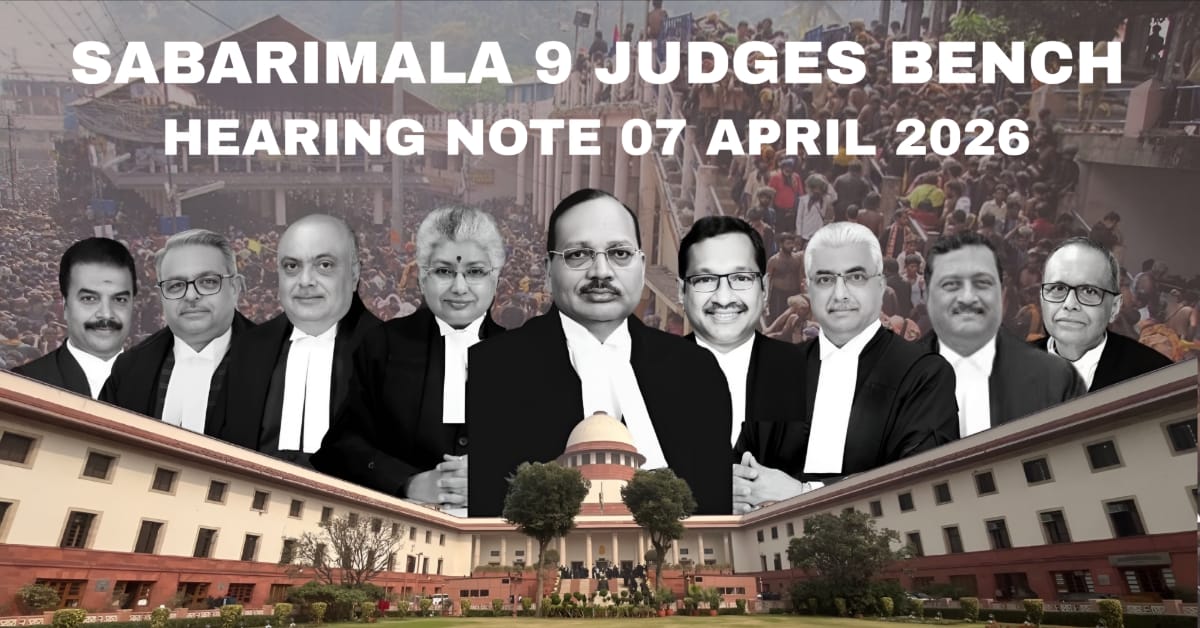
The hearing before the Constitution Bench on April 7, 2026, in the Sabarimala review matter marked a significant moment in the ongoing constitutional discourse on religious freedom, denominational rights, and judicial review. The Solicitor General of India, Tushar Mehta, presented extensive submissions supporting the review of the 2018 Sabarimala judgment. His arguments delved into constitutional interpretation, religious plurality, and the limits of judicial intervention in matters of faith.
This article provides a detailed and structured account of the submissions made, preserving every aspect of the original hearing while presenting it in a reader-friendly blog format.

Submissions of the Solicitor General
Support for Review of the 2018 Judgment
The Solicitor General commenced his submissions by affirming that the Union Government supports the review petitions against the 2018 Sabarimala judgment. He argued that the earlier judgment requires reconsideration as it approached religious practices through a narrow and modern lens, without adequately accounting for the diversity and complexity of Indian religious traditions.
His arguments were rooted in foundational constitutional principles laid down in the Shirur Mutt Case, where Articles 25 and 26 were interpreted together, distinguishing between:
- Religious matters under Article 26(b), and
- Administration of property under Article 26(d)
Understanding Religion Under the Constitution
Absence of a Definition
The Solicitor General emphasised that the Constitution does not define religion, and therefore it cannot be confined within rigid or straight-jacket definitions.
Scope of Religion
According to his submissions, religion includes:
- Faith and belief
- Relationship between man and God
- Philosophical concepts such as Advaita
- Rituals, ceremonies, observances
- Practices involving food, clothing, and daily conduct
He highlighted that traditional practices (anishtanas) cannot be questioned by courts based on logic or rationality.
Plurality of Religions
Hinduism as a Pluralistic System
The Solicitor General stressed the internal plurality of Hinduism, noting that it:
- Has no single authority or central text
- Includes Vedas, Agamas, and Puranas
- Accommodates diverse philosophical schools, including Charvak Darshan
Plurality Across Religions
He further noted that:
- Islam includes Shia and Sunni traditions
- Christianity includes Catholic, Protestant, and Orthodox denominations
This plurality, he argued, requires courts to avoid imposing uniform standards on religious practices.
Concept of Religious Denomination
Definition and Characteristics
Relying on the Shirur Mutt Case, the Solicitor General explained that a religious denomination is identified by:
- A common faith
- A common organisation
- A distinctive name
Examples of Denominations
He cited:
- Sects founded by Shankaracharya, Madhvacharya, and Ramanujacharya
- Shaivites and Vaishnavites
- Institutions like the Ashta Maths of Udupi
He emphasised that Article 26 protects not only denominations but also any “section thereof.”
Protection of Sections Within Religions
Broad Interpretation of Article 26
The Solicitor General argued that even groups that are not separate religions but follow distinct traditions qualify for protection.
Illustrative Examples
He referred to places of worship such as:
- Shirdi
- Tirupati
- Ajmer Dargah
- Nizamuddin Dargah
These, he argued, demonstrate that identifiable sections with distinct practices exist even within shared spaces of worship.
Limits of Judicial Review in Religious Matters
Lack of Judicial Expertise
The Solicitor General contended that courts lack:
- Spiritual authority
- Theological expertise
Critique of Rationality-Based Review
He cautioned against evaluating religion using:
- Rationality
- Modernity
- Scientific temper
Religion, he argued, is based on belief rather than logic.
Criticism of the Essential Religious Practices Doctrine
Judicial Overreach
He submitted that the Essential Religious Practices (ERP) doctrine:
- Leads courts into theological adjudication
- Exceeds institutional competence
Determination of Essentiality
He argued that essentiality must be determined:
- From the perspective of the religious community
- Not by judicial interpretation
Drafting History of Article 25
Shift from “Worship” to “Practice”
The Solicitor General highlighted that:
- The original draft referred to “religious worship”
- It was later changed to “religious practice”
This change followed objections from members such as:
- Rajkumari Amrit Kaur
- Hansa Mehta
Broader Scope of Protection
This amendment expanded constitutional protection to include:
- Rituals
- Processions
- Practices outside temples
He cited Ganpati immersion as an example.
Interpretation of “All Persons Are Equally Entitled”
Historical Context
The phrase was introduced in April 1947 during:
- Communal tensions surrounding Partition
Purpose of the Phrase
According to the Solicitor General:
- It ensures inter-religious equality
- It promotes secularism
- It prevents religious superiority
He clarified that:
- It is not a guarantee of gender equality
- Gender equality is addressed under Articles 14 and 15
Interplay Between Articles 25 and 26
Autonomy Under Article 26
Article 26 guarantees:
- Autonomy to religious denominations
- Subject only to public order, morality, and health
Temple Entry Under Article 25(2)(b)
Article 25(2)(b) allows:
- Laws enabling temple entry for all classes of Hindus
- Measures of social reform
Need for Harmonious Construction
Balancing Competing Rights
Relying on Sri Venkataramana Devaru v. State of Mysore, the Solicitor General argued that:
- Articles 25 and 26 must be read together
- Neither provision should override the other
Key Principles
- Temple entry rights are not absolute
- Denominational rights cannot be extinguished
- Both must coexist
Doctrine of Proportionality
Ensuring Balance
He invoked:
- Harmonious construction
- Proportionality
Core Argument
Any restriction under Article 25(2)(b):
- Must be proportionate
- Must not destroy denominational identity
Critique of Constitutional Morality
Original Purpose
The Solicitor General argued that constitutional morality:
- Was meant to guide constitutional functionaries
- Applies when law is silent
Objection to Judicial Use
He criticised its use:
- As a tool for judicial review
- For striking down religious practices
He argued this introduces subjectivity.
Deity and Matters of Faith
Attributes of the Deity
He submitted that:
- The character of Lord Ayyappa as a Naishtika Brahmachari is a matter of faith
Limits of Judicial Intervention
Courts cannot:
- Reform a deity
- Question beliefs about divine attributes
Procedural Concerns and PILs
Question of Standing
The Solicitor General raised concerns about:
- Whether persons unconnected with a faith can challenge its practices
Suggested Approach
He suggested:
- Such disputes should involve proper evidentiary processes
- Not abstract constitutional adjudication
Conclusion of Submissions
The Solicitor General concluded that the legal position is well established:
- Religion includes practices and observances
- Denominations and their sections have protected rights
- Judicial review in matters of faith must be limited
- Articles 25 and 26 must be interpreted harmoniously
He emphasised that:
- Neither provision should override the other
- The constitutional framework must preserve religious autonomy while maintaining balance
Final Thought
The submissions made on April 7, 2026, underscore a deeper constitutional tension between individual rights, religious autonomy, and judicial authority. By advocating restraint in judicial intervention and emphasising the pluralistic nature of Indian religion, the Solicitor General has reignited a fundamental debate: how should courts navigate faith in a constitutional democracy?
The outcome of this case will likely have far-reaching implications—not only for Sabarimala but for the broader relationship between law and religion in India.