The ongoing constitutional battle over Sabarimala temple traditions before the Hon’ble Supreme Court has become one of the most significant legal struggles concerning Hindu religious rights in independent India. The proceedings before the Nine-Judge Bench are not merely about one temple or one practice. They concern the future of denominational rights, temple autonomy, religious customs and the constitutional protection available to ancient Hindu traditions under Articles 25 and 26.
It is in this context that the recent submissions and pleadings associated with Adv. C. Rajendran have triggered serious concern among many Ayyappa devotees and supporters of Sabarimala temple traditions.
What has particularly surprised devotees is that Adv. C. Rajendran was earlier perceived by many as someone broadly supportive of the protection of Sabarimala temple traditions and the rights of devotees. However, a closer examination of his written submissions and oral arguments reveals what many believe to be a deeply contradictory approach that could ultimately weaken the constitutional defence of the temple itself.
The Positive Aspects of the Submissions
The written submissions do contain several arguments supporting the uniqueness of Sabarimala temple traditions. The pleadings recognise:
- the 41-day vratham,
- spiritual austerity,
- celibacy,
- Kundalini Yoga,
- yogic discipline,
- and the Naishtika Brahmachari nature of Lord Ayyappa.
The submissions further argue that the traditional restriction concerning women of a particular age group was historically connected to the unique spiritual discipline of the temple and not based on impurity or discrimination.
These portions appear broadly supportive of Sabarimala temple traditions and align with arguments raised by many devotees and organisations defending the temple’s practices before the Supreme Court.
Where the Serious Concern Begins
The controversy arises from another stream of arguments reportedly advanced in connection with the same case — particularly theories suggesting Buddhist links, “Buddha Pagoda” interpretations and attempts to reinterpret the historical foundations of Sabarimala outside its accepted Hindu traditional framework.
This is where many devotees believe the arguments become dangerous.
The defence of Sabarimala temple traditions before the Supreme Court fundamentally depends upon establishing:
- continuity of ancient Hindu worship,
- denominational rights,
- Thantric and Agamic authority,
- the unique character of the deity,
- and constitutional protection under Articles 25 and 26.
Any argument that weakens the Hindu theological identity or historical continuity of Sabarimala can directly damage this constitutional foundation.
A Contradictory Legal Strategy
This contradiction is what has alarmed many supporters of Sabarimala temple traditions.
On one hand, the submissions speak extensively about:
- Yoga,
- spiritual transformation,
- celibacy,
- austerity,
- and the unique nature of Lord Ayyappa worship.
On the other hand, theories that attempt to dilute or reinterpret the Hindu identity of Sabarimala risk undermining the very basis upon which constitutional protection is being claimed.
This creates a strategic inconsistency.
A constitutional defence of Sabarimala temple traditions cannot simultaneously:
- rely upon the unique religious identity of the temple,
and - weaken that identity through speculative reinterpretations.
Why Devotees Fear These Arguments May “Hit Back”

The fear among devotees is not emotional alone. It is also legal and constitutional.
If speculative reinterpretations are accepted:
- opponents of temple customs may argue that rituals are socially constructed and therefore open to judicial modification,
- denominational protection under Article 26 may weaken,
- and similar challenges could later be raised against numerous Hindu temples across Bharat.
This is why many believe such arguments may eventually “hit back” against the very cause they claim to support.
The larger battle today is not only about entry issues. It is about whether Hindu communities will continue to retain the constitutional right to preserve their ancient religious practices without external reinterpretation.
The Real Constitutional Issue
The strongest defence of Sabarimala temple traditions historically rests upon:
- uninterrupted worship,
- recognised temple customs,
- the rights of devotees,
- denominational autonomy,
- the authority of Thantris,
- and landmark constitutional principles laid down in cases such as Shirur Mutt.
Any attempt to shift the debate into uncertain historical theories risks weakening this core constitutional framework.
That is why many devotees now openly question whether certain arguments, though presented as intellectual or academic exercises, may ultimately damage the long-term protection of Hindu temple traditions.
Conclusion
There is no doubt that portions of the written submissions acknowledge the unique spiritual character of Sabarimala temple traditions.
However, the simultaneous advancement of theories that dilute the established Hindu traditional foundations of the temple has created widespread concern among devotees.
The confusion among supporters is therefore understandable. Many expected a clear and uncompromising defence of Sabarimala temple traditions before the Nine-Judge Bench. Instead, what has emerged appears to many as a mixed and internally contradictory approach.
The consequences of such arguments may extend far beyond Sabarimala itself. The outcome of this constitutional battle may influence the future protection available to Hindu temples, rituals and denominational rights throughout the country.
For that reason, every argument advanced before the Supreme Court in relation to Sabarimala temple traditions must be examined carefully, critically and responsibly.
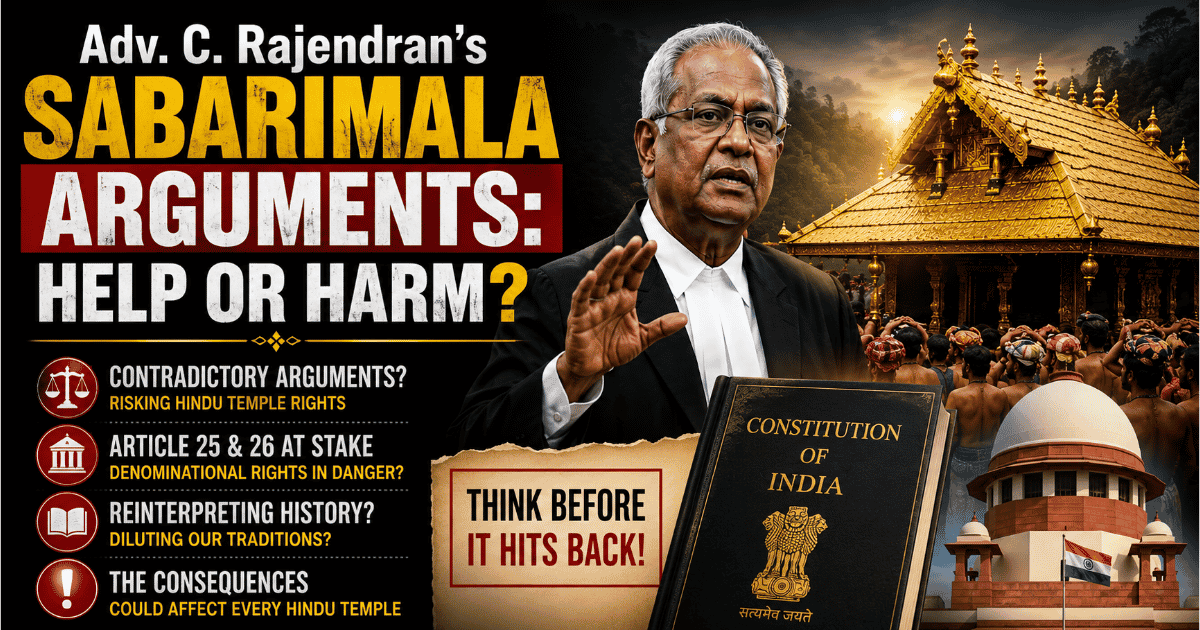
Adv. C Rajendran presenting his Budhist Pagoda theory before the 9-Judges Bench
OTHER SUBMISSIONS BEFORE THE 9 JUDGES BENCH
- Sabarimala 9 Judges Bench – Hearing Note 07 April 2026
- Sabarimala 9 Judges Bench – Hearing Note 08 April 2026
- Sabarimala 9 Judges Bench – Hearing Note 09 April 2026
- Sabarimala 9 Judges Bench – Hearing Note 15 April 2026
- Sabarimala 9 Judges Bench – Hearing Note 17 April 2026
- Sabarimala 9 Judges Bench – Hearing Note 22 April 2026