Table of Contents
- I. India as a Civilisation State: The Framework of Diverse Faiths
- II. Decoding the Rights Under Articles 25 and 26
- III. The Fallacy of “Essential Religious Practices”
- IV. Restricting the Locus Standi of PILs
- V. Rejecting “Constitutional Morality” as a Standard for Faith
- VI. The Primacy of Article 26 Over State Reform
- VII. The Legal Reality of the Deity and Article 17
- Final Thoughts: A Victory for Dharma
- OTHER SUBMISSIONS BEFORE THE 9 JUDGES BENCH
The ongoing proceedings before the 9-judge bench of the Supreme Court of India have reached a historic juncture, defending tradition, signalling a powerful vindication for the millions of devotees represented by the Sabarimala Karma Samithi. As a principal petitioner in this landmark case, I have stood firm against the entry of women aged 10 to 50 to protect the traditional rituals, customs, and practices that define the sanctity of Lord Ayyappa’s abode.
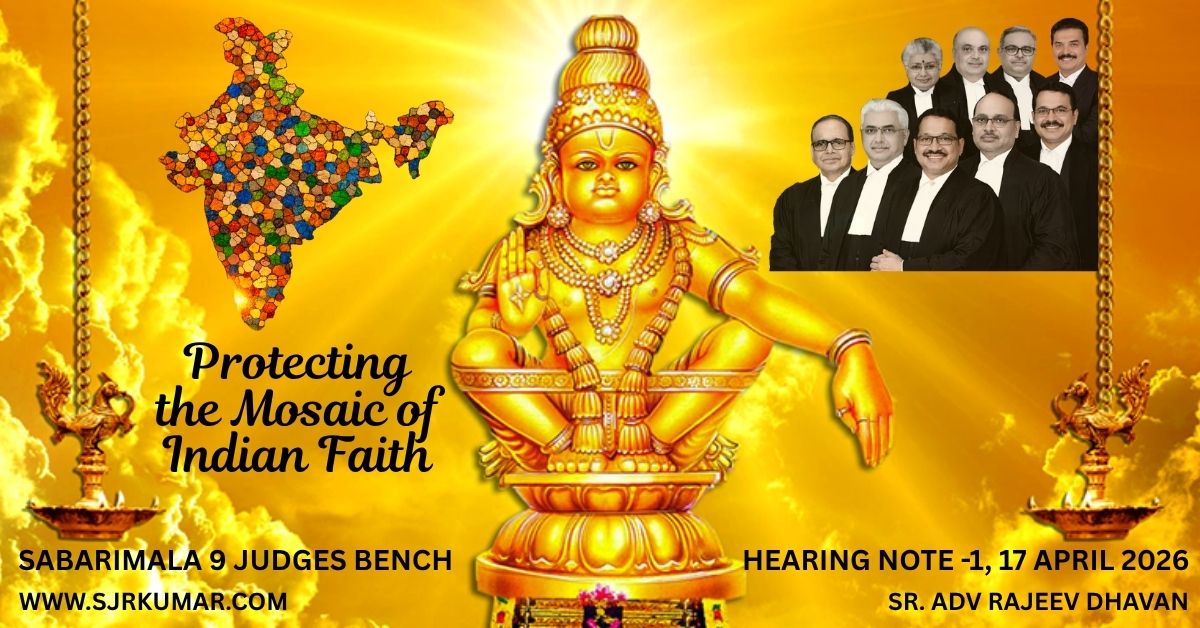
The shift in the legal landscape—most notably the Travancore Devaswom Board’s decision to return to its original stance of protecting tradition—marks a monumental victory for the Sabarimala Karma Samithi. It validates our tireless agitation against the forceful disruption of time-honored customs and reinforces our core argument: that the Constitution of India, when interpreted correctly, provides robust protection for denominational autonomy and the unique character of a deity. The following is a descriptive elaboration of the arguments presented by Senior Advocate Rajeev Dhavan on April 17, 2026, which pave the way for a new era of religious freedom in India.
I. India as a Civilisation State: The Framework of Diverse Faiths
Senior Advocate Rajeev Dhavan began by framing the Indian Constitution not merely as a legal document for a nation-state, but as a charter for a “Civilization State”. He argued that India’s social, cultural, and religious diversity is greater than half the world combined.
The Mosaic of Secularism
- Preserving Individual Identity: Dhavan invoked the TMA Pai judgment, which describes India as a relief map in mosaic, where every individual piece (citizen) must retain its own “color” and identity to maintain the beauty of the whole.
- Beyond Traditional Religions: He cited Justice Chinnappa Reddy to argue that “religion” is not confined to popular faiths like Hinduism or Islam but includes several less known or even unknown tribal and “ism-less” faiths.
- The Concept of “Becoming”: The Constitution is in a state of ‘becoming’ rather than ‘being’, meaning faiths evolve and new ones emerge across this diversity.
- A Nation for All Faiths: The rejection of amendments like “In the name of God” in the Constituent Assembly proves that while the nation is not against religion, it must celebrate all faiths equally without allowing one to swallow the other.
Healing a Fractured Society
- Constitutional Promise: After partition, the Constitution was a solemn promise to heal a diverse and sometimes fractured nation.
- Fundamental Duties: Articles 51A(e) and (f) capture the duty to promote harmony and value the rich heritage of our composite culture.
- Combating Divisive Forces: In today’s climate, the healing touch of the Constitution is crucial to protect traditions from being dismantled by outsiders.
II. Decoding the Rights Under Articles 25 and 26
A significant portion of Dhavan’s submission involved “decoding” the specific rights and limitations embedded in the freedom of religion. For the Sabarimala Karma Samithi, this decoding is essential to prove that Article 26 is the ultimate safeguard for our temples.
The Independent Right of Conscience
- Choice and Privacy: Freedom of conscience is independent of the right to religion.
- Link to Article 21: Following the Puttaswamy judgment, this is linked to the concept of “choice” and privacy.
- Multi-Religious Discourse: While dissent is part of public discourse, it must remain respectful and not violate constitutional limitations.
The Institutional Shield: Article 26
- The Vital Institutional Right: Dhavan argued that Article 26 is the most crucial institutional right, without which no religion can survive.
- Autonomy of Management: Article 26(b) protects the “autonomy of the faith” in the broadest sense of religious affairs as they are intertwined with real life.
- Survival Over Time: Without the power to acquire property and manage affairs according to their own traditions, religions would be reduced to mere rituals subject to shifting interpretations.
- Independent of Article 25: Crucially, Dhavan argued that Article 26 is an independent right and not just a compendium of individual rights.
III. The Fallacy of “Essential Religious Practices”
The Sabarimala Karma Samithi has long demanded the removal of the “Essential Religious Practices” (ERP) test, which allows secular judges to decide what is “core” to a religion. Dhavan’s submissions on this point were exhaustive and revolutionary.
A Threshold Implication
- The Gatekeeper Problem: Currently, if a claimant cannot prove a practice is “essential,” they are denied constitutional protection entirely.
- No Textual Basis: Dhavan pointed out that the ERP test has no reference to the text of the Constitution or the Constituent Assembly Debates.
- An Invented Doctrine: He argued that the Court did not “invent” this doctrine but rather inherited it from arguments made by the Attorney General in the 1954 Shirur Mutt case, which the Court initially rejected.
The Five Stages of Expansion
Dhavan traced how the ERP test became a “monster” through various judicial stages:
- Stage I (Limitation): It began as a way to find an “integral part” of religion.
- Stage II (Determinative Factor): It was used to judge whether beliefs were an integral part of the faith.
- Stage III (Fundamental Alteration): The test became whether removing the practice would fundamentally alter the religion. This was used in the original Sabarimala judgment to claim excluding women was a “mere embellishment”.
- Stage IV (Core Beliefs Only): It restricted protection only to the “cornerstone” beliefs.
- Stage V (The Superstition Trap): Courts began dismissing beliefs as “superstitious” or “unnecessary accretions,” which Dhavan criticized as being inconsistent with the protection of subjective faith.
Proposed Solution: The “Sincerity of Belief” Test
- Focus on the Claimant: Dhavan proposed that the concept of essential practices be overruled and replaced by testing “bona fide beliefs” as a threshold test.
- No Judicial Theology: The Court should inquire into the sincerity of the claimant (is the claim honest and not fictitious?) rather than sitting in judgment over the validity of the religious tenet itself.
- Protecting Irrational Beliefs: As noted in international law, an individual is at liberty to hold beliefs however “irrational or inconsistent” they may seem to others, provided they are held in good faith.
IV. Restricting the Locus Standi of PILs
A core grievance of the Sabarimala Karma Samithi is the “nuisance factor” of Public Interest Litigations filed by those who do not believe in the deity. Dhavan’s arguments regarding Locus Standi and the role of non-religious actors were particularly detailed.
The Misuse of Derivative PILs
- Traditional Rules: Locus should lie with an “aggrieved person” who has a cause of action.
- Threshold Rejections: Dhavan submitted that there should be a “threshold rejection” of writs under Article 32 and 226 for religious rights when filed by non-believers.
- The Civil Court Alternative: He argued that intra-religious or inter-se disputes (disputes within or between faiths) should ideally proceed by way of a civil suit in trial courts rather than through PILs in Constitutional Courts.
When Can Non-Members Intervene?
Dhavan suggested very limited situations where persons of another faith might have locus:
- Universal Values: Where universal constitutional values like Article 17 (Caste-based untouchability) are at stake.
- Statutory Duty: Where an enabling law passed by the state is being ignored.
- Health and Order: Where a practice affects a non-member’s health or public order (e.g., COVID-19 restrictions).
- The General Rule: A person of another faith cannot file a writ to raise a religious dispute that has no bearing on a constitutional right.
V. Rejecting “Constitutional Morality” as a Standard for Faith
The Sabarimala Karma Samithi has consistently argued that “Constitutional Morality” is a modern, secular concept that should not be used to dismantle ancient traditions. Dhavan’s submissions on this point were a direct critique of the majority view in the 2018 judgment.
Relativism and Uncertainty
- Undefined Concept: Dhavan argued that concepts like “democracy,” “federalism,” and “secularism” are undefined and introduce an element of uncertainty into adjudication.
- Not a Limitation: Because opinions on “Constitutional Morality” vary so wildly among judges, it is “relativistic” and cannot be accepted as a constitutional limitation on religious freedom.
- The “Back Door” Critique: He criticized the attempt to bring in these values through the “back door” of the term ‘morality’ in Article 25.
The Madarsa Case Warning
Dhavan cited the Anjum Kadari case to argue that a statute can only be struck down for violating express provisions of the Constitution, not for violating the “Basic Structure” or “Secularism” in the abstract. Similarly, “Constitutional Morality” should be a vision for functionaries, not a tool to strike down faith-based practices.
VI. The Primacy of Article 26 Over State Reform
The Sabarimala Karma Samithi demands that the right of a religious group to manage its internal rituals (Article 26) be protected from government-led social reform (Article 25). Dhavan provided a rigorous legal justification for this hierarchy.
Harmonization, Not Subordination
- Co-Equal Authority: Dhavan argued that Article 25(2)(b) (the power of the state to open temples for social reform) and Article 26 (the right to manage religious affairs) are of co-equal authority.
- The Devaru Error: He explicitly stated that the famous Venkataramana Devaru case was “wrongly decided” to the extent that it made Article 26 “subject to” Article 25(2)(b).
- Textual Integrity: He pointed out that Article 26 notably lacks the phrase “subject to the other provisions of this Part,” a phrase that is present in Article 25. This omission was intentional and must be respected to prevent the “crippling” of religious institutions.
Defending Tradition: Limits of “Social Reform”
- Not Religious Reform: Social reform concerns external manifestations and social welfare; it is not meant to be religious reform of the belief or conscience.
- Protecting the Sanctum: Even when a temple is opened for “worship” to all classes, it does not include the performance of rituals by unqualified persons. The right of the denomination to perform services in the inner sanctum remains inviolable.
VII. The Legal Reality of the Deity and Article 17
Finally, Dhavan’s submissions provided a framework to support the Sabarimala Karma Samithi’s stance on the nature of the deity and the misapplication of the “Untouchability” clause.
The Distinction of Article 17
- Gender is Not Caste: The legal ban on untouchability (Article 17) was designed to combat caste-based discrimination.
- The “Abhorrent” Test: Justice Nariman’s view was cited, suggesting that “morality” in Article 25 should only be used to stop things “abhorrent to a civilized society,” such as the degradation of human beings.
- Ritual Context: Ritual restrictions based on the specific character of a deity (like an “eternal celibate”) are normatively acceptable in their own context and should not be equated with the social evil of untouchability.
The Institutional Future
- Viability of Religion: Dhavan concluded that if this institutional protection is not given, and if the state continues to interfere in the “economic, financial, or secular” aspects of faith in an invasive way, no religion will survive in the long term.
- Horizontal and Vertical Classes: While Article 25(2)(b) opens temples to “all classes,” the interpretation must balance this with the deity’s unique status and the denomination’s right to maintain its core identity.
Final Thoughts: A Victory for Dharma
The 5th day of proceedings before the 9-judge bench has laid the groundwork for a monumental correction of past judicial errors. The submissions by Senior Advocate Rajeev Dhavan align closely with the vision of the Sabarimala Karma Samithi: a future where the “Sincerity of Belief” is the only test for faith, where PIL-warriors are restricted from interfering in sacred spaces, and where the institutional autonomy of Article 26 is restored to its rightful, independent status.
This is more than a legal debate; it is a battle for the right of Lord Ayyappa to remain an Naishtika Brahmachari and for the Hindu community to manage its temples without state interference. The shift in the Devaswom Board’s stance and the rigorous legal arguments presented this week signal that the truth of our traditions is finally being heard in the highest corridors of power. The Sabarimala Karma Samithi will continue to lead this agitation until the sacred customs of all temples are fully protected under the shadow of the Constitution.
OTHER SUBMISSIONS BEFORE THE 9 JUDGES BENCH
- Sabarimala 9 Judges Bench – Hearing Note 07 April 2026
- Sabarimala 9 Judges Bench – Hearing Note 08 April 2026
- Sabarimala 9 Judges Bench – Hearing Note 09 April 2026
- Sabarimala 9 Judges Bench – Hearing Note 15 April 2026
SABARIMALA PROTEST – ONE OF THE FALSE CASES QUASHED BY KERALA HIGH COURT