
Table of Contents
- Introduction: Why Preservation of Sabarimala is Important?
- Understanding Sanatana Dharma in Kaliyuga
- The Sacred Agamic Framework of Sabarimala
- Bhakti and Shakti: Two Pillars, Not One
- The Myth of Silence as Supreme Dharma
- Refuting the Doctrine of Passive Restraint
- Historical Lessons: When Hindus Chose to Resist
- The Ayodhya Movement
- The Cost of Reclaiming Dharma
- The 2018 Sabarimala Protests: A Living Example
- Civilizational Threats Facing Sabarimala Today
- Predatory Ideologies and Cultural Erosion
- Dharma Himsa: The Forgotten Half of Dharma
- Why Passivity Leads to Extinction
- Hindu Unity as the Real Shield
- Political Awakening and Cultural Survival
- Beyond Passive Devotion: A Call to Conscious Action
- Conclusion: The Iron Will of the Ayyappas
- FAQs
Introduction: Why Preservation of Sabarimala is Important?
Sabarimala Is More Than a Temple: Sabarimala is not merely a pilgrimage destination tucked away in the Western Ghats. It is not just stone steps, dense forests, or a deity enshrined on a hilltop. Sabarimala is a living civilizational contract. It represents discipline over desire, restraint over indulgence, and continuity over convenience. For millions of devotees, the very act of undertaking the Sabarimala pilgrimage is a spiritual reprogramming—a reminder that faith is not consumed, but cultivated.
In an era obsessed with instant gratification, Sabarimala demands preparation, austerity, and submission to tradition. The vratham, the barefoot trek, the shared suffering—none of these are symbolic accidents. They are intentional filters, preserving the unique spiritual ecology of the shrine. To preserve Sabarimala, therefore, is not simply to preserve a temple; it is to preserve a way of life embedded deeply within Sanatana Dharma.
The discomfort surrounding Sabarimala in modern discourse arises precisely because it refuses to bend easily. It stands as a civilizational speed breaker in a world rushing toward homogenization. That is why the conversation around Sabarimala is never really about access alone—it is about authority, continuity, and the right of an ancient civilization to remain itself in Kaliyuga.

Understanding Sanatana Dharma in Kaliyuga
Dharma as a Living Civilization
Sanatana Dharma is often misunderstood as a religion in the narrow, modern sense. In truth, it is a civilizational ecosystem. It encompasses metaphysics and medicine, rituals and resistance, renunciation and responsibility. Unlike belief-centric traditions, Sanatana Dharma survives through practice. Temples like Sabarimala are not optional cultural accessories; they are load-bearing pillars of this ecosystem.
Dharma is not frozen in time, but it is also not infinitely malleable. It adapts organically, not forcibly. Its survival depends on unbroken transmission—teacher to student, parent to child, devotee to deity. When a temple’s unique practices are disturbed, the ripple effect extends far beyond the sanctum. It weakens the collective muscle memory of a civilization.
Sabarimala’s rules are not arbitrary. They are the result of centuries of lived wisdom, spiritual experimentation, and social consensus. To reduce Dharma to abstract ideals while ignoring its institutional expressions is like admiring a tree while cutting its roots.
Kaliyuga and the Crisis of Continuity
Kaliyuga is often described as an age of moral decline, but its most dangerous feature is amnesia. Traditions do not vanish overnight; they erode gradually through reinterpretation, dilution, and selective outrage. The crisis of Kaliyuga is not that people reject Dharma outright, but that they demand Dharma without discipline.
In Kaliyuga, continuity itself becomes revolutionary. Simply insisting that ancient practices be respected is framed as extremism. The danger lies not in open opposition, but in well-meaning interference that ignores context, sacred geometry, and spiritual psychology. Sabarimala stands today at the intersection of this crisis—where civilizational continuity is tested by modern impatience.
The Sacred Agamic Framework of Sabarimala
Role of the Thantri
The Thantri is not a ceremonial figurehead. He is the custodian of the Agamic system governing the temple. His authority is rooted in scripture, lineage, and spiritual discipline. Agamas are not flexible guidelines; they are precise manuals detailing how divinity is invoked, sustained, and respected within a consecrated space.
Interfering with Agamic practices is not administrative tinkering—it is spiritual vandalism. The Thantri’s role ensures that rituals remain aligned with the deity’s sankalpa. In Sabarimala, where the deity is worshipped as a Naishtika Brahmachari, the Agamic framework is inseparable from the deity’s very identity.
Role of the Pandalam Raja
Historically, the Pandalam Raja served as the temporal guardian of Sabarimala. This was not a power role, but a protective one. Kings in the Dharmic framework were expected to shield temples from disruption, not dictate theology. Their legitimacy flowed from their service to Dharma, not dominance over it.
The Pandalam Raja represented the balance between spiritual autonomy and worldly protection. When this role is replaced by a modern bureaucratic state, the delicate equilibrium collapses. The state lacks spiritual accountability, yet exercises total control—creating a vacuum where Dharma becomes vulnerable.
Balance Between Ritual Authority and Temporal Protection
Civilizations survive when spiritual authority and temporal power operate in harmony. When courts override Agamas or governments micromanage temples, that harmony disintegrates. Sabarimala’s crisis is not accidental—it is the direct result of dismantling this ancient balance without offering a viable alternative rooted in Dharma.
Bhakti and Shakti: Two Pillars, Not One
The Limits of Bhakti Alone
Bhakti is the emotional and devotional core of Sanatana Dharma. It melts the ego and binds the devotee to the divine. But Bhakti alone, when divorced from Shakti, becomes vulnerable. A devotee may weep in prayer, but tears cannot stop ideological bulldozers or legal overreach.
History repeatedly shows that faith without force of will invites exploitation. Bhakti must inspire courage, not complacency. When devotion is reduced to passive acceptance, it ceases to be transformative.
Why Shakti Is Indispensable Today
Shakti does not mean chaos or violence. It means organized resistance, moral confidence, and collective action. In the Devi Mahatmya, the goddess does not negotiate endlessly with adharma—she confronts it. In Kaliyuga, Shakti manifests as awareness, unity, and the refusal to be gaslit into surrender.
For Sabarimala to survive, Bhakti must be backed by Shakti. Love for Ayyappa must translate into the will to protect His abode from erosion.
The Myth of Silence as Supreme Dharma
Silence in Spiritual Contexts
Silence has its place. In meditation, silence is a gateway to the self. In contemplation, it refines awareness. Saints embraced silence to transcend the ego. But spiritual silence is voluntary and contextual—it is not imposed submission.
Silence in Civilizational Conflicts
When silence is demanded in the face of aggression, it becomes a tool of erasure. Civilizational conflicts are not resolved through introspection alone. Silence here is misrepresented as virtue, while resistance is mislabeled as intolerance. This inversion is one of Kaliyuga’s greatest tricks.
Refuting the Doctrine of Passive Restraint
When Silence Becomes Surrender
There is a fine line between restraint and surrender. When traditions are dismantled piece by piece and the response is perpetual patience, the outcome is predictable. No civilization has survived on apologies alone.
Misreading Kerala’s Spiritual Temperament
Kerala’s spiritual history is rich with resistance—intellectual, cultural, and physical. To paint its devotees as passive is to misunderstand their resilience. The protection of Sabarimala is not a deviation from Kerala’s ethos; it is its continuation.
Historical Lessons: When Hindus Chose to Resist
The Ayodhya Movement
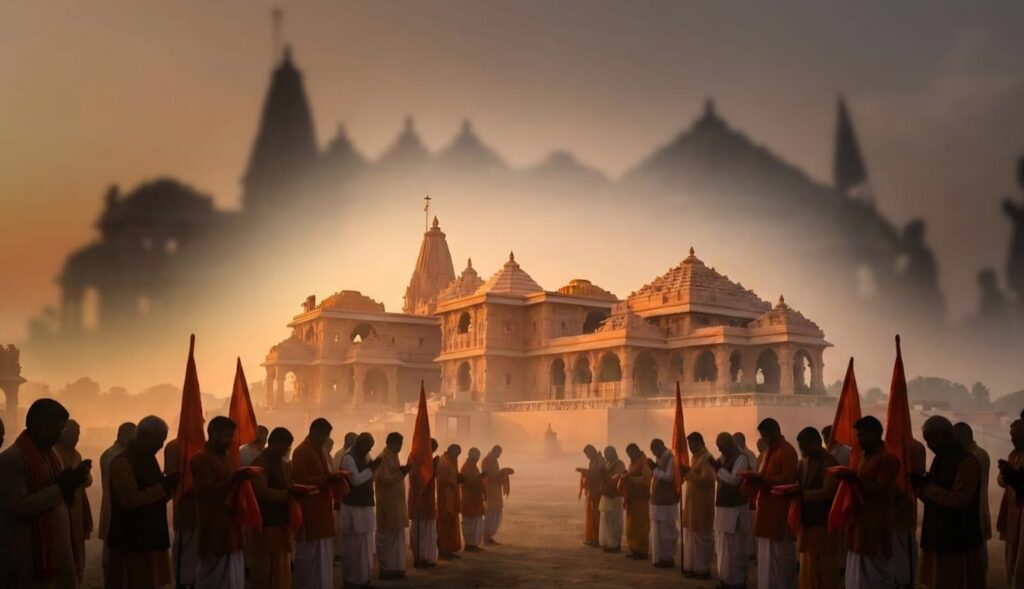
The Ayodhya movement acts as a profound case study in the context of the themes we are exploring—resistance, endurance, and the reclamation of sacred spaces. It serves as the historical counter-weight to the issues of “state control” and “dilution” I mentioned earlier. Where administrative overreach seeks to weaken from within, the Ayodhya movement demonstrated how a civilization mobilizes to reclaim what was lost from without.
Here is a detailed perspective on the Ayodhya movement as a lesson in civilizational resistance:
Resistance as a Long-Term Commitment
The defining characteristic of the Ayodhya movement was its refusal to accept the status quo as permanent.
- Beyond the Legal Battle: While the legal case ran for over 70 years in independent India, the struggle itself spanned centuries. The “historical lesson” here is that resistance was not a single event but a multi-generational vow. It demonstrated that a community could sustain a memory of injustice—the destruction of the temple—over hundreds of years without letting it fade into history.
- Refusal to “Move On”: For decades, the dominant political and intellectual advice to Hindus was to “forget the past” for the sake of peace. The resistance lay in the community’s collective decision that peace without justice was merely submission. They chose the harder path of keeping the issue alive until a resolution was achieved.
The Power of Mass Mobilization (The Jan Andolan)
Unlike the bureaucratic control seen in state-managed temples today, Ayodhya showed the power of the devotee over the administrator.
- The Kar Sevak: The movement democratized the defense of Dharma. It wasn’t left to kings or courts alone; the Kar Sevak (volunteer) became the primary agent of change. People from every corner of India—bringing bricks (Shila) from their villages—created a physical and emotional stake in the temple.
- Unity Across Divides: The movement successfully bridged caste and regional lines, uniting the Hindu society under a single civilizational cause. This unity was the “Shakti” that eventually made the political and legal pressure insurmountable.
Correcting the “Civilizational Wound”
I have described the temple not just as a place of worship, but as a “civilizational wound” that needed healing.
- Symbol of Dignity: The Babri Masjid structure standing over the birthplace of Lord Ram was viewed not just as a mosque, but as a monument to conquest—a visual reminder of a time when the indigenous faith was subjugated.
- Restoration, Not Just Construction: The construction of the Ram Mandir was framed as “Pran Pratishtha” (infusing life) not just for an idol, but for the national consciousness. It symbolized the end of a “defeatist” mindset and the assertion that the civilization had the right to correct historical wrongs.
The Price of Resistance
- Endurance of Stigma: For years, proponents of the temple were labeled as communal, regressive, or anti-national by the establishment media and academia. The resistance required the intellectual toughness to withstand this demonization.
- Physical Sacrifice: The movement saw tangible sacrifices, from the Kothari brothers to countless unnamed activists who faced police bullets, imprisonment, and violence. The lesson reinforced is that reclaiming heritage often demands a physical and personal price, not just a vote or a signature.
If the current state control of temples represents a “passive erosion” of Hindu institutions, Ayodhya represents “active reclamation.” It teaches that when the state or the status quo is indifferent or hostile to the faith, the organized will of the society is the only force capable of turning the tide. It is the ultimate proof that silence does not buy peace; it only ensures the permanence of the loss.
The Cost of Reclaiming Dharma
The cost of reclaiming Dharma is indeed high, but as observed, the cost of passivity is the erasure of the civilisation itself. History provides stark examples: civilisations that ceased to resist or diluted their core values to accommodate conquerors eventually vanished. Dharma has survived in India precisely because each generation produced individuals who refused to trade their identity for temporary peace.
Here is a breakdown of the “costs” involved in this struggle, and why they are necessary investments for survival:
The Cost of Comfort
Resistance disrupts the comfort of the status quo.
- Social Ostracization: Those who stand for Dharma often face ridicule from the “intellectual” class. They are labeled as backward, communal, or intolerant. The cost here is the willingness to be unpopular in elite circles to remain true to one’s roots.
- Mental Toll: Constant vigilance against administrative overreach (like the TDB issues) or cultural distortion requires immense mental energy. It is easier to be a passive devotee than an active defender.
The Cost of Resources
Reclaiming institutions requires material sacrifice.
- Economic Independence: Temples and institutions cannot remain autonomous if they depend on state handouts. The community must bear the financial burden of supporting their own priests, maintaining their own temples, and fighting expensive legal battles (like the decades-long Ayodhya case or the Sabarimala intervention).
- Building Ecosystems: It requires investing in parallel educational and cultural ecosystems so that the next generation understands why they must resist, rather than just inheriting empty rituals.
The Cost of Conflict
As the Ayodhya movement showed, resistance is rarely bloodless or polite.
- Physical endurance: From the Kar Sevaks to the devotees engaging in the Namajapa Yatra for Sabarimala, the physical act of protest—facing police action, arrest, or violence—is a price that history often demands.
- Standing Alone: Often, the resistance must happen without the support of the state or global institutions, which may be hostile to the cause.
The Return on Investment: Survival
The “profit” of this cost is not monetary, but existential.
- Cultural Continuity: Because ancestors paid this cost, the Vedas are still chanted, temples still stand, and the lineage remains unbroken.
- Self-Respect: A community that fights for its gods and its rights commands respect. Passivity invites contempt and further encroachment.
The lesson is clear: Peace that comes from surrender is the peace of the graveyard. The “struggle” you mention is the heartbeat of a living civilization. As long as there is struggle, there is life.
The 2018 Sabarimala Protests: A Living Example
Role of Common Devotees
The 2018 Sabarimala protests stand as a powerful testament to the spirit and resilience of ordinary devotees. Contrary to popular belief, these protests were not engineered by political elites or well-funded organizations. Instead, they erupted spontaneously from the hearts and minds of everyday people—fishermen, farmers, laborers, and small shopkeepers—who deeply understood the stakes involved.
These were not individuals seeking fame or political gain. They were guardians of a centuries-old tradition who realized that remaining silent in the face of judicial and political interference would inevitably lead to the dismantling of a sacred ritual and the erosion of their cultural identity. The protests symbolised a grassroots movement where devotion met determination.
In villages, towns, and cities across Kerala and beyond, common devotees took to the streets, chanting hymns, holding vigils, and organizing peaceful demonstrations. Mothers, fathers, young adults, and elders united as one voice to protect the sanctity of Lord Ayyappa’s shrine. Their presence was a vivid reminder that the survival of Sabarimala did not rest in the hands of a few priests or rulers but in the collective will of the people.
This movement underscored the importance of community participation in safeguarding traditions. It demonstrated that when the heart of devotion is stirred, it transcends social and economic divisions. The 2018 protests showed that true power lies not in positions of authority, but in the unwavering commitment of the common devotee.
Women as Protectors of Tradition
One of the most overlooked and profound truths of the 2018 Sabarimala protests was the pivotal role played by women. Contrary to common misconceptions that framed the issue purely as a matter of women’s entry or exclusion, countless mothers, grandmothers, and sisters stood firmly as defenders of tradition. Their participation powerfully demonstrated that tradition is not synonymous with patriarchy, nor is protection of faith a form of oppression.
These women embodied courage and conviction, challenging the simplistic narratives that often reduced the debate to a binary of rights versus restrictions. For them, the Sabarimala pilgrimage was not about exclusion but about preserving a sacred space that holds deep spiritual significance for millions. Their voices and presence dismantled the false notion that protecting religious customs meant silencing or subjugating women.
By taking active roles—whether through organizing prayers, leading peaceful protests, or vocally supporting the cause—they redefined what it means to be a guardian of tradition. Their unwavering stand made it clear that respecting and upholding Sanatana Dharma is a collective responsibility, inclusive of women’s perspectives and participation.
The bravery of these women was a watershed moment. It showed that the protection of faith transcends gender and that true empowerment lies in the freedom to choose and defend one’s spiritual heritage with pride and dignity.
Civilizational Threats Facing Sabarimala Today
Judicial Overreach
Courts play a crucial role in maintaining justice and upholding the rule of law. However, their authority has limits—especially when it comes to matters of faith and tradition. Courts are trained in legal reasoning, not in theological wisdom or the intricate spiritual codes that govern sacred institutions like Sabarimala.
When judicial decisions begin to override centuries-old Agamic principles and ritualistic frameworks, the delicate fabric of Dharma risks being torn apart. Legal reasoning, while necessary for social order, often lacks the cultural sensitivity and contextual understanding required to safeguard religious traditions.
This disconnect can lead to unintended consequences where Dharma—Sanatana Dharma in particular—becomes collateral damage in broader social or political battles. What follows is not just a legal verdict; it’s the gradual erosion of faith, customs, and the autonomy that temples and spiritual communities have long maintained.
Judicial overreach, therefore, is not merely a question of law; it is a question of respect—respect for the living traditions that sustain millions of devotees. Without this respect, legal interventions risk undermining the very heritage they seek to protect.
Political Interference in Temples
State control over temples has, over time, normalized a level of political interference that would be unthinkable in other faiths. Temples, which are meant to be spiritual sanctuaries governed by age-old religious laws and community trust, have increasingly become arenas of bureaucratic management and political maneuvering.
No other major religion tolerates this degree of intrusion where elected officials or government-appointed boards dictate temple affairs—from the appointment of priests to the management of temple lands and finances. This asymmetry creates a significant imbalance, where Hindu institutions are weakened not by external attack alone but by internal dilution of their sacred autonomy.
Political interference erodes the traditional governance structures, reduces the role of the priesthood, and often sidelines the devotee community’s voice. Over time, this not only undermines the sanctity of the temple but also saps the collective energy that keeps ancient rituals alive.
In essence, such state control transforms living spiritual centers into administrative entities—robbed of their soul, making Hindu institutions vulnerable from within.
Recent events in Kerala, particularly involving the Travancore Devaswom Board (TDB) and the Guruvayur Devaswom, have intensified concerns regarding state control over Hindu temples. The following details outline the specific allegations of “gold loot,” the involvement of government-appointed officials, and the political context involving the ruling Communist Party of India (Marxist) [CPI(M)].
The “Gold Loot” Allegations and Administrative Corruption
The term “loot” in this context refers to a series of audits, police investigations, and High Court observations that have revealed missing valuables, substitution of gold with inferior metals, and a complete lack of transparent records in temples managed by the state.
- The Sabarimala “Missing Gold” Scandal: A major controversy erupted regarding the gold-plated Dwarapalaka (door guardian) idols and the Sreekovil (sanctum) door frames at Sabarimala.
- The Scam: Investigations revealed that in 2019, approximately 42.8 kg of gold-clad items were handed over for “maintenance” but were recorded in TDB registers merely as “copper plates” or “bronze-gold” to hide their true value.
- The Discrepancy: When these items were audited, significant discrepancies were found in their weight and gold content. Forensic tests and vigilance reports suggested that gold had been siphoned off and replaced with cheaper metals.
- Arrests of Top Officials: The Special Investigation Team (SIT) has arrested high-ranking officials, including former TDB President A. Padmakumar (a senior CPI(M) leader) and former TDB President N. Vasu. They are accused of conspiracy and falsifying records to facilitate this misappropriation.
- Guruvayur Temple Audit Shock:
- Audits by the Kerala State Audit Department for 2019-21 exposed that the annual physical verification of valuables—mandated by law—had not been conducted for over 40 years.
- The audit found that gold ornaments were often replaced with silver or copper items in the records without explanation. For instance, a gold crown was recorded as replaced by a silver one, and huge quantities of gold and silver offered by devotees were missing from the “Double Lock” registers.
Alleged Political Backing and the Role of the Communist Party
The structural link between the Devaswom Boards and the ruling government is central to the allegations of “political backing.”
- Political Appointees as “Guardians”: The TDB is not a body of independent religious elders but a statutory body where members are effectively nominees of the ruling government. Critics argue this turns the board into a “rehabilitation centre” for politicians rather than a spiritual trust.
- The Padmakumar Connection: The arrest of A. Padmakumar, a former CPI(M) MLA and district committee member, is cited by the opposition as proof of a direct nexus between the party and the loot. Critics allege that the party machinery was used to shield these irregularities until the High Court intervened.
- “Vested Interest Nexus”: Opposition parties (BJP and Congress) have alleged that the ruling LDF government uses temple wealth to fund non-religious activities or to enrich party cadres appointed as contractors and board members.
- Government Defense: The Kerala government and the CPI(M) leadership have denied institutional involvement, arguing that the arrests demonstrate their willingness to punish wrongdoers regardless of party affiliation. They maintain that the Devaswom funds are distinct from the state treasury.
High Court Observations: “Guardians Turned Predators”
The strongest validation of the “internal dilution” you mentioned comes from the Kerala High Court, which has been scathing in its criticism of the TDB:
- “Archaic” Systems: The Court slammed the TDB for deliberately maintaining “archaic” manual record-keeping systems to avoid transparency, calling it a “fertile ground for misappropriation.”
- Betrayal of Trust: In denying bail to the accused officials, the Court observed that the situation represented a “total breach of trust” where the statutory guardians of the deity’s wealth had turned into predators.
- Forced Digitization: It was only after judicial intervention that the TDB was forced to begin digitizing its inventory, a basic management practice that had been ignored for decades to maintain opacity.
The Erosion of Sanctity
The events confirm the fear that when temples become administrative subjects of the state:
- Bureaucracy replaces Piety: Decisions are made based on political expediency or contractor profits rather than scriptural injunctions.
- Loss of Accountability: Unlike community-run trusts where leaders face immediate social accountability, government boards are insulated by layers of bureaucracy and political protection.
- Spiritual Decay: The focus shifts from the Sannidhanam (sanctum) to the Bhandaram (treasury), reducing a living civilization to a revenue-generating department.
Predatory Ideologies and Cultural Erosion
Proselytisation and Mockery of Faith
Mockery thrives where confidence erodes. Silence signals permission. Cultural erosion begins with ridicule and ends with replacement.
Encroachment of Temple Lands
Temple lands are often misunderstood as surplus property or dormant real estate, but in the Dharmic framework they serve a far more essential purpose. These lands were historically endowed to ensure the self-sufficiency of temples—funding daily rituals, festivals, maintenance, charity, education, and the livelihoods of those who serve the deity. They are economic lifelines for Dharma, not commercial assets waiting to be monetized or redistributed.
When temple lands are encroached upon, leased irresponsibly, or absorbed through bureaucratic neglect, the damage extends beyond financial loss. Temples become dependent on external funding, political discretion, or state-controlled grants, eroding their autonomy. Spiritual institutions that once sustained themselves with dignity are reduced to petitioners, vulnerable to pressure and interference.
The loss of temple lands also severs a critical link between the temple and the community it serves. Historically, these lands supported annadanam, shelters, learning centers, and social welfare rooted in Dharma. Encroachment dismantles this ecosystem quietly, often under the guise of development or reform, while leaving temples spiritually intact but materially weakened.
Protecting temple lands is therefore not an act of hoarding wealth; it is an act of preservation. Safeguarding these resources ensures that temples remain living institutions rather than hollow monuments—capable of sustaining rituals, serving society, and transmitting Dharma with independence and integrity.
Dharma Himsa: The Forgotten Half of Dharma
Scriptural Foundations
Sanatana Dharma has never been a one-dimensional moral system. Its ethical strength lies in its completeness, not in selective emphasis. The Shastras clearly uphold ahimsa—non-violence—as a supreme value, but they do not elevate it into an absolute divorced from context. When fragments of scripture are quoted in isolation, Dharma is weakened rather than purified.
The often-repeated line “Ahimsa Paramo Dharmaha” is only half the teaching. The full injunction—“Ahimsa Paramo Dharmaha, Dharma Hiṃsā Tathaiva Cha”—offers balance, not contradiction. It recognizes that while non-violence is the highest ideal, the defense of Dharma itself is equally sacred. Ignoring this second half distorts the moral architecture of Sanatana Dharma and turns a dynamic ethical system into a rigid slogan.
Dharma was never meant to be passive in the face of adharma. The epics, Puranas, and Smritis consistently affirm that restraint without responsibility leads to decay. From the Bhagavad Gita to the narratives of the Ramayana and Mahabharata, righteous resistance is presented not as moral failure, but as moral duty when all other paths are exhausted.
The Mandate of Dharma Himsa
Dharma Himsa does not glorify violence, nor does it encourage cruelty. It recognizes a difficult truth: when adharma actively seeks to dismantle righteousness, refusing to resist becomes a form of complicity. Forceful resistance, when guided by moral clarity and proportionality, is not a betrayal of Dharma—it is an expression of it.
The mandate of Dharma Himsa is not impulsive action, but conscious responsibility. It demands discrimination (viveka), restraint (niyama), and a clear understanding of purpose. The aim is protection, not punishment; preservation, not vengeance. When resistance is rooted in Dharma, it is governed by limits—ethical, contextual, and spiritual.
Forgetting Dharma, Himsa leaves Dharma defenceless. Embracing it without wisdom corrupts it. Remembering the full teaching ensures balance: compassion without cowardice, strength without savagery. In Kaliyuga, this forgotten half of Dharma is not a call to abandon peace, but a reminder that peace itself sometimes requires protection.
Moral Clarity in Defense of Faith
Defending Dharma is often mischaracterized as hostility or intolerance, yet this framing collapses the crucial difference between hatred and responsibility. Protection of faith, when guided by moral clarity, is an act of stewardship—not aggression. It arises from an understanding of what must be preserved and why, rather than from fear or animosity toward others. Without this clarity, defense either slips into excess or dissolves into inaction.
Moral clarity provides boundaries. It ensures that resistance does not become cruelty, and that compassion does not degrade into cowardice. When devotees are clear about the principles they are safeguarding, they can act firmly without losing restraint, and speak decisively without abandoning dignity. This balance is essential, especially in times when emotional reactions are easily provoked and deliberately exploited.
A faith defended without moral grounding risks losing its soul; a faith left undefended risks losing its future. Moral clarity allows Dharma to be protected in a way that remains faithful to its own values—strong without being ruthless, peaceful without being passive.
Why Passivity Leads to Extinction
Lessons from Global Civilizations
Civilizations that refused to defend themselves now exist only in museums and footnotes.
Nalanda, Hagia Sophia, and the Cost of Silence
History is a graveyard of cultures that chose “restraint” while their institutions were being weaponised against them. From the destruction of the ancient temples of Nalanda to the conversion of the Hagia Sophia, silence has never stopped an invader. Nalanda burned while scholars debated ethics. Hagia Sophia fell while prayers echoed. Silence did not save them.
Hindu Unity as the Real Shield
Role of the Masses
To show tolerance toward those who seek to destroy our roots is not Dharma; it is Adharma. In the current environment, passivity leads only to defeat. We must respond with a strength that matches the threat. Dharma does not survive in silos. Unity among devotees is its strongest armour.
Beyond Priesthood and Royal Lineages
The survival of the priesthood and the Raja’s lineage depends on the Hindu Unity of the masses. The political shift in Bharat, which has allowed for the protection of Sanatana Dharma, did not happen through “organic silence”—it happened through the active, vocal, and organised participation of devotees who refused to be bullied. No lineage can protect Dharma alone. Collective will is the ultimate guardian.
Political Awakening and Cultural Survival
Democracy as a Tool, Not a Threat
Democracy is often misunderstood within spiritual discourse as something impure, divisive, or worldly—yet this misunderstanding itself becomes a vulnerability. Engaging politically does not dilute Dharma; refusing to engage allows others to define its future. Democracy is not the enemy of tradition. It is a mechanism, a tool, whose moral direction depends entirely on who uses it and for what purpose.
Sanatana Dharma has never demanded withdrawal from society. It has always recognized power, governance, and collective decision-making as necessary instruments for protecting sacred spaces and cultural continuity. In the modern age, democratic participation replaces the ancient duty of kingship. Voting, organizing, and voicing concerns are contemporary expressions of the same responsibility once carried by rulers who safeguarded temples and traditions.
When devotees disengage out of fear of “polluting” spirituality, they create a vacuum—one that is quickly filled by ideologies indifferent or hostile to Dharma. Conscious participation, on the other hand, allows democracy to function as a shield rather than a threat. Used wisely, it can defend temple autonomy, resist cultural erosion, and ensure that sacred institutions are not left at the mercy of transient political interests.
Democracy does not weaken Dharma. Apathy does. Awareness, unity, and disciplined engagement transform democracy from a battleground into a protective framework—one capable of preserving spiritual heritage in an ever-changing world.
Vocal, Organised Devotion
Faith that remains confined to private spaces gradually loses its public relevance. In every age, devotion has survived not merely through personal belief, but through collective expression and organised action. When devotees speak with clarity, organise with purpose, and participate responsibly in civic processes, faith gains the structural strength needed to endure external pressures.
Silence, often mistaken for spiritual maturity, becomes a liability when cultural narratives are shaped without the presence of those who live the tradition. Devotion must find a voice—not in anger or chaos, but in confidence and coherence. Organisation transforms scattered belief into collective influence, allowing concerns to be articulated, rights to be defended, and traditions to be preserved within the frameworks of modern society.
Participation, including voting and civic engagement, is not a departure from spirituality; it is an extension of responsibility. When devotees withdraw from public life, decisions affecting temples, rituals, and cultural heritage are made without them. Vocal, organised devotion ensures that faith is neither marginalised nor misrepresented. It affirms that devotion, when united and aware, remains a living force capable of shaping its own future rather than reacting to it.
Beyond Passive Devotion: A Call to Conscious Action
Devotion with Backbone
True devotion is not fragile. It is not defined by constant accommodation or fear of disapproval. While folded hands symbolize humility before the divine, a bowed head must still rest on a straight spine. Devotion that lacks courage risks becoming performative—visible in ritual, yet absent in resolve. Sanatana Dharma was never sustained by submission alone; it endured because devotion was paired with inner strength and moral confidence.
Courage in devotion does not mean aggression or intolerance. It means the willingness to stand firm when sacred boundaries are questioned and to speak when silence would lead to erosion. A devotee who prays with sincerity but retreats at the first sign of pressure abandons responsibility midway. Faith, in its complete form, demands both reverence and resilience.
Devotion with backbone recognizes that protecting what is sacred is itself a sacred act. It understands that humility before the divine does not require weakness before the world. When devotion is rooted in courage, it ceases to be reactive and becomes protective—capable of preserving tradition, dignity, and continuity even in challenging times.
Protecting Rituals by Protecting Power
Rituals do not survive on sanctity alone; they require protection. Throughout history, every sacred tradition that endured did so because it was shielded by some form of power—social, institutional, or political. When communities become powerless, even the most ancient and revered rituals become vulnerable to interference, reinterpretation, and eventual dilution. Powerlessness sends an unspoken message that sacred boundaries are negotiable.
Power, in this context, does not mean domination or coercion. It means the capacity to defend autonomy, to say no when necessary, and to ensure that those outside a tradition do not dictate its inner workings. Whether through legal awareness, organized community structures, economic strength, or political participation, power creates the conditions in which purity can be preserved.
When devotees neglect the structures that protect their rituals, they leave those rituals exposed to external control. Protecting power, therefore, is not a departure from spirituality—it is an act of stewardship. By strengthening the means of protection, communities ensure that rituals remain intact, meaningful, and transmitted without distortion to future generations.
Conclusion: The Iron Will of the Ayyappas
Sabarimala endures because its devotees endure. Its strength lies not only in mantras, but in memory, unity, and resolve. Bhakti without Shakti fades. Silence without resistance invites erasure. The future of Sabarimala depends on whether devotees choose comfort or continuity.
FAQs
1. Is resistance compatible with Sanatana Dharma?
Yes. Dharma mandates resistance when Dharma itself is threatened.
2. Why is silence dangerous in Kaliyuga?
Because modern threats exploit restraint as weakness.
3. Did the 2018 protests violate spirituality?
No. They embodied responsibility.
4. Can Bhakti alone protect temples?
No. Bhakti requires Shakti to survive hostile environments.
5. What is the greatest threat to Sabarimala today?
Complacency disguised as spirituality.