Table of Contents
- INTRODUCTION
- THE 7 QUESTIONS BEFORE THE 9-JUDGE BENCH
- 1. Scope and ambit of Article 25 (Freedom of Religion)
- 2. Interplay between Articles 25 and 26
- 3. Whether Article 26 is subject to other Fundamental Rights
- 4. Meaning of “Morality” under Articles 25 and 26
- 5. Scope of Judicial Review in Religious Matters
- 6. Meaning of “Sections of Hindus” under Article 25(2)(b)
- 7. Maintainability of PILs in Religious Matters
- BACKGROUND OF THE SABARIMALA DISPUTE
- ARYAMA SUNDARAM’S CORE ARGUMENT: RELIGION IS NOT SUBJECT TO JUDICIAL RECONSTRUCTION
- ARTICLE 25: FREEDOM OF RELIGION – NOT A RIGHT TO CHOOSE ANY PLACE OF WORSHIP
- ARTICLE 26: THE HEART OF DENOMINATIONAL AUTONOMY
- SABARIMALA AS A RELIGIOUS DENOMINATION
- THE RIGHTS OF THE DEITY: A FORGOTTEN DIMENSION
- ROLE OF THE THANTRI: SPIRITUAL AUTHORITY, NOT ADMINISTRATIVE FUNCTIONARY
- ESSENTIAL RELIGIOUS PRACTICES: WHO DECIDES?
- ARTICLE 14: EQUALITY IS NOT UNIFORMITY
- ARTICLE 17: CLEARLY INAPPLICABLE
- ARTICLE 25(2)(b): LIMITED TO CASTE REFORM
- JUDICIAL REVIEW: WHERE SHOULD COURTS STOP?
- PIL IN RELIGIOUS MATTERS: A DANGEROUS TREND
- CRITICAL ANALYSIS OF THE 2018 JUDGMENT
- WHY THIS CASE IS A CIVILISATIONAL MOMENT
- CONCLUSION: THE FUTURE OF RELIGIOUS FREEDOM IN INDIA
- FINAL THOUGHT
INTRODUCTION
The Sabarimala 9-Judge Bench Hearing 2026 marks one of the most constitutionally significant proceedings in the history of the Supreme Court of India. What began as a dispute concerning the entry of women into the Sabarimala Temple has evolved into a far deeper inquiry into the nature of religious freedom, denominational autonomy, and the limits of judicial review in matters of faith.
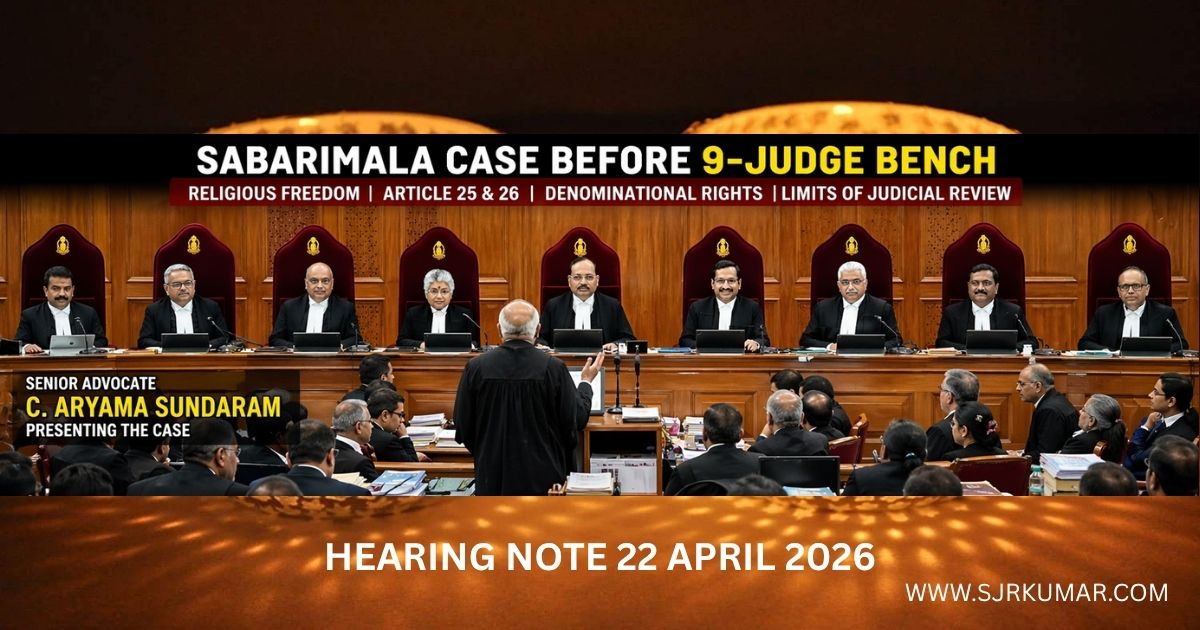
On 22 April 2026, Senior Advocate Aryama Sundaram, appearing on behalf of S. J. R. Kumar (in both the Writ and Review Petitions), presented a comprehensive and constitutionally grounded set of submissions before the Bench. His arguments were not merely a defense of a temple practice—they were a defense of India’s civilisational pluralism.
This article provides a detailed and structured account of those submissions, contextualised within the broader constitutional framework and the questions referred to the Bench.
THE 7 QUESTIONS BEFORE THE 9-JUDGE BENCH
At the outset, it is essential to understand the seven key constitutional questions that the Bench is examining. These questions define the scope of the Sabarimala 9-Judge Bench Hearing 2026:
1. Scope and ambit of Article 25 (Freedom of Religion)
What is the extent of the individual’s right to profess, practice, and propagate religion?
2. Interplay between Articles 25 and 26
How should individual rights be balanced with the collective rights of religious denominations?
3. Whether Article 26 is subject to other Fundamental Rights
Can denominational rights be overridden by Article 14 or other provisions?
4. Meaning of “Morality” under Articles 25 and 26
Does “morality” include constitutional morality or only public morality?
5. Scope of Judicial Review in Religious Matters
To what extent can courts intervene in religious practices?
6. Meaning of “Sections of Hindus” under Article 25(2)(b)
Does it include gender, or is it limited to caste-based reform?
7. Maintainability of PILs in Religious Matters
Can non-adherents challenge religious practices through PILs?
These questions go far beyond Sabarimala—they determine the future relationship between the Constitution and religion in India.
BACKGROUND OF THE SABARIMALA DISPUTE
The Sabarimala Temple, dedicated to Lord Ayyappa, represents a unique religious tradition centered on austerity, celibacy, and spiritual discipline.
Devotees undertake:
- A 41-day Vratham (penance)
- Strict celibacy
- Renunciation of worldly pleasures
The deity is worshipped as a Naishtika Brahmachari, and the customs of the temple are intrinsically linked to this characteristic.
The Petitioner’s submissions emphasise that:
- The issue is not about exclusion
- It is about preserving a distinct form of worship rooted in belief
ARYAMA SUNDARAM’S CORE ARGUMENT: RELIGION IS NOT SUBJECT TO JUDICIAL RECONSTRUCTION
One of the central themes of the Sabarimala 9-Judge Bench Hearing 2026 was the argument that courts cannot reconstruct religion.
Senior Advocate Aryama Sundaram argued:
- Courts must not test religious practices on rationality or modern standards
- The only relevant test is whether the belief is genuinely and conscientiously held
This position flows from established precedent, including:
- Shirur Mutt Case
- Bijoe Emmanuel Case
ARTICLE 25: FREEDOM OF RELIGION – NOT A RIGHT TO CHOOSE ANY PLACE OF WORSHIP
A significant part of the submissions focused on clarifying a critical misconception.
Key Argument:
Article 25 guarantees the right to practice religion—but not at any place of one’s choosing.
The submissions emphasised the following:
- Worship is subject to the customs of the institution
- A person cannot impose their belief on a specific religious space
This distinction is crucial because
- If Article 25 included a right to worship anywhere
- It would destroy denominational autonomy under Article 26
ARTICLE 26: THE HEART OF DENOMINATIONAL AUTONOMY
The most powerful submissions in the Sabarimala 9-Judge Bench Hearing 2026 were centered around Article 26.
Why Article 26 Matters
Article 26 protects:
- The right to manage religious affairs
- The autonomy of religious denominations
Critical Constitutional Argument
Unlike Article 25, Article 26:
- Is not subject to other Fundamental Rights
- Is limited only by:
- Public order
- Morality
- Health
This distinction is deliberate and fundamental.
Implication
If Article 26 is subordinated to Article 14:
- Every religious practice could be challenged
- Courts would effectively govern religion
SABARIMALA AS A RELIGIOUS DENOMINATION
A cornerstone of the submissions was establishing the following:
Ayyappa Devotees = Religious Denomination
They satisfy:
- Common faith
- Common practices
- Distinct identity
The practice of:
- 41-day Vratham
- Observance of celibacy
- Identification as “Swami”
creates a unique religious identity
THE RIGHTS OF THE DEITY: A FORGOTTEN DIMENSION
A profound aspect of the arguments was the assertion of:
The Deity as a Juristic Person
The submissions emphasised the following:
- The deity has rights under law
- These include:
- Preservation of the nature of worship
- Protection from alteration of rituals
This shifts the discourse from:
- Individual rights
to - Rights of the deity itself
ROLE OF THE THANTRI: SPIRITUAL AUTHORITY, NOT ADMINISTRATIVE FUNCTIONARY
The Thantri is not merely a priest but:
- The ultimate authority on ritual purity
- The custodian of religious practices
The submissions argued:
- Courts cannot override the Thantri’s authority
- Doing so would violate Article 26(b)
ESSENTIAL RELIGIOUS PRACTICES: WHO DECIDES?
The Sabarimala 9-Judge Bench Hearing 2026 revisits the controversial doctrine of Essential Religious Practices.
Submission
- Essentiality must be determined by the religion itself
- Courts cannot act as theological experts
Application to Sabarimala
The restriction is essential because:
- It flows from the nature of the deity
- It is inseparable from the pilgrimage discipline
ARTICLE 14: EQUALITY IS NOT UNIFORMITY
A major part of the submissions addressed Article 14.
Key Argument
Equality does not mean:
- Uniform treatment across all contexts
In religious matters:
- Equality must be understood as:
- Equal application of religious discipline
Illustration
Just as:
- A church can restrict sacraments to Christians
- A mosque can restrict certain practices to Muslims
Similarly:
- Sabarimala can maintain its unique discipline
ARTICLE 17: CLEARLY INAPPLICABLE
The expansion of Article 17 in the 2018 judgment was strongly challenged.
Submission
- Article 17 deals with caste-based untouchability
- It cannot be extended to:
- Religious practices unrelated to caste
ARTICLE 25(2)(b): LIMITED TO CASTE REFORM
The submissions clarified:
- “Sections of Hindus” refers to:
- Caste groups historically excluded
It does NOT include:
- Gender-based distinctions rooted in religious doctrine
JUDICIAL REVIEW: WHERE SHOULD COURTS STOP?
The Sabarimala 9-Judge Bench Hearing 2026 raises a fundamental question:
Can courts decide religious correctness?
Answer (Submission): NO
Courts can only examine:
- Whether a practice is religious
- Whether it violates public order, morality, health
They cannot:
- Rewrite religious practices
PIL IN RELIGIOUS MATTERS: A DANGEROUS TREND
The submissions strongly opposed:
PILs by Non-Adherents
Reason:
- Religion is based on belief
- Outsiders cannot define its practices
Allowing such PILs would:
- Open floodgates
- Undermine all religious institutions
CRITICAL ANALYSIS OF THE 2018 JUDGMENT
The submissions identified several constitutional errors:
- Rejection of denominational status
- Misapplication of Article 14
- Expansion of Article 17
- Judicial determination of theology
WHY THIS CASE IS A CIVILISATIONAL MOMENT
The Sabarimala 9-Judge Bench Hearing 2026 is not merely about:
- A temple
- A practice
It is about:
- Whether India remains a pluralistic civilisation
- Or becomes a uniform constitutional state overriding tradition
CONCLUSION: THE FUTURE OF RELIGIOUS FREEDOM IN INDIA
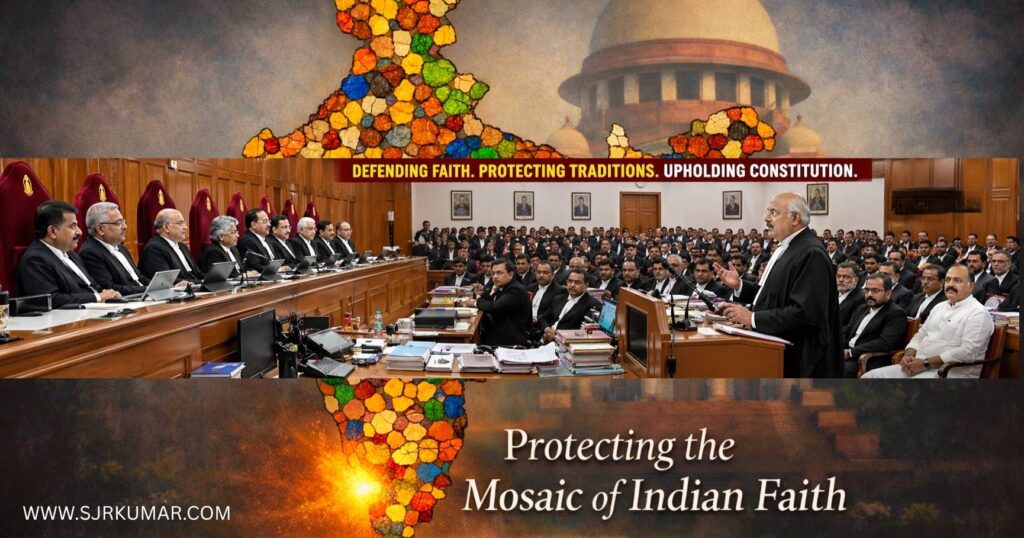
The submissions of Senior Advocate Aryama Sundaram represent a powerful defense of:
- Religious autonomy
- Constitutional balance
- Civilisational diversity
The outcome of this case will determine:
- The limits of judicial power
- The survival of religious traditions
FINAL THOUGHT
At its core, the Sabarimala 9-Judge Bench Hearing 2026 asks a profound question:
Can faith survive constitutional standardisation?
Or will the Constitution continue to protect the rich diversity of beliefs that define India?
OTHER SUBMISSIONS BEFORE THE 9 JUDGES BENCH
- Sabarimala 9 Judges Bench – Hearing Note 07 April 2026
- Sabarimala 9 Judges Bench – Hearing Note 08 April 2026
- Sabarimala 9 Judges Bench – Hearing Note 09 April 2026
- Sabarimala 9 Judges Bench – Hearing Note 15 April 2026
- Sabarimala 9 Judges Bench – Hearing Note 17 April 2026