Dharma Chakra | sjrkumar.com
While the World Watched Football, India Quietly Rewrote History
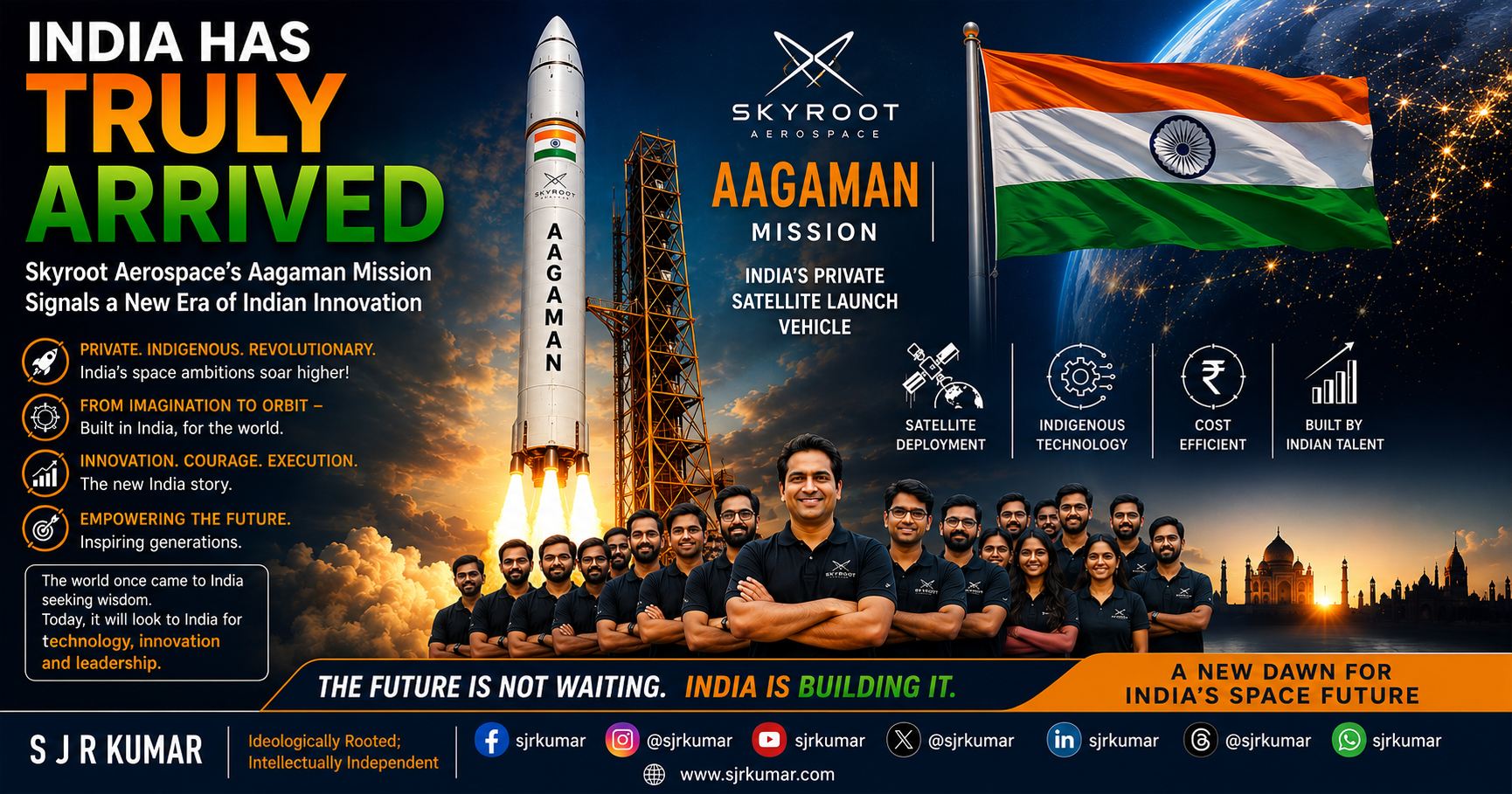
On July 18, 2026, as millions of football fans around the globe were absorbed in the drama of the FIFA Club World Cup, something far more consequential was unfolding on the eastern coast of India. At the Satish Dhawan Space Centre in Sriharikota, a four-stage rocket called Vikram-1, built entirely by a private Indian company, rose into the sky under a mission named Aagaman — Sanskrit for “Arrival.”
Fifteen minutes later, it had placed its payload into a 450-kilometre orbit, and India had joined an extraordinarily small club: nations where a private company, not a government agency, had achieved orbital launch capability. Only the United States and China had done this before. Skyroot Aerospace had just done it for India.
Sporting tournaments dominate news cycles for a few weeks and then fade from memory. Technological breakthroughs like this one quietly reshape the destiny of nations for generations. Mission Aagaman was not merely another rocket launch. It was a declaration — of engineering maturity, of entrepreneurial ambition, and of a civilisation once again finding its voice in the language of science.
This article is an attempt to explain why.
The Origin of Skyroot Aerospace: From ISRO’s Corridors to a Hyderabad Garage
Every great company begins with a simple, almost naive question. For Skyroot Aerospace, that question was: what if reaching orbit could be as routine and affordable as booking a flight?
The company was founded in 2018 by Pawan Kumar Chandana and Naga Bharath Daka, two rocket engineers who had cut their teeth at ISRO, India’s storied space agency. Chandana, an IIT Kharagpur alumnus and a Forbes 30 Under 30 Asia honouree, had spent years working on solid propulsion systems within the government establishment before deciding that the future of Indian spaceflight needed a private, entrepreneurial push. Daka, his co-founder and now Chief Operating Officer, brought complementary expertise in avionics and vehicle systems.
They were not alone. A number of former ISRO scientists and defence-establishment engineers joined them in the early days, drawn by the audacity of the mission and frustrated by the slow pace at which a purely government-run programme could move. The company raised early seed capital — roughly $1.5 million — from investors including Mukesh Bansal, and set up shop in Hyderabad, incubated at T-Hub and supported by T-Works, two of India’s prominent startup ecosystems.
The path from a ten-person team to a company capable of orbital flight was neither quick nor easy. Building rocket engines requires years of iterative testing, enormous capital, and a tolerance for very public failure. Skyroot tested a scaled-down solid-fuel engine in December 2020, followed by full-duration tests of larger engines through 2021 and 2022. Along the way, the company achieved a string of firsts: India’s first privately developed solid rocket stage, and the country’s first privately built cryogenic engine.
None of this would have been possible without a fundamental shift in Indian policy.
How Liberalisation Opened the Skies
For decades, India’s space programme was the exclusive domain of ISRO. That changed on 16 May 2020, when the Government of India announced sweeping reforms to the space sector. As Finance Minister Nirmala Sitharaman put it at the time, the private sector would now be “a co-traveler in India’s space journey.” Weeks later, the government established the Indian National Space Promotion and Authorisation Centre (IN-SPACe), a single-window regulatory body tasked with authorising and supporting non-governmental space ventures, alongside NewSpace India Limited (NSIL), ISRO’s commercial arm.
This was the opening Skyroot needed. In November 2022, under IN-SPACe’s authorisation, the company launched Vikram-S, a sub-orbital sounding rocket, in a mission fittingly named Prarambh — “the beginning.” It reached a peak altitude of 88.8 kilometres and became the first rocket built by a private Indian company to fly. Prime Minister Narendra Modi himself called it a historic moment for the country’s private space industry.
Prarambh was a proof of concept. Aagaman, nearly four years later, was the proof of capability.
The Aagaman Mission: What Vikram-1 Actually Achieved
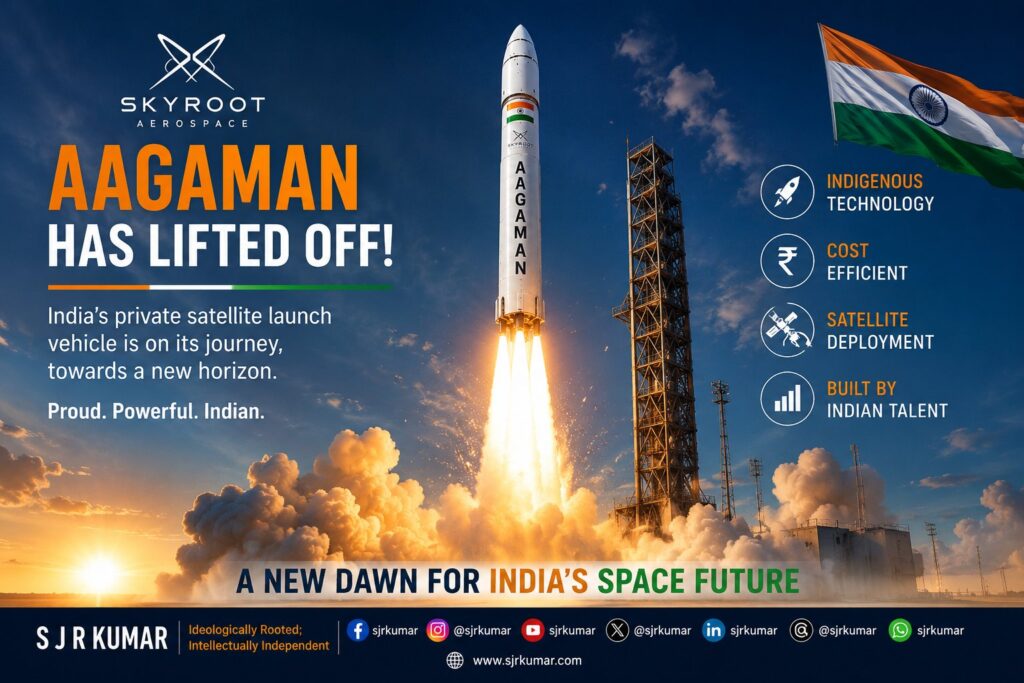
Vikram-1 is Skyroot’s flagship orbital small-satellite launch vehicle — a four-stage rocket built around an all-carbon-fibre structure, a design choice that dramatically reduces weight compared to traditional metal airframes. The vehicle is capable of carrying payloads of up to roughly 350 kilograms into low Earth orbit, or around 260 kilograms into sun-synchronous orbit, placing it in a similar performance class to internationally recognised small-launch vehicles built by companies such as Rocket Lab and Firefly Aerospace.
The rocket’s propulsion systems reflect years of indigenous engineering work: solid-fuel boosters developed in-house, alongside 3D-printed liquid engines that had already been tested and validated during the Prarambh mission. The Raman engine series, used for roll and attitude control, and the Kalam family of solid motors represent genuine indigenous intellectual property — not licensed or imported technology.
Mission Aagaman itself was explicitly framed by Skyroot as a test flight, designed to validate the rocket’s propulsion, avionics, telemetry, guidance, navigation, and control systems under real flight conditions, while gathering data to refine future commercial launches. The company has been candid that a handful of similar test missions will precede full commercial operations — an approach that mirrors the iterative, data-driven philosophy used by leading global launch companies rather than promising perfection on the first attempt.
Even so, the achievement is not diminished by its status as a test. Successfully injecting a payload into a 450-kilometre orbit on a maiden orbital attempt is an extraordinarily difficult engineering feat. Many national space programmes have taken multiple attempts, and significant public failures, to reach orbit for the first time. Skyroot did it on its first try, with a vehicle designed, built, and financed almost entirely outside the government system.
Why This Launch Matters Beyond the Satellite It Carried
It would be easy to reduce Aagaman to a single sentence: an Indian startup put a payload into orbit. But the deeper significance lies elsewhere.
It demonstrates that Indian engineers can conceive, design, and manufacture a complex aerospace system end-to-end, without depending on foreign vendors for critical components. It proves that Indian systems engineering — the unglamorous but essential discipline of making thousands of subsystems work together flawlessly under extreme stress — has reached a globally competitive standard. It shows that private capital, both domestic and international, is willing to bet hundreds of millions of dollars on Indian deep-tech founders, not merely Indian software services. And it signals to a generation of engineers that building hardware, not just apps, is now a viable and celebrated career path in India.
This is the quiet, unglamorous foundation on which “India has arrived” rests — not slogans, but validated telemetry.
India’s Long Technological Journey: From Aryabhata to Aagaman
To appreciate how remarkable this moment is, it helps to look back.
India’s space story began humbly. The country’s first satellite, Aryabhata, was launched in 1975 aboard a Soviet rocket, because India had no launch capability of its own. For the following decades, ISRO methodically built indigenous capability from the ground up: the Polar Satellite Launch Vehicle (PSLV), which became one of the most reliable workhorse rockets in the world; the more powerful Geosynchronous Satellite Launch Vehicle (GSLV), which gave India the ability to loft heavier payloads into higher orbits; and eventually, missions that captured the world’s imagination.
Chandrayaan-1 confirmed the presence of water molecules on the Moon in 2008. Mangalyaan, India’s Mars Orbiter Mission, reached the Red Planet in 2014 on its very first attempt, at a fraction of the cost of comparable Western missions — a feat that stunned space agencies worldwide. Chandrayaan-3 made India the fourth nation to achieve a soft lunar landing, and the first to land near the lunar south pole. Aditya-L1, India’s first dedicated solar observation mission, extended the country’s scientific reach to the Sun. And the ongoing Gaganyaan programme is preparing to send Indian astronauts into orbit aboard an Indian-built spacecraft, launched from Indian soil.
Each of these milestones was achieved almost entirely within the government system. What makes this moment different is that Aagaman was not an ISRO mission. It was built by a company with private investors, private engineers, and private capital — operating alongside ISRO rather than as a substitute for it, in a genuinely new commercial ecosystem that simply did not exist a decade ago.
India has moved from importing rockets to launch its first satellite, to building world-class launch vehicles in a private garage-turned-unicorn. That is the arc of this story.
The Rise of India’s Private Space Economy
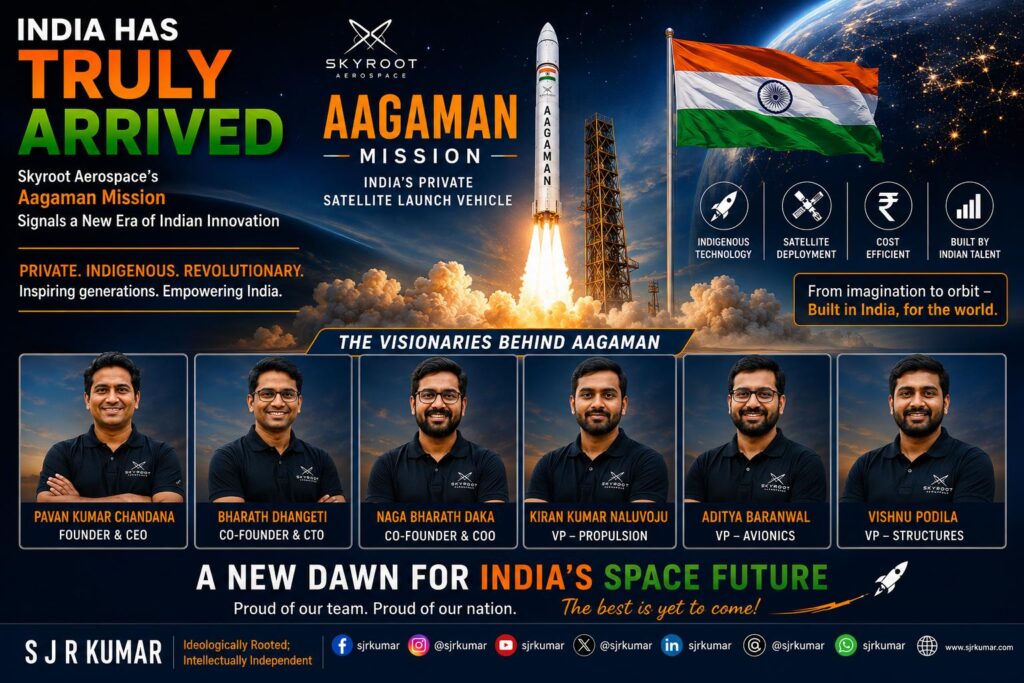
Skyroot is the most visible face of this movement, but it is far from alone. India’s private space sector has grown to nearly 400 startups as of early 2026, according to government estimates, spanning launch vehicles, satellite manufacturing, space-based imaging, and orbital data services.
Agnikul Cosmos, based in Chennai and incubated at IIT Madras, is developing small-satellite launch vehicles built around 3D-printed engines, with a focus on rapid, customisable manufacturing. Pixxel is building a constellation of hyperspectral imaging satellites capable of monitoring crops, mineral deposits, and environmental changes with a level of detail conventional satellites cannot match. Bellatrix Aerospace focuses on in-space propulsion systems, essential for satellites that need to manoeuvre, avoid collisions, and extend their operational life. Dhruva Space builds satellite platforms and ground infrastructure, effectively acting as an enabler for other companies entering the space economy. Digantara specialises in space situational awareness — tracking debris and objects in orbit, a capability that will only grow more critical as orbits become more crowded. GalaxEye is developing satellites that combine optical and radar imaging for all-weather, day-and-night Earth observation.
Together, these companies are not simply building rockets and satellites. They are constructing an entire economic ecosystem: manufacturing supply chains, testing infrastructure, ground stations, and a talent pipeline of engineers who no longer need to leave India to build frontier technology.
India’s Innovators in Global Context
It is tempting, and not entirely unfair, to draw comparisons between India’s emerging deep-tech founders and the entrepreneurs who reshaped global industries over the past three decades. Elon Musk demonstrated that a private company could out-innovate national space agencies on cost and iteration speed. Steve Jobs showed how obsessive design thinking could transform an entire consumer electronics industry. Jensen Huang built the computational infrastructure that now underpins the artificial intelligence revolution. Jeff Bezos proved that logistics and infrastructure, patiently built over decades, could become as valuable as any single product.
These leaders did not merely build companies; they built entirely new categories of industry. India’s founders are not attempting to replicate that story — they are writing their own version of it, grounded in India’s particular strengths: a vast pool of engineering talent, a cost structure that allows for genuine innovation at a fraction of Western budgets, and a domestic market large enough to sustain ambitious long-term bets.
The old narrative held that Indian talent achieved its greatest successes abroad — in Silicon Valley boardrooms, in NASA laboratories, in the executive suites of global technology companies. Skyroot’s story suggests a quieter but more significant shift: that the next generation of frontier technology may increasingly be conceived, designed, and commercialised inside India itself. India no longer needs to imitate the playbooks written elsewhere. It is beginning to write its own.
The Economic Case: Why Space Matters to India’s GDP
A thriving private space sector is not merely a matter of national pride. It is an economic multiplier.
Launch vehicle companies like Skyroot create high-skilled engineering employment directly, but their ripple effects extend far further: demand for advanced composite materials, precision manufacturing, avionics, and semiconductors; growth in electronics assembly and testing capability; integration with artificial intelligence for satellite data processing and autonomous flight systems; and dual-use applications that strengthen India’s defence-technology base.
Beyond the vehicles themselves, the downstream services enabled by cheaper, more frequent access to orbit are enormous. Satellite-based internet connectivity can reach India’s remotest regions. Precision agriculture, powered by hyperspectral imaging from companies like Pixxel, can help farmers optimise water use and predict crop yields with far greater accuracy. Climate and environmental monitoring becomes cheaper and more granular. Navigation, positioning, and timing services underpin everything from logistics to disaster response. And when floods, cyclones, or earthquakes strike, timely satellite data can be the difference between an efficient rescue operation and a chaotic one.
India’s space economy, currently estimated at around $8.4 billion, is projected by government estimates to grow to roughly $44 billion by 2033. Every rupee invested in this sector tends to generate returns well beyond the sector itself, through the manufacturing, electronics, and export ecosystems it demands.
The Strategic Dimension: Sovereignty in Orbit
There is also a harder-edged, strategic case for indigenous launch capability. A nation that can design, build, and launch its own satellites — on its own timeline, without waiting in a queue for a foreign launch provider — possesses a form of sovereignty that is increasingly relevant in a world of contested supply chains and export controls.
Indigenous launch capability strengthens national security by ensuring reliable access to reconnaissance, communication, and navigation satellites even in periods of geopolitical tension. It reduces dependence on foreign launch providers whose priorities may not always align with India’s own. It builds supply-chain resilience across the defence and aerospace sectors. And it gives India a stronger hand in space diplomacy — the ability to offer launch services to other nations, particularly in the Global South, as a partner rather than a customer.
This is not about competing militarily with any single nation. It is about ensuring that India’s access to the ultimate strategic high ground — space itself — is never dependent on the goodwill of others.
A Message to India’s Youth
Perhaps the most powerful consequence of Aagaman will not be measured in orbits achieved or dollars raised, but in the young minds it inspires.
For too long, the dominant career narrative for India’s brightest engineering students has been built around software services, coding bootcamps, and jobs at global IT firms. Skyroot’s story offers a different, equally compelling path: that it is possible to build genuinely hard, physical, deep-technology companies from Indian soil — companies that manufacture carbon-fibre rocket bodies, test cryogenic engines, and compete directly against the best aerospace companies in the world.
Students studying mathematics, physics, robotics, artificial intelligence, and aerospace engineering today have a living example, barely a few years older than themselves in company-age, that proves such ambitions are achievable. India’s future will not be built solely in government research laboratories. Increasingly, it will be built in startups founded by twenty-somethings willing to spend years testing engines that fail before they finally succeed.
That is a message worth repeating in every classroom in the country: dream in hardware, not just in apps.
The Policy Foundation Behind the Breakthrough
None of this would have been possible without deliberate policy choices. The 2020 space sector reforms, the creation of IN-SPACe as a single-window regulator, and the establishment of NSIL as ISRO’s commercial arm together created a framework where private companies could access government launch infrastructure, testing facilities, and technical expertise without having to build every piece of the ecosystem from scratch.
Ease of doing business matters enormously in a capital-intensive, technically complex sector like aerospace. Public-private partnerships — where ISRO’s decades of institutional knowledge support, rather than compete with, private innovation — have proven to be a far more productive model than either pure state control or an unregulated private free-for-all. This partnership approach deserves credit as a genuine enabler of what Skyroot and its peers have achieved.
Challenges That Remain
It would be a disservice to readers, and to the spirit of intellectual honesty this publication values, to pretend the road ahead is free of obstacles.
Global competition in the small-launch market is intensifying, with well-funded companies in the United States, Europe, and China all racing for the same customers. Sustained access to capital will remain essential, given how expensive iterative rocket development is. Advanced manufacturing capability — particularly in areas like precision composites and high-performance alloys — still requires deepening. Export control regimes around sensitive aerospace and dual-use technologies can complicate international partnerships and component sourcing. The growing problem of space debris demands responsible operational practices from every new entrant, including Indian ones. Achieving a high, reliable launch frequency — the kind that transforms a company from a technology demonstrator into a genuine commercial service provider — is a milestone Skyroot and its peers have yet to fully prove. And in a globally competitive talent market, retaining India’s best aerospace engineers, rather than losing them to better-funded foreign companies, will require sustained investment in compensation, culture, and mission.
None of these challenges are unique to India, and none of them diminish what has been achieved. But genuine, lasting success will require the same discipline, patience, and willingness to iterate through failure that got Skyroot to Sriharikota’s launchpad in the first place.
India Has Truly Arrived
For decades, the story of Indian talent was a story of departure — of brilliant engineers, scientists, and entrepreneurs leaving India to build their careers, and often their most significant work, abroad. The world benefited from Indian minds; India, too often, watched from a distance.
That story is changing. India is evolving from being primarily a service provider and software outsourcing destination into becoming a genuine technology creator — a place where world-class systems are conceived, designed, engineered, manufactured, and commercialised, not merely operated on behalf of others. Skyroot Aerospace’s Aagaman mission is one of the clearest pieces of evidence yet that this transition is real, not aspirational.
India is becoming, simultaneously, an innovation leader, a global manufacturing hub, and — with Aagaman — a space power built on private enterprise.
A Civilisational Perspective
It would be incomplete to discuss this moment purely in terms of engineering and economics, without situating it within the older, deeper current from which it flows. India’s ancient civilisation was never a stranger to scientific inquiry. Its ancient astronomers mapped planetary motion with remarkable precision. Its mathematicians gave the world the concept of zero and the decimal system that underpins all of modern computation. Its scholars pursued knowledge not as a luxury, but as a form of ethical and spiritual progress.
The Rig Veda captures this spirit in a single, timeless line: “आ नो भद्राः क्रतवो यन्तु विश्वतः” — “Let noble thoughts come to us from every side.” This was never a call for isolation or self-satisfaction. It was an invitation to draw wisdom and knowledge from every direction, and in turn, to contribute one’s own discoveries back to the world.
Seen in this light, India’s technological resurgence — from Aryabhata to Aagaman — is not a departure from its civilisational character. It is a continuation of it. The same impulse that once produced treatises on astronomy and algebra now produces carbon-fibre rocket stages and cryogenic engines. The tools have changed. The underlying pursuit of knowledge, applied in service of humanity, has not.
Conclusion: A Rocket, and a Declaration
Sporting victories inspire a nation for a season. Scientific achievements inspire it for generations. When the final whistle blows on this year’s football tournaments, the scorelines will fade into archives. But the data streaming back from Vikram-1’s flight computers on July 18, 2026, will shape the trajectories — literal and figurative — of Indian engineering for decades to come.
Mission Aagaman is not merely another rocket launch. It is a declaration that India is entering a new era of innovation, entrepreneurship, technological excellence, and global leadership — built not by decree, but by engineers who tested, failed, rebuilt, and finally flew.
The world once came to India seeking wisdom. Today, it will increasingly look to India for technology, innovation, and leadership. India has truly arrived.
What does India’s emerging role as a global technology and space leader mean to you? Do you see this as the beginning of a genuine deep-tech renaissance, or do significant hurdles still lie ahead? Share your thoughts in the comments below — Dharma Chakra would love to hear from you