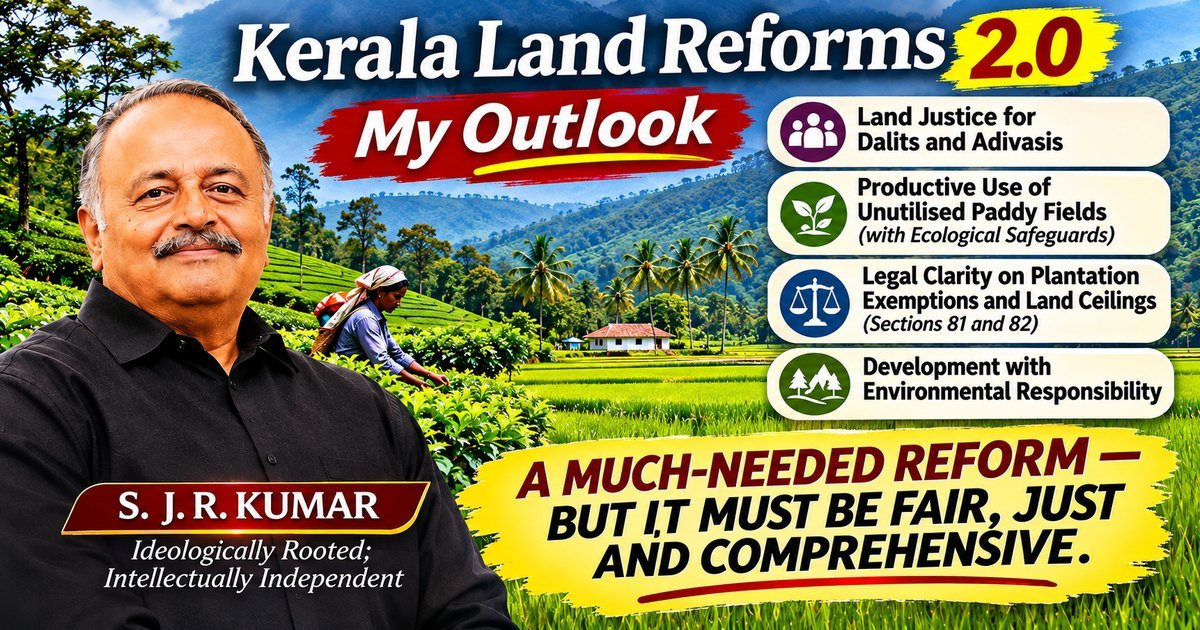
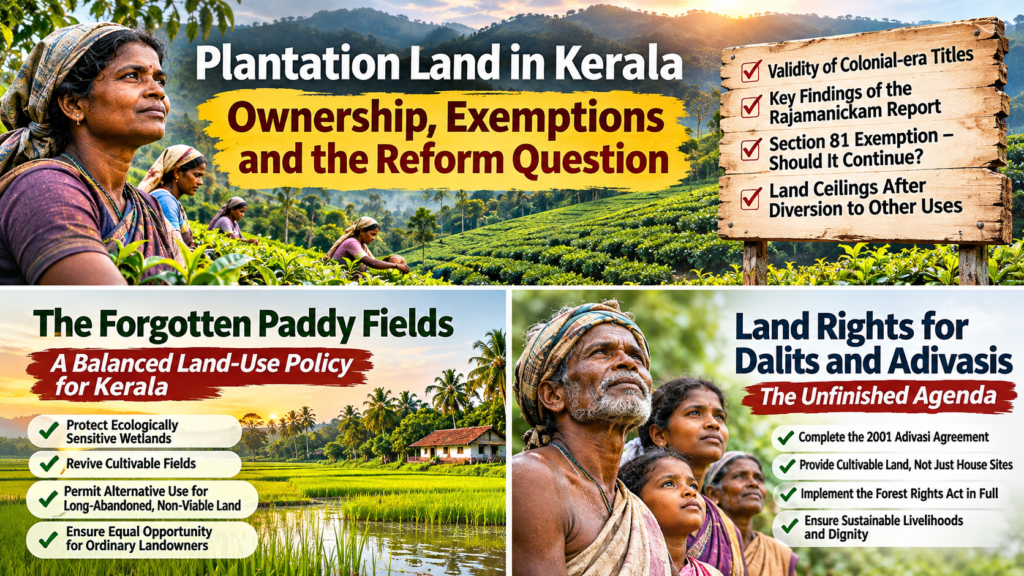
The proposed changes to Kerala’s land laws, as Kerala Land Reforms 2.0, must address historical injustice to Dalits and Adivasis, resolve disputed plantation ownership, protect the interests of ordinary landowners, and unlock the productive potential of abandoned agricultural land. Reform must not become a privilege reserved for large plantation companies.
Introduction: An Opportunity for a Historic Correction
Kerala has long taken pride in its land reforms, often described as among the most progressive social transformations in independent India. The abolition of landlordism and the transfer of ownership rights to cultivating tenants fundamentally altered the state’s agrarian and social structure.
However, behind this celebrated achievement lies an uncomfortable reality: the benefits of the first land reforms were not distributed equitably.
While cultivating tenants obtained ownership rights, large sections of Dalits, Adivasis and agricultural labourers remained landless or were confined to tiny residential plots. Plantation workers continued to live in company-owned labour lines without ownership of their homes. Meanwhile, extensive plantation holdings remained outside the ordinary land-ceiling provisions.
Today, Kerala faces another land-related crisis. Large areas of paddy fields remain uncultivated, plantation estates are struggling with economic viability, disputed land titles continue to occupy the attention of courts and government departments, and ordinary landowners find themselves constrained by outdated land-use regulations.
It is against this background that the United Democratic Front (UDF) government’s proposed Land Reforms 2.0 initiative must be examined.
The proposal offers an opportunity to modernise Kerala’s land laws. But the fundamental question is whether the proposed reforms will serve the larger interests of society or primarily benefit a relatively small group of large plantation owners and commercial investors.
A genuine second land reform must reconcile three objectives: social justice, productive utilisation of land and environmental sustainability.
1. The First Land Reform: A Historic Achievement with an Unfinished Agenda
The Kerala Land Reforms Act, 1963, substantially amended in 1969, came into force on January 1, 1970.
It brought an end to the traditional landlord system by conferring ownership rights on cultivating tenants. This was a major social and economic transformation.
However, the legislation primarily addressed the relationship between landlords and tenants. It did not adequately address the plight of agricultural labourers who had worked on the same land for generations without recognised tenancy rights.
Dalits constituted a substantial section of this agricultural workforce. Since they were predominantly agricultural labourers rather than cultivating tenants, they were largely excluded from the principal redistribution provisions.
Their entitlement was mainly confined to kudikidappu rights, which provided ownership or protection of small residential plots, subject to statutory conditions. In rural areas, the maximum extent could be ten cents.
The consequences are visible even today.
The State Planning Board’s working group report for the Fourteenth Five-Year Plan, citing a 2009–10 survey by the Kerala Institute of Local Administration (KILA), recorded 5,64,329 Scheduled Caste families living in 26,342 settlements or colonies, now commonly referred to as unnathis. These families represented approximately 77 per cent of the State’s Scheduled Caste population.
The survey identified 1,23,871 single-room houses and 45,959 houses considered unfit for habitation.
Many families possess only two to five cents of land. Their children, after marriage, often have no space to construct separate houses.
Thus, the first land reform transferred ownership to many cultivating tenants but did not provide meaningful land ownership to a substantial section of those who actually worked the land.
The plantation exemption
Another major exclusion arose from Section 81 of the Land Reforms Act, which exempted plantations from the ordinary land-ceiling provisions.
Large estates cultivating tea, coffee, rubber and cardamom continued to hold extensive areas of land, many originating from grants and leases issued during the princely and colonial periods.
The workers employed on these plantations, many of them Tamil-speaking Dalits, continued to live in company-owned layams or line houses.
They generally have no independent ownership of their accommodation. Retirement can mean losing the house in which they have lived and worked for decades.
A land reform that failed to provide land security to agricultural labourers and plantation workers cannot be considered a completely fulfilled social revolution.
2. Adivasis: The Most Persistent Victims of Land Alienation
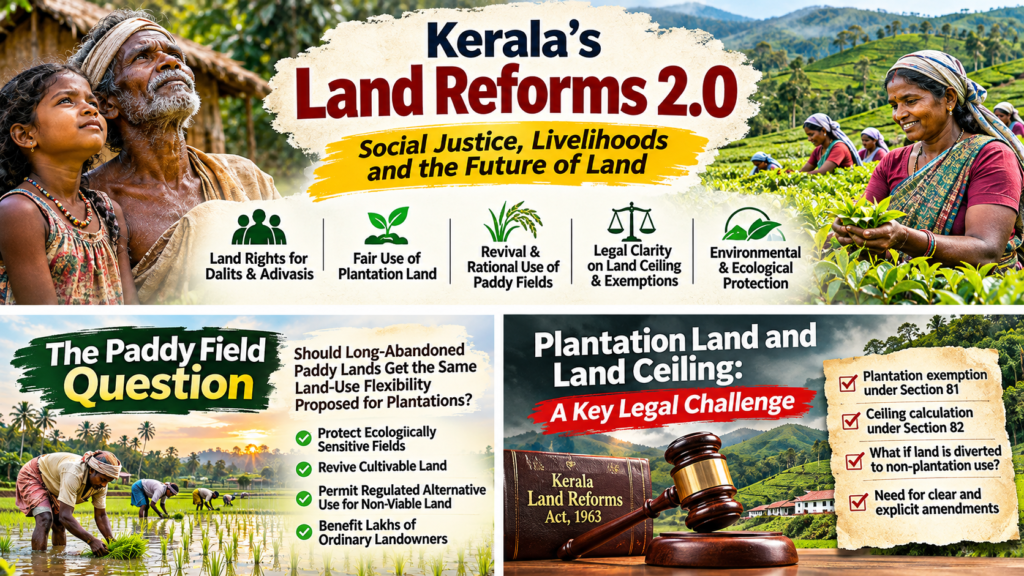
The land question affecting Adivasi communities is different but equally serious.
Traditional Adivasi lands were alienated through settler migration, questionable land transactions, administrative interventions and the reservation of forests by the State.
This happened particularly in Wayanad, Attappady, Idukki and the high ranges of Kottayam.
The first land reform legislation was primarily designed to address landlord-tenant relationships. It did not adequately recognise the customary landholding systems and traditional cultivation practices of Adivasi communities.
In several areas, Adivasis who cultivated land without formal tenancy documents were unable to establish their claims, while settlers holding recognised leases obtained ownership rights.
Consequently, communities with the longest historical relationship with the land were often the least protected by the legal framework.
The unfulfilled promise of the 2001 agreement
One of the most important commitments concerning Adivasi land rights was the agreement signed on October 16, 2001, between the A.K. Antony government and the Adivasi Gothra Maha Sabha (AGMS), following the prolonged Kudil Ketti Samaram led by C.K. Janu and M. Geethanandan.
The agreement promised one to five acres of cultivable land to eligible landless Adivasi families. Families holding less than one acre were also to be brought up to the prescribed minimum.
It included financial assistance for developing the land and led to the establishment of the Tribal Resettlement and Development Mission.
However, implementation remained incomplete.
Some families received small residential plots rather than cultivable agricultural land. Others were allotted land unsuitable for sustainable cultivation or located in areas affected by human-wildlife conflict.
The Frontline investigation cites an assessment indicating that 118 families under the Sulthan Bathery Tribal Development Office received approximately 15 acres in total between 2021 and 2025. This works out to approximately 0.13 acre per family, far below the original commitment.
An important distinction must be maintained: providing a family with a few cents for constructing a house is not equivalent to providing cultivable agricultural land.
A house site offers shelter. A sufficiently large cultivable holding can provide food security, livelihood, income and economic independence.
The proposed Land Reforms 2.0 must therefore begin by addressing the unfulfilled commitments of 2001.
3. The Plantation Land Controversy: Who Really Owns Kerala’s Estates?
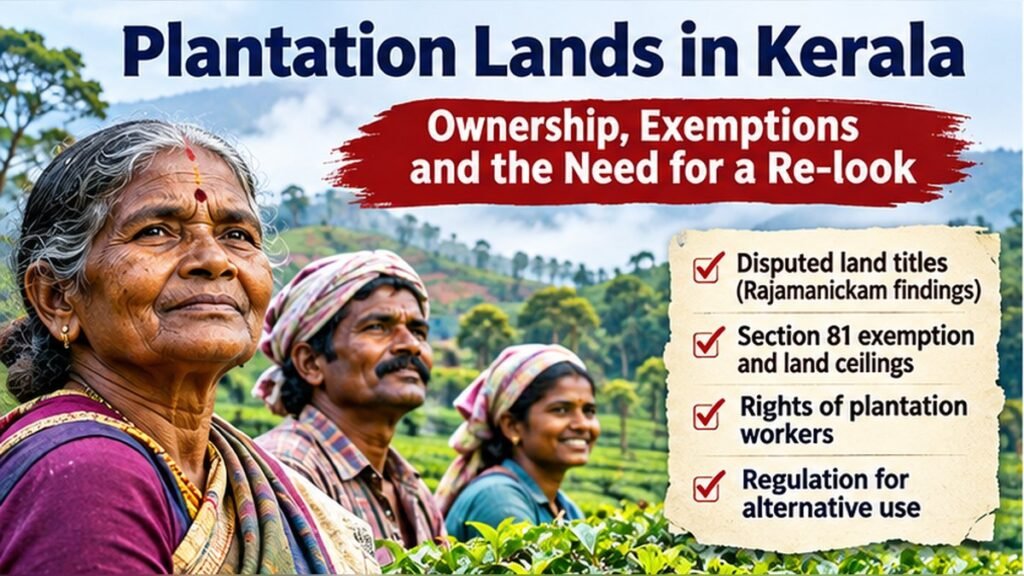
The ownership of extensive plantation holdings has remained one of Kerala’s most contentious land-related issues.
Over the past two decades, several government-appointed inquiries examined the origin of landholdings of major plantation companies, particularly Harrisons Malayalam and the estates associated with the Kannan Devan Hills.
The findings of M.G. Rajamanickam, IAS, appointed as Special Officer and Collector for government land resumption, are particularly important.
His investigations raised serious questions concerning the historical ownership of plantation estates, the validity of certain grants and leases, the applicability of the Kerala Land Reforms Act to foreign companies, and the manner in which land ownership was subsequently transferred.
Important findings of the Rajamanickam inquiry
The findings of the 2016 inquiry deserve particular attention because they go beyond merely identifying the extent of land occupied by plantation companies.
A. The extent of land under Harrisons Malayalam
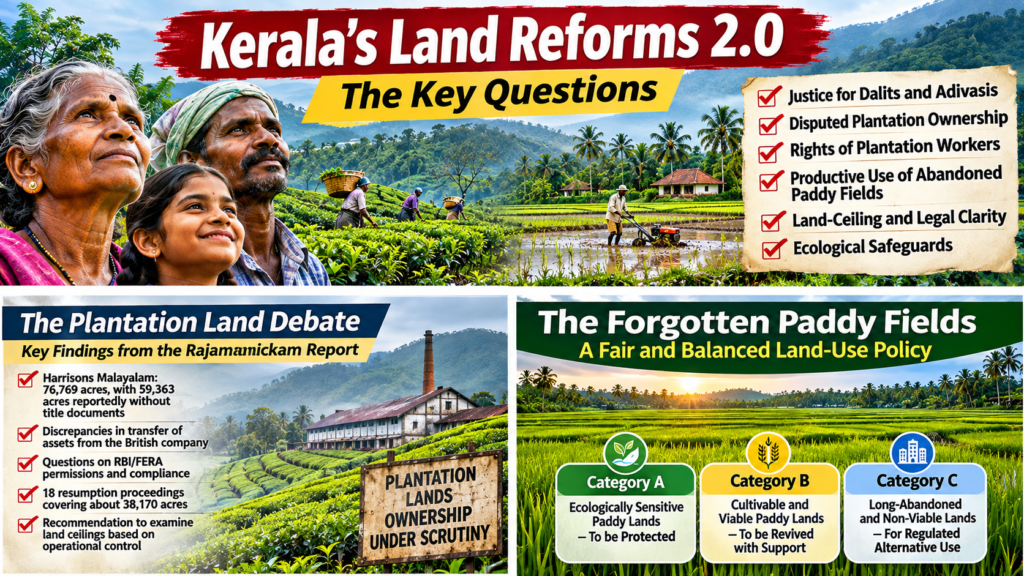
According to the figures cited in the Frontline investigation, Harrisons Malayalam alone held 76,769 acres, of which 59,363 acres reportedly lacked ownership documents. Another 12,658 acres had already been transferred to other parties.
These figures raised serious questions about the documentary basis of ownership and subsequent transfers.
B. The historical corporate structure
In his report dated September 24, 2016, Rajamanickam examined the corporate history of Malayalam Plantations and Harrisons Malayalam.
The report referred to a British company, Malayalam Plantations (UK) Ltd, incorporated in 1921, and the subsequent incorporation of Malayalam Plantations (Holdings) Ltd in the United Kingdom in 1977.
The latter’s company records, according to the report, identified investments in Indian companies, including Harrisons Malayalam.
The report also examined the relationship with Ambledown Investment Ltd, registered in Guernsey in 2005, which it identified as the ultimate parent company.
One of the important discrepancies highlighted was that the Indian company claimed that the assets and liabilities of the earlier British company had been transferred in 1978, whereas records published in the London Gazette indicated that the British company entered winding-up proceedings during 1986–87.
Rajamanickam questioned the absence of evidence showing the registration of the transfer of immovable properties in Kerala.
He recommended further investigation into the corporate relationships and the possibility that the Indian company was holding property on behalf of foreign interests.
These were allegations and investigative conclusions in the Special Officer’s report, not judicial findings establishing fraud. Nevertheless, the documentary discrepancies warranted serious examination.
C. The question of land ownership documents
The report examined the annual report of Harrisons Malayalam for 2015–16.
According to the Special Officer’s examination of the company’s disclosures, the title deeds of several freehold and leasehold properties continued to be recorded in the names of Malayalam Plantations (UK) Ltd and Harrisons & Crossfield (UK) Ltd.
The report also pointed out that the company’s financial statements identified only a comparatively small value of land and buildings in the name of Harrisons Malayalam itself.
This raised an important question: if the Indian company claimed ownership through amalgamation and transfer of assets, why did the title documents of substantial properties continue to remain in the names of the earlier foreign companies?
The Special Officer argued that the registration and transfer of these properties required detailed scrutiny.
D. The question of foreign-company eligibility and RBI permissions
Another important aspect examined in the report concerned the Foreign Exchange Regulation Act (FERA).
The report drew attention to the distinction between permission to carry on business in India and permission to hold immovable property.
It referred to Reserve Bank of India permissions under Section 29(2) of FERA, 1973, and questioned whether the company had obtained the separate permission required under Section 31 for holding immovable property.
It also examined the conditions attached to the Kerala High Court’s 1984 approval of the corporate amalgamation and whether those conditions had been complied with.
The Special Officer’s argument was that the benefits of the Kerala Land Reforms Act could not automatically be extended to foreign companies that did not satisfy the statutory requirements.
This was a significant legal issue because the Land Reforms Act was enacted to protect landless cultivating tenants, not to confer unrestricted landholding privileges on large corporate entities.
The subsequent judicial proceedings, however, require careful distinction. These were issues raised in the inquiry and in earlier court proceedings, not final judicial findings that the companies had illegally acquired all the disputed properties.
E. The extent of land under resumption proceedings
The September 2016 report also referred to 18 proceedings initiated under Rule 11 of the Kerala Land Conservancy Rules, covering approximately 38,170.92 acres in Kollam, Pathanamthitta, Kottayam and Idukki districts.
These proceedings related to land claimed by the State to have been occupied through historical grants and leases.
The report recorded that status quo was being maintained pursuant to High Court directions, with restrictions on encumbrances, transfers and tree cutting in the lands covered by the proceedings.
The larger significance of these findings is that the dispute was not confined to one company or one estate. It concerned the historical documentation, legal status and ownership of extensive plantation holdings across Kerala.
The wider Rajamanickam recommendations
Rajamanickam’s final report in June 2016 went beyond the Harrisons Malayalam investigation.
One of its most important recommendations was that land ceilings should be examined not merely in terms of formal ownership but also in terms of operational control, so that the concentration of extensive landholdings through corporate arrangements could be addressed.
He also recommended comprehensive legislation on the lines of the Kannan Devan Hills (Resumption of Lands) Act, 1971, instead of depending exclusively on proceedings under the Kerala Land Conservancy Act.
The proposed approach included:
- Verification of plantation ownership and the legal validity of landholdings.
- Resumption of land established to be held without valid title.
- Reservation of a substantial portion of recovered land for landless and homeless people and public purposes.
- Leasing of remaining suitable land through transparent auctions, with a proposed lease period of 30 years and safeguards allowing the government to resume land when legally justified.
These recommendations are particularly relevant to the present debate.
They demonstrate that the question of plantation land should not be reduced to whether companies should be allowed to diversify their activities. The more fundamental question is whether the land is legally held and whether the exemptions granted under the land reform legislation continue to be justified.
What did the courts decide?
The government attempted to resume substantial plantation holdings through proceedings under the Kerala Land Conservancy Act.
However, on April 11, 2018, the Kerala High Court set aside the resumption orders concerning Harrisons Malayalam.
The Court held that the Special Officer could not decide disputed ownership titles or determine allegations of fraud and forgery through summary proceedings under the Land Conservancy Act. Such questions had to be established through properly instituted civil proceedings.
Importantly, the judgment did not finally establish that every disputed property belonged to Harrisons Malayalam. It held that ownership disputes required adjudication by a competent civil court.
The State was therefore required to pursue its claims through appropriate legal proceedings.
The dispute over the 2,263-acre Cheruvally estate provides a more recent illustration. On January 19, 2026, the Pala Sub-Court dismissed the State’s ownership suit concerning the estate, which had been purchased by Ayana Charitable Trust from Harrisons Malayalam in 2005. The government indicated its intention to appeal.
These developments demonstrate the importance of pursuing ownership claims through legally sustainable procedures.
The government must not abandon its legitimate claims over public land. Equally, ownership cannot be determined merely by administrative assertions.
The proposed Land Reforms 2.0 must therefore address the outstanding ownership disputes before facilitating large-scale commercial development on the disputed properties.
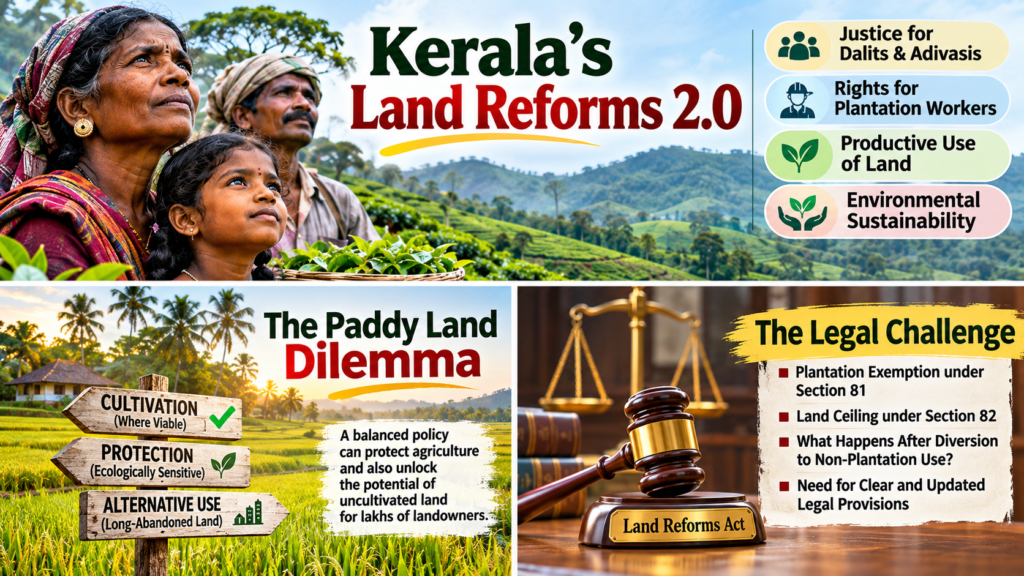
4. Illegal Transfers of Disputed Plantation Land: Should Subsequent Transactions Be Allowed to Stand?
An equally serious dimension of Kerala’s plantation land controversy is the subsequent transfer of extensive properties by companies whose own legal title to those lands has been questioned.
The Rajamanickam Committee’s investigation raised serious questions not only about the original possession of plantation estates but also about their subsequent sale, transfer and alienation to other companies, trusts and private parties. According to the findings and land records examined in the inquiry, the extent of such transfers ran into thousands of acres, with approximately 12,000 acres reportedly involved.
This raises a fundamental legal question:
If a company did not possess valid ownership rights over a property, on what legal basis could it transfer that property to another party and confer ownership rights upon the purchaser?
The general principle of property law is that a transferor cannot ordinarily convey a better title than it possesses, subject to applicable statutory provisions and recognised legal exceptions. Therefore, where the original title is established to be defective, the validity of subsequent transactions must also be examined.
The government must undertake a comprehensive investigation into every such transaction, identify the original owners, examine the documents under which the transfers took place and determine whether the transactions are legally sustainable.
Where transfers are established to be fraudulent, void or otherwise legally invalid, appropriate proceedings must be initiated to set them aside, recover possession and restore the property to its lawful owner.
Where evidence establishes deliberate fraud, fabrication of documents, criminal conspiracy or other offences, the responsible companies, directors and individuals must also face appropriate civil and criminal proceedings.
Cheruvally Estate: A significant example of competing ownership claims
The 2,263-acre Cheruvally Estate near Erumely provides an important illustration of the complexity of this issue.
The estate was transferred by Harrisons Malayalam to Gospel for Asia, subsequently known as Ayana Charitable Trust, in 2005. The Kerala Government challenged the transaction, contending that Harrisons Malayalam did not possess valid ownership rights over the property and that the land belonged to the State. The estate subsequently acquired additional significance when the government identified it as the proposed site for the Sabarimala Greenfield Airport.
However, the controversy involves another important dimension that cannot be ignored: the historical ownership claims of the Cheruvallikavu and Chenappady Devaswoms.
In W.P.(C) No. 23238/2020, filed by the Vishwa Hindu Parishad, Kottayam District Committee, before the Kerala High Court, the petitioner’s case was that the property originally belonged to these Devaswom institutions and was leased in 1910 to J.R. Vincent under Deed No. 1675/1910. The leasehold rights were subsequently transferred to H.R. Knight in 1912, and the property eventually came into the possession of Harrisons Malayalam.
The petitioner contended that the original jenmom rights of the Devaswoms had never been extinguished and that subsequent transfers could not confer ownership upon the purchasers.
The High Court recorded these contentions but did not adjudicate the competing ownership claims on their merits. The writ petition was dismissed in limine because the disputed questions of title and historical ownership required examination through appropriate legal proceedings.
There have also been separate proceedings involving claims by members of the original lessor’s family. The legal rights of such claimants must likewise be examined on the basis of the relevant historical documents and judicial proceedings.
What did the Pala Sub Court decide?
The Kerala Government subsequently instituted O.S. No. 72/2019 before the Pala Sub Court, seeking a declaration of its title over Cheruvally Estate and recovery of the property.
On January 19, 2026, the court dismissed the government’s suit. However, an important distinction must be noted: the judgment did not constitute a positive or declaratory pronouncement establishing the absolute or indefeasible title of Ayana Charitable Trust.
The court’s observations, as explained by the Special Government Pleader following the judgment, made it clear that dismissal of the State’s suit should not be interpreted as a conclusive declaration of the defendants’ absolute ownership.
Consequently, the judgment cannot be treated as having finally settled every question concerning the estate’s ownership. Nor does it automatically extinguish the independent claims of the Devaswom institutions or other legitimate claimants.
The legal position therefore requires careful examination of the competing claims of the State, the Devaswoms, the original lessor’s family and the present purchaser through the appropriate judicial proceedings.
Cheruvally demonstrates why disputed plantation ownership and subsequent transfers require comprehensive legal scrutiny before the government introduces further concessions for commercial utilisation.
Every subsequent transfer must be investigated
Cheruvally may not be the only instance requiring examination.
The government should prepare a comprehensive inventory of all plantation lands that were subsequently sold, transferred, assigned or otherwise alienated by companies whose original title or leasehold rights have been questioned.
For every transaction, the investigation should establish:
- The identity of the original owner or grantor—whether the State, a temple, a Devaswom institution or a private individual or family.
- The nature and validity of the original grant, lease or title.
- Whether the lease had expired or had been lawfully renewed at the time of transfer.
- Whether the transferor possessed a legally transferable interest in the property.
- Whether the required governmental, judicial or statutory permissions were obtained.
- Whether the subsequent purchaser acquired a valid title under the applicable law.
- Whether fraud, concealment, fabrication of documents or collusion was involved.
- Whether further transfers, mortgages, encumbrances or commercial developments have taken place after the original transaction.
The investigation should cover every subsequent transaction, including transfers to associated companies, subsidiaries, trusts and other third parties.
Where unlawful transfers are established, the government or the legitimate original owners must initiate appropriate proceedings to cancel or set aside those transactions, recover the properties and restore them to their rightful owners through the competent legal process.
Where the original property belongs to a temple, Devaswom institution or private family, restoration should be made to that institution or rightful owner rather than automatically treating the property as government land.
Similarly, where the land is established to belong to the State, it must be recovered and protected as public property.
Accountability must accompany recovery
The cancellation of an unlawful transaction alone may not be sufficient.
If companies or their responsible officers knowingly transferred properties without possessing valid title, or resorted to fraudulent documentation or other illegal means, appropriate penal proceedings must follow wherever the evidence establishes criminal liability.
The government must also examine the role of officials who may have facilitated questionable transactions through negligence, collusion or abuse of authority.
At the same time, legitimate purchasers must be afforded due process, and their rights must be examined under the applicable law. The mere existence of an ownership dispute cannot automatically establish criminal liability or invalidate every subsequent transaction.
The objective must be to ensure that fraudulent or legally invalid transactions do not become a means of permanently appropriating government, institutional or private property.
A company cannot acquire an unrestricted commercial advantage by transferring land whose very title it was never legally entitled to establish.
A clear safeguard in Land Reforms 2.0
The proposed legislation must therefore provide an explicit mechanism for:
- Tracing the historical ownership of plantation properties.
- Investigating all subsequent transfers of land whose original title or leasehold rights are disputed.
- Identifying properties transferred without lawful authority.
- Initiating proceedings to set aside transactions established to be illegal.
- Recovering properties and restoring them to their legitimate original owners.
- Taking appropriate civil, financial and criminal action against those responsible for proven violations.
- Preventing commercial development on properties involved in unresolved ownership disputes.
No commercial development permission should be granted on such properties until the ownership dispute is resolved through the appropriate legal process.
The proposed relaxation of plantation land-use restrictions must not become an indirect means of protecting or enhancing the commercial value of properties whose ownership remains under serious legal challenge.
Land Reforms 2.0 must ensure that the benefits of land-use liberalisation go only to legitimate landholders and that properties acquired or transferred unlawfully are restored to their rightful owners.
5. No Commercial Benefits for Land Under Disputed or Unlawful Possession
Perhaps the most serious concern regarding the proposed relaxation of plantation land-use restrictions is the legal status of the land itself.
The reports of M.G. Rajamanickam and other government inquiries have raised serious questions about extensive plantation holdings across Kerala. The Rajamanickam inquiry reportedly identified approximately 76,769 acres in the possession of Harrisons Malayalam, of which 59,363 acres were stated to be unsupported by ownership documents. His wider investigation also examined the landholdings of several plantation groups and raised questions about expired leases, questionable grants and transfers, and the legal validity of corporate landholdings.
The final report submitted in June 2016 recommended a comprehensive legislative framework to recover land established to be illegally held by private plantation groups. It also recommended examining land ceilings based on operational control rather than merely registered ownership.
These findings raise a fundamental question about the proposed Land Reforms 2.0:
Should the government permit commercial development on plantation land before establishing whether the person or company seeking permission has a lawful right to possess that land?
The answer must be an unequivocal no.
If the government permits resorts, hotels, commercial establishments or industrial activities on land whose ownership is disputed or whose lease has expired, it could seriously complicate its efforts to recover that property.
Such permissions may lead to the creation of substantial investments, third-party interests, financial liabilities and subsequent claims for compensation. Although a development permission would not automatically extinguish the government’s title or defeat a pending ownership claim, it could make future recovery considerably more complicated and expensive.
The government must not create circumstances in which its own policy decisions weaken its legal position in pending or prospective land-recovery proceedings.
Establish title before permitting commercial development
The proposed legislation must therefore establish an explicit condition:
Commercial utilisation of plantation land should be permitted only where the applicant establishes a valid and legally recognised title or lawful right of possession, and where the proposed activity is consistent with the terms of the relevant grant, lease and applicable legislation.
Where the lease has expired, the government must first determine whether it has been validly renewed or whether the land is liable to be resumed.
Where the land is found to be under unauthorised occupation, the government must initiate appropriate recovery proceedings rather than granting commercial advantages to the occupants.
The State should first protect its property, establish its title and recover land wherever legally justified. Only thereafter should questions of alternative commercial utilisation be considered.
A policy intended to encourage investment must not become an indirect mechanism for legitimising disputed or unauthorised landholdings.
6. Protect Temple, Devaswom and Private Lands Under Litigation
The plantation land controversy is not confined to government-owned properties.
Among the extensive estates and properties under disputed possession are lands claimed by temples, private Devaswom institutions and individual families. Some of these claims originate from historical grants, leases and other ownership arrangements. Several disputes have reached the courts and remain unresolved.
Temple properties and Devaswom lands are not ordinary commercial assets. They are held for religious and institutional purposes and are subject to the legal framework governing their administration and protection.
Similarly, private properties cannot be treated as government land merely because their historical ownership documents require examination.
If a plantation company or another entity seeks permission to convert such disputed property into a resort, tourism facility or commercial establishment, the consequences could be serious.
Commercial development may create third-party interests and substantially complicate the eventual restoration of the property to its legitimate owner.
Therefore, the proposed Land Reforms 2.0 must contain an express safeguard prohibiting commercial-use permissions on land where there is a substantial and unresolved ownership dispute.
This restriction should apply to:
- Government land subject to pending recovery or resumption proceedings.
- Temple and Devaswom properties claimed by the respective institutions.
- Private properties involved in genuine ownership disputes.
- Plantation estates operating under expired or disputed lease agreements.
- Land subject to court orders concerning title, possession or status quo.
Such restrictions need not prevent legitimate maintenance or existing lawful agricultural operations. They should specifically prevent new commercial development that could prejudice the rights of the parties or interfere with judicial proceedings.
Where ownership is disputed, the parties must establish their respective rights through the competent courts or legally authorised mechanisms before any permanent commercial diversion is considered.
The government must not facilitate the commercial exploitation of property whose rightful ownership has yet to be established.
7. Recover Government Land and Give Priority to the Landless
The recovery of illegally occupied government land should be one of the principal objectives of Land Reforms 2.0.
Rajamanickam’s report did not merely question the ownership of plantation estates. It also proposed a constructive way of utilising recovered land.
His recommendation was that, after verification and lawful resumption, a substantial portion should be reserved for landless and homeless people and public purposes. Suitable remaining land could be leased through transparent procedures, subject to safeguards protecting the government’s right to resume possession.
This recommendation deserves serious consideration.
Kerala continues to have thousands of landless families, particularly among Scheduled Castes and Scheduled Tribes. Many Adivasi families who were promised cultivable land under the 2001 agreement are still waiting for meaningful implementation.
It is therefore difficult to justify a situation in which extensive government land remains under unauthorised occupation while landless families continue to struggle for even a modest agricultural holding.
The government should undertake a comprehensive survey and identify all government lands under unauthorised occupation, including those within plantation estates.
Once ownership is established and the land is lawfully recovered, priority should be given to:
- Landless Adivasi families, particularly those covered by the unfulfilled 2001 agreement.
- Landless Scheduled Caste families.
- Landless agricultural labourers and plantation workers.
- Other genuinely landless and economically vulnerable families.
Land must provide a livelihood, not merely a house site
An important distinction must be made between distributing house sites and providing cultivable land.
Giving a family three or five cents may provide an opportunity to construct a house, but it cannot create an independent livelihood.
The objective should be to allot sufficiently large, suitable and cultivable holdings that enable families to undertake agriculture, horticulture, animal husbandry or other sustainable livelihood activities.
The extent should be determined by the nature and productivity of the land, local agricultural conditions and the needs of the family. Wherever possible, holdings should be consolidated rather than fragmented into uneconomic parcels.
The government should also provide basic infrastructure, irrigation, access roads, agricultural inputs, technical assistance and initial financial support.
Collective farming and cooperative arrangements may be encouraged where individual holdings are unsuitable for independent cultivation.
For Adivasi communities, the allotment process must also respect customary rights, community forest rights and the provisions of the Forest Rights Act, 2006.
The objective should be to transform landless families into independent and productive landholders.
A Land Bank for social justice
Kerala should establish a statutory Land Bank consisting of government land recovered through lawful proceedings, surplus land available for assignment and other suitable public land.
The Land Bank should maintain a transparent district-wise inventory of available land, its ownership status, extent, soil quality, irrigation facilities and ecological classification.
Priority should be given to distributing suitable agricultural land to landless families.
Land unsuitable for agriculture may be reserved for housing, public infrastructure, ecological restoration or other legitimate public purposes.
This would convert the recovery of illegally occupied land into a meaningful programme of social and economic rehabilitation.
8. Forest Encroachments and Illegal Settlements Must Be Addressed
Another issue that cannot be ignored is the encroachment of forest land and ecologically sensitive areas.
There have been instances of unauthorised occupation and commercial development in forest areas and on disputed plantation properties adjoining protected forests.
Illegal settlers, resort operators and other encroachers must be identified through a comprehensive survey.
The government must distinguish between:
- Genuine Adivasi and traditional forest-dwelling communities with rights recognised or claimable under the Forest Rights Act, 2006.
- Persons who have lawfully received land assignments or other valid entitlements.
- Persons who have entered forest land or government property without any legal entitlement.
- Commercial operators who have occupied forest or disputed plantation land through unauthorised arrangements.
The rights of eligible forest-dwelling communities must be protected. At the same time, the Forest Rights Act must not be used as a justification for protecting commercial encroachments or unrelated illegal occupations.
Where encroachment is established, appropriate eviction and restoration proceedings must be initiated in accordance with the applicable laws and court orders.
The objective must be to restore unlawfully occupied forest areas, protect biodiversity, safeguard wildlife corridors and preserve the ecological integrity of the Western Ghats.
Similarly, abandoned and disputed plantation properties must not become convenient destinations for unauthorised settlers or commercial operators.
The government should identify such occupation, establish ownership and take appropriate action to protect the property.
Environmental protection and land reform must proceed together. The State cannot claim to be protecting the Western Ghats while allowing unauthorised occupation and commercial exploitation of ecologically sensitive land.
9. A Comprehensive Land Policy: The Real Objective of Land Reforms 2.0
The proposed Land Reforms 2.0 should not be confined to amendments that permit alternative uses of plantation land.
Kerala needs a comprehensive land policy that addresses the entire spectrum of land-related issues.
It should bring together:
- Recovery of government land under unauthorised occupation.
- Verification of plantation ownership and the validity of historical grants and leases.
- Protection of temple, Devaswom and private properties under ownership litigation.
- Clarification of plantation exemptions and land-ceiling provisions.
- Distribution of recovered government land to landless Dalit and Adivasi families.
- Implementation of the 2001 Adivasi land agreement.
- Secure housing and livelihood rights for plantation workers.
- Rational utilisation of long-abandoned paddy fields.
- Protection of wetlands, forests and ecologically sensitive regions.
- Regulation of commercial development on plantation land.
- Prevention and removal of unauthorised settlements and commercial encroachments.
An independent statutory Land and Land-Use Commission should coordinate these responsibilities, maintain a comprehensive land inventory and ensure transparent, time-bound implementation.
The State should also publish an annual report showing the extent of government land identified, land recovered, land under litigation, land assigned to landless families and land approved for alternative commercial use.
Such transparency would make it possible for the public to assess whether Land Reforms 2.0 is actually achieving its stated objectives.
10. A Fundamental Legal Question: What Happens to Plantation Land-Ceiling Exemptions?
The proposed relaxation of plantation land-use restrictions raises a fundamental legal question that must be answered before any amendment is introduced.
Section 81(1)(e) of the Kerala Land Reforms Act exempts plantations from the provisions of Chapter III, which deals with restrictions on ownership and possession of land beyond the prescribed ceiling.
Section 82(6) specifically provides that lands exempted under Section 81 shall be excluded when calculating the ceiling area.
The rationale for the exemption was the distinctive nature and economic requirements of plantation agriculture.
However, what happens when a portion of the plantation is permanently diverted to resorts, hotels, commercial establishments, industrial activities or other non-plantation purposes?
Does that portion continue to enjoy the plantation exemption?
This question is particularly important if the permitted alternative use is increased substantially from the existing five per cent.
Section 81(4), introduced through an amendment that received presidential assent in 2012, already permits up to five per cent of plantation holdings to be used for specified alternative activities, including floriculture, medicinal plants, other agricultural crops, dairy farms, hotels, resorts and tourism projects, subject to prescribed conditions.
But a much wider relaxation would raise a more consequential question.
If a plantation owner permanently converts 30 or 50 per cent of an estate to commercial activities, can the entire holding continue to enjoy exemption from land ceilings merely because the remaining portion continues to be used as a plantation?
There are two possible legislative approaches.
First: Withdrawal of the exemption for the diverted portion.
The amended law could provide that land permanently diverted from plantation use to unrelated commercial or non-agricultural activities will cease to enjoy the plantation exemption, unless it qualifies for another specific statutory exemption.
The diverted land would then have to be examined under the ordinary ceiling provisions, taking into account the applicable definitions, land classification, ownership structure and statutory calculations.
Second: Continuation of the exemption through express legislation.
Alternatively, the legislature could expressly provide that land permitted for alternative use under the amended plantation provisions will continue to enjoy exemption from ceiling restrictions.
But such a decision must be supported by a clear legislative justification and adequate safeguards.
Otherwise, plantation owners could retain extensive holdings beyond ordinary ceiling limits while using substantial portions of those holdings for commercial development.
This would create a serious inequality between large plantation companies and ordinary landowners.
The danger of undermining the original land reforms
Rajamanickam’s recommendation that land ceilings should consider operational control, and not merely registered ownership, becomes particularly relevant here.
The government must examine whether corporate restructuring, transfers to associated entities, subdivision of estates and changes in land use could be used to circumvent ceiling provisions.
The proposed amendment must also protect pending government ownership claims and prevent commercial development from creating third-party interests that complicate ongoing litigation.
The legislature must expressly clarify:
- Whether the plantation exemption continues after permanent diversion to non-plantation activities.
- Whether the diverted portion will be included in the ceiling calculation under Section 82.
- How ceiling provisions will apply to companies, subsidiaries, associated entities and persons exercising common operational control.
- Whether subdividing or transferring converted land can be used to circumvent the statutory ceiling.
- How land subject to pending government ownership litigation will be protected.
This is not merely a technical amendment. It concerns the fundamental principle on which Kerala’s original land reforms were based.
If the government changes the permitted use of plantation land, it must also explain whether the special legal privileges attached to its original use will continue.
11. The Forgotten Paddy Fields: Why Should Land-Use Reform Apply Only to Plantations?
There is another major issue that deserves equal attention in Land Reforms 2.0: the enormous extent of paddy land lying uncultivated across Kerala.
The Kerala Conservation of Paddy Land and Wetland Act, 2008, was enacted to prevent indiscriminate reclamation, protect wetlands, preserve agricultural production and maintain ecological balance.
Its objectives are unquestionably legitimate.
However, the economic and agricultural realities of Kerala have changed considerably.
For many small and medium landowners, paddy cultivation has become economically unviable. Rising labour costs, difficulties in securing workers at the required time, fragmentation of holdings, inadequate mechanisation, labour disputes and uncertainty over returns have discouraged cultivation.
In certain localities, landowners also complain of militant trade-union practices and political interference in agricultural operations. These concerns deserve independent examination, although they should not be generalised to all workers or labour organisations.
The result is that substantial areas of formerly cultivated paddy land remain fallow for extended periods.
Landowners find themselves in an unfortunate position. They cannot earn a reasonable income by cultivating the land, but they are also prevented from putting it to alternative productive uses.
This raises an important question of fairness.
If the proposed Land Reforms 2.0 initiative is prepared to permit plantation companies to use a specified percentage of their holdings for tourism, commercial activities and other purposes, why should similar consideration not be given to ordinary landowners whose paddy fields have remained unutilised for decades?
The proposal should not be to indiscriminately convert paddy fields. It should be to distinguish between land that must be protected for its agricultural and ecological value and land for which alternative productive use can be permitted without causing environmental damage.
The economic reality of paddy cultivation
The State’s own Kerala Development Report 2026 acknowledges the challenges facing agriculture while documenting the efforts made to revive fallow land.
During 2024–25, Kerala’s wetland paddy cultivation covered approximately 1.76 lakh hectares, producing about 5.30 lakh tonnes of rice.
The same report records that 24,595 hectares of fallow land were brought back under rice cultivation between 2016–17 and 2024–25.
This is an encouraging development. It demonstrates that suitable fallow land can be restored to cultivation through appropriate support.
The State has also provided substantial assistance, including support for wages and agricultural inputs, and special assistance of up to ₹40,000 per hectare for initiating cultivation in previously fallow land.
These figures establish two important principles.
First, where cultivation is economically and environmentally viable, it should be encouraged through mechanisation, collective farming, financial assistance and better marketing arrangements.
Second, there will be land where cultivation is no longer realistically viable or where the ecological characteristics do not justify treating it as an ordinary paddy field.
The law must recognise this distinction.
A rational classification of paddy land
The proposed legislation should introduce a scientific, transparent and time-bound classification of paddy land.
Category A – Ecologically sensitive paddy fields and wetlands
Lands that serve as natural flood-retention areas, wetlands, groundwater recharge zones, drainage systems or environmentally sensitive habitats must remain protected.
Their conversion should not be permitted merely because they have remained uncultivated.
Category B – Cultivable and economically viable paddy fields
These should be brought back into cultivation through mechanisation, collective farming, agricultural cooperatives, land leasing and appropriate government incentives.
The objective should be to restore agricultural productivity and food security.
Category C – Long-abandoned and non-viable paddy fields
Land that has remained uncultivated for many years, is demonstrably unsuitable or economically non-viable for continued paddy cultivation, and has no significant ecological or hydrological function should be considered for regulated alternative productive uses.
Such uses could include horticulture, nurseries, agroforestry, food-processing facilities, agricultural storage, small-scale industries and other activities that do not cause environmental destruction.
Where justified, limited non-agricultural development could also be considered under clearly defined statutory conditions.
The classification must be based on scientific evidence, not merely on the owner’s assertion that cultivation is uneconomical.
Why should the benefits be restricted to plantation owners?
There is also a fundamental question of distributive justice.
The proposed relaxation of plantation land-use restrictions could benefit a relatively small number of companies and individuals holding extensive estates.
By contrast, a rational and carefully regulated relaxation for eligible abandoned paddy fields could benefit a much wider section of Kerala’s population, potentially lakhs of ordinary landowners.
Many of these people own small parcels of inherited agricultural land. They cannot derive meaningful economic benefit from the land under the present regulatory framework.
The proposed reform should not create a situation in which large plantation interests receive substantial commercial advantages while ordinary landowners remain trapped by restrictions that prevent them from making productive use of their property.
Equal treatment does not necessarily mean identical treatment. Plantation estates and paddy fields have different agricultural, ecological and legal characteristics.
But the principles governing land-use reform must be fair, transparent and based on demonstrable public interest.
The law must protect ecologically valuable paddy fields without permanently denying reasonable productive use to landowners whose properties have no realistic agricultural future.
Revisiting the Paddy Land Act

The 2008 Act defines paddy land to include land suitable for paddy cultivation even when it remains uncultivated and fallow.
It also contains provisions directing landowners to cultivate fallow land and allowing local bodies to arrange cultivation under specified conditions.
The 2017–18 amendments introduced Section 27A, which provides a procedure for changing the nature of unnotified land, subject to prescribed safeguards.
However, the existing framework does not provide a comprehensive, clearly defined route for alternative productive use of all long-abandoned paddy lands that may be unsuitable for continued cultivation.
Land Reforms 2.0 should therefore examine amendments to the Paddy Land and Wetland Act alongside the Land Reforms Act.
The proposed framework should provide:
- Scientific identification of land that has genuine agricultural and ecological value.
- Protection of wetlands, floodplains and natural drainage systems.
- Priority for restoration of cultivable fallow land.
- Regulated alternative use for demonstrably non-viable land.
- Protection of neighbouring agricultural holdings and water-flow channels.
- Time-bound decisions by competent authorities.
- An independent appeal mechanism against arbitrary administrative decisions.
The objective should be to protect agriculture without converting the protection of land into a permanent denial of its productive use.
12. Plantation Workers: Another Forgotten Community
The plight of plantation workers deserves particular attention.
A considerable section of plantation labourers, including Tamil-speaking Dalit workers, continue to live in traditional layam systems of company-owned line houses.
These workers have contributed to the plantation economy for generations, yet many have no independent ownership of the houses in which they live.
Retirement can mean losing access to their accommodation.
If plantation lands are opened for tourism, resorts and commercial projects, what happens to the workers who have sustained these estates?
Any new policy must ensure that plantation workers receive secure residential rights, ownership of appropriate house sites and a fair share of the benefits arising from the transformation of the plantation sector.
Economic modernisation cannot be achieved by making the people who built the industry more vulnerable.
13. Ecological Security Cannot Be Ignored
There is another dimension that makes the proposed policy particularly sensitive: the ecology of the Western Ghats.
Many plantations are situated on environmentally fragile slopes, close to reserved forests, river catchments and ecologically sensitive regions.
The recommendations of the Gadgil Committee (2011) and Kasturirangan Committee (2013) highlighted the need to regulate development in the Western Ghats.
The devastating landslides at Mundakkai and Chooralmala in Wayanad on July 30, 2024, which claimed more than 200 lives, demonstrated the consequences of ignoring environmental vulnerabilities.
It would therefore be irresponsible to treat extensive commercial construction on plantation land as an ordinary land-use change.
Tourism development, resorts, roads and large buildings can alter drainage patterns, increase pressure on slopes and damage fragile ecosystems.
The same caution must apply to paddy fields.
A paddy field may not appear to be a wetland in the conventional sense, but it can perform essential functions in retaining rainwater, controlling floods and maintaining groundwater levels.
Consequently, the absence of paddy cultivation alone cannot establish that a parcel of land is ecologically insignificant.
Environmental assessments must consider the wider hydrological system, not merely the individual survey number.
At the same time, genuine land redistribution must also be environmentally responsible. Ecologically sensitive areas should be protected, while cultivable land suitable for redistribution should be identified scientifically.
The rights of indigenous communities and environmental conservation need not be contradictory. Properly implemented community forest rights can contribute significantly to ecological protection.
14. The Forest Rights Act and the Unfinished Adivasi Rights Agenda
The Scheduled Tribes and Other Traditional Forest Dwellers (Recognition of Forest Rights) Act, 2006, provides an important legal framework.
It recognises individual forest rights as well as community rights over forest resources.
However, recognition of individual titles alone does not fulfil the entire purpose of the legislation.
Community forest resource rights are equally important because they empower eligible forest-dwelling communities to protect, conserve and manage their traditional forest resources.
Kerala must ensure that eligible Adivasi settlements receive the rights guaranteed under the Act.
There are also unresolved conflicts between forest and revenue records, creating uncertainty for families who have already received land titles.
Furthermore, the absence of Scheduled Areas under the Fifth Schedule means that the Panchayats (Extension to Scheduled Areas) Act, 1996, does not currently apply to Kerala.
The question of extending appropriate self-governance protections to Adivasi-majority areas must therefore receive serious consideration.
The proposed Land Reforms 2.0 must address these outstanding commitments rather than treating land distribution as an isolated administrative exercise.
15. A Statutory Land and Land-Use Commission Is Necessary
Kerala has already witnessed several inquiries into plantation ownership and land records.
The reports of Nivedita P. Haran, Justice L. Manoharan and M.G. Rajamanickam generated substantial information about plantation land, but many of their recommendations remained unimplemented.
Another administrative committee may not be sufficient.
What Kerala needs is an independent statutory Land and Land-Use Commission with adequate investigative and adjudicatory powers within the limits of law.
Such a commission should be headed by a sitting or retired High Court judge and include experts in land law, agriculture, plantation management, environmental science and revenue administration.
Representatives of Dalit and Adivasi organisations, plantation workers and ordinary agricultural landowners must also be included.
Its responsibilities should include:
- Examining the ownership and title documents of major plantation holdings.
- Investigating disputed grants, leases, transfers and land transactions.
- Reviewing the applicability of plantation exemptions under Sections 81 and 82.
- Examining the claims of landless Dalit and Adivasi families.
- Reviewing the implementation of the 2001 Adivasi land agreement.
- Identifying ecologically sensitive and economically non-viable fallow paddy lands.
- Recommending suitable land-use alternatives under clearly defined conditions.
- Protecting the residential and livelihood rights of plantation workers.
- Examining the implications of corporate ownership and operational control for land ceilings.
- Recommending time-bound measures for resolving pending land disputes.
The commission should conduct public hearings in affected districts and publish its findings, subject to legitimate confidentiality and judicial restrictions.
The objective must be to establish a transparent land ownership and land-use framework for Kerala.
16. What Should a Genuine Second Land Reform Deliver?
A meaningful second land reform must be measured by the extent to which it corrects the failures of the first while responding to contemporary economic realities.
The following priorities deserve consideration.
First, complete the unfinished redistribution agenda.
Landless Dalit and Adivasi families must receive priority in the identification and distribution of suitable government and legally recovered land.
Second, implement the 2001 Adivasi agreement.
Eligible Adivasi families must receive the cultivable land promised to them, with secure and legally valid titles.
Third, resolve disputed plantation ownership.
The government must pursue its pending legal cases and establish its claims through proper judicial proceedings before permitting major changes in land use.
Fourth, clarify plantation land-ceiling exemptions.
The amended legislation must expressly determine whether plantation land diverted to non-plantation activities continues to enjoy exemption under Section 81 and whether the ceiling provisions under Section 82 will apply.
Fifth, recognise the rights of plantation workers.
Workers who have spent generations in plantations should receive secure residential plots and appropriate rehabilitation guarantees.
Sixth, introduce a rational paddy land-use policy.
Ecologically sensitive and cultivable paddy fields must be protected and restored, while genuinely non-viable land should be considered for regulated alternative productive use.
Seventh, protect ordinary landowners.
Land-use reform must provide fair opportunities to small and medium landowners and should not disproportionately favour large plantation companies.
Eighth, protect the Western Ghats and wetlands.
No commercial development should be permitted without rigorous environmental assessment and enforceable safeguards.
Finally, ensure public accountability.
The entire process must involve affected communities, independent experts, agricultural organisations, landowners and public consultation.
Conclusion: Land Reform Must Mean Justice, Productivity and Equal Opportunity
Kerala’s first land reform was a historic achievement. Yet it left behind substantial sections of society that contributed their labour to agriculture and plantation production without receiving meaningful ownership of land.
The proposed Land Reforms 2.0 initiative offers an opportunity to correct that historical injustice.
But it must be more than an amendment designed to facilitate the commercial utilisation of plantation estates.
There is a compelling case for modernising plantations, encouraging agricultural diversification and promoting responsible tourism. Equally, there is a compelling case for addressing the plight of ordinary landowners whose paddy fields have remained unproductive for decades because of economic and regulatory constraints.
Why should the State consider substantial land-use relaxations for a handful of large plantation companies but refuse to examine reasonable alternatives for thousands of ordinary landowners?
Why should a company holding thousands of acres continue to enjoy special land-ceiling privileges if a substantial portion of its holding is permanently diverted to commercial activities?
Why should the promises made to Adivasi families in 2001 remain unfulfilled after so many years?
And why should land that has no realistic agricultural future remain economically unproductive merely because the law has not kept pace with changing realities?
These are not isolated questions. They are interconnected dimensions of the same larger problem: Kerala needs a rational, equitable and transparent land policy.
A genuine second land reform must protect agricultural land that is essential for food security and ecology, restore ownership rights to those historically deprived of land, resolve disputed plantation titles, protect the interests of plantation workers and provide reasonable opportunities for productive utilisation of land.
The success of Land Reforms 2.0 should not be measured by how many acres are opened up for commercial investment. It should be measured by how many people receive justice, how much land is put to productive use and how effectively Kerala protects its natural resources.
Land is not merely a commodity for investment. It is a source of livelihood, security, social dignity and economic independence.
Kerala must ensure that its second land reform does not become another missed opportunity for social justice.
It must be a reform that benefits the landless, the cultivators, the plantation workers and the ordinary landowners alike.
The real question is not simply who gets to use the land. It is who benefits from the reform, who bears its consequences, and whether the State is acting in the larger public interest.
Sources and further reading
- Government of Kerala, State Planning Board, March 2026 – Kerala Development Report 2026.
- Government of Kerala – Kerala Conservation of Paddy Land and Wetland Act, 2008 and amendments.
This article is an independent editorial analysis. The findings and allegations in inquiry reports are distinguished from judicial determinations. Legal questions concerning land ownership, statutory exemptions and ceiling provisions require interpretation in the light of the applicable legislation and subsequent court decisions.