
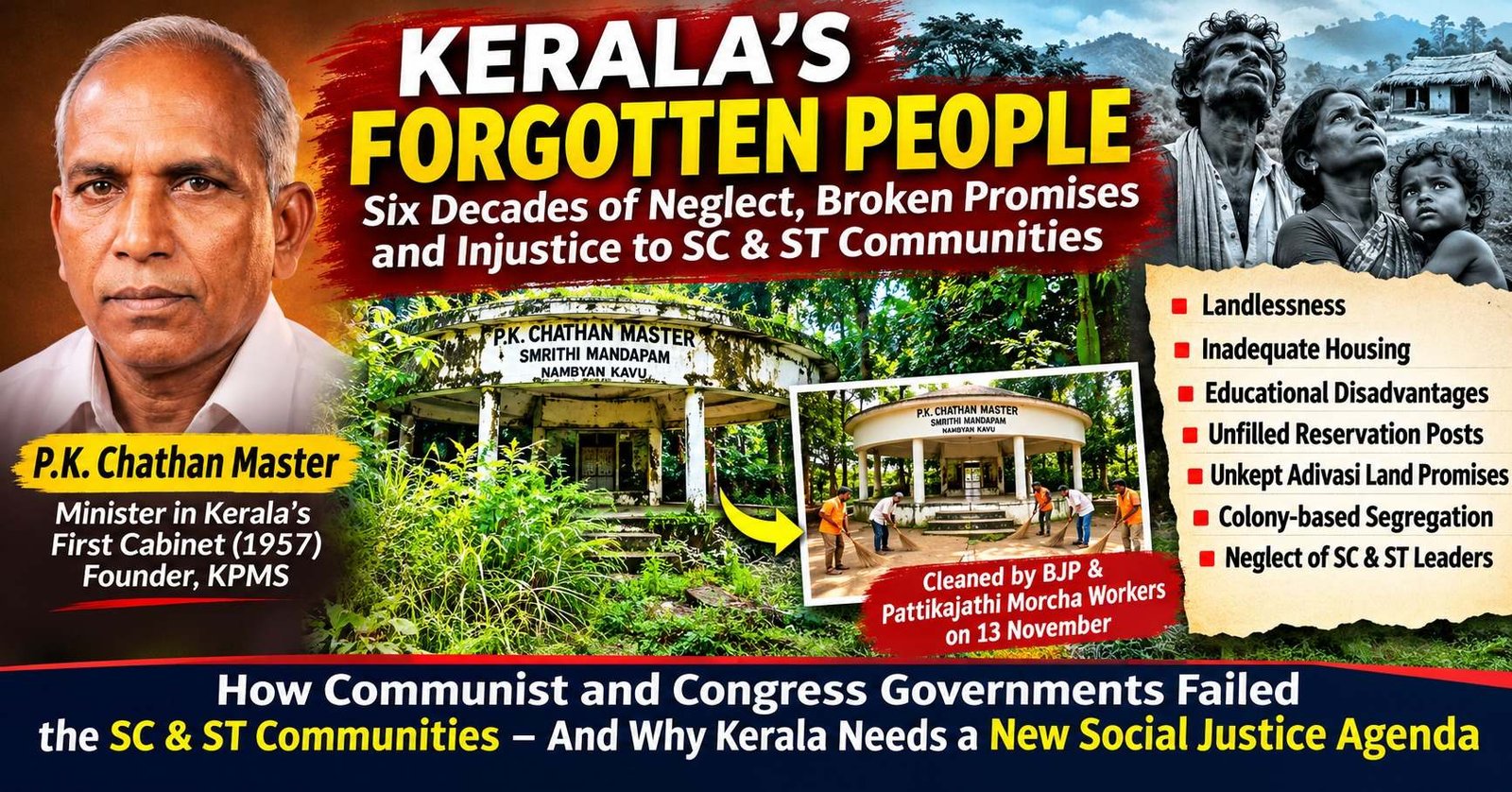
How Communist and Congress Governments Failed the Scheduled Castes and Scheduled Tribes of Kerala – And Why the State Needs a New Social Justice Movement
By S. J. R. Kumar
SC/ST Communities in Kerala have endured decades of landlessness, inadequate housing, educational disadvantages, unemployment and broken political promises. Despite the claims of social progress and development made by successive governments, the Scheduled Castes and Scheduled Tribes continue to face deep-rooted inequalities that have not received the urgent attention they deserve. From the historic failures of land reforms to the continuing struggles of Adivasi families for their rightful land, the story of these communities exposes a serious gap between Kerala’s claims of social justice and the reality experienced by its most disadvantaged people.
But behind this celebrated image lies a deeply uncomfortable reality.
Nearly seven decades after the formation of Kerala and the installation of its first elected government in 1957, large sections of Scheduled Caste (SC) and Scheduled Tribe (ST) communities continue to struggle for the most fundamental requirements of a dignified life: ownership of land, decent housing, quality education, employment, economic independence and social recognition.
The question that Kerala’s political establishment must answer is simple:
What has actually changed in the lives of Scheduled Castes and Scheduled Tribes after nearly seven decades of Communist and Congress governments?
Have these communities received their rightful share of land and resources? Have generations of landless families been rehabilitated? Have their children received equal educational opportunities? Have constitutional reservations translated into adequate representation in government employment? Have Adivasi communities regained their alienated lands and control over their traditional resources?
Unfortunately, the answers reveal a long history of neglect, unfulfilled promises and administrative indifference.
The tragedy is not merely that these communities have been left behind. It is that political organisations which claimed to represent the oppressed and exploited sections of society have repeatedly failed to bring about the structural transformation necessary to free them from generations of poverty, dependency and social exclusion.
Both the Communist and Congress parties have governed Kerala for extended periods. Both have sought the support of these communities during elections. Both have announced welfare schemes, allocated funds and made promises of social advancement.
Yet the fundamental problems remain unresolved.
It is time to examine this history honestly.
1. P.K. Chathan Master: A Pioneer Forgotten by His Own Political Establishment
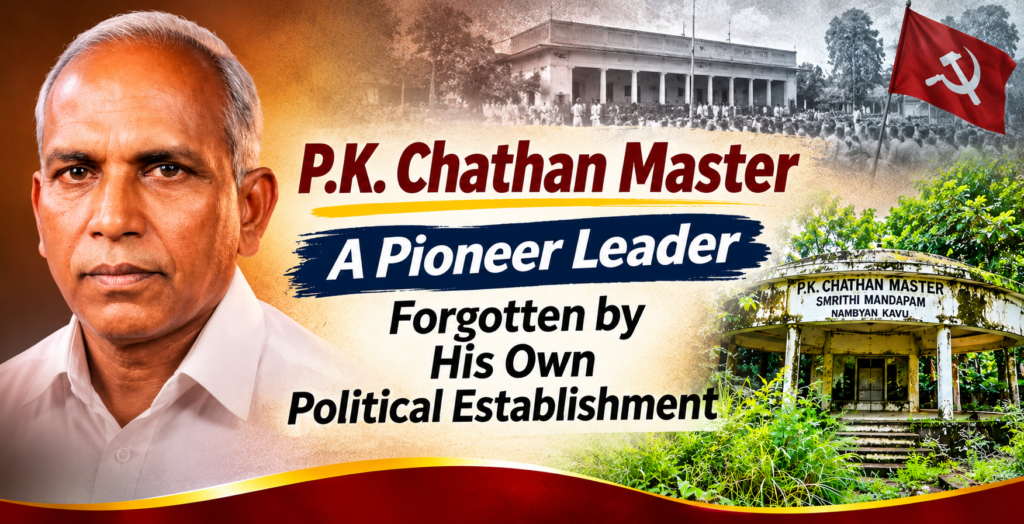
Any discussion about the historical neglect of Scheduled Caste communities in Kerala must begin with the life and contributions of P.K. Chathan Master.
P.K. Chathan Master was one of the pioneering political representatives of the Scheduled Castes in Kerala. Rising from a socially oppressed background, he became an important figure in the State’s political and social history.
He was a member of the Travancore-Cochin Legislative Assembly during 1954–56. Following the formation of Kerala, he was elected to the First Kerala Legislative Assembly from the reserved Chalakudy constituency.
On April 5, 1957, he became a minister in the first Kerala Cabinet headed by E.M.S. Namboodiripad, holding the portfolios of Local Self-Government and Harijan Welfare until July 31, 1959.
Consider the historical significance of this achievement.
At a time when caste discrimination and social exclusion were deeply entrenched, a leader from an oppressed community had entered the first Cabinet of Kerala. He was entrusted with responsibilities directly connected with local administration and the welfare of historically disadvantaged sections.
He also played a significant role in organising the Pulaya community and was associated with the establishment and development of the Kerala Pulayar Maha Sabha (KPMS).
His political journey represented the aspirations of an entire generation that struggled for dignity, representation and social advancement.
Yet, what has Kerala done to preserve his legacy?
The condition of the Smrithi Mandapam dedicated to P.K. Chathan Master at Nambyan Kavu, near Irinjalakkuda, is a disturbing example of the neglect of a historical leader from the Scheduled Caste community.
The premises had been left unattended for so long that the area had become virtually a jungle, overgrown with vegetation and wild plant growth. A place that should have been maintained with dignity and respect had been reduced to a neglected and abandoned condition.
What makes this particularly painful is that the political establishment and the party with which this pioneer was associated had not taken the responsibility of properly maintaining the Smrithi Mandapam.
On November 13, 2026, BJP and Pattikajathi Morcha workers took the initiative to clear the overgrown vegetation and clean the premises. Their intervention brought some dignity back to a place that should never have been allowed to deteriorate in the first place.
This incident raises an uncomfortable question for the Communist leadership and the political establishment associated with Chathan Master:
If a pioneering Scheduled Caste leader who served in Kerala’s first Cabinet cannot even have his Smrithi Mandapam properly maintained by his own political establishment, what value do its claims of commitment to the welfare and dignity of Scheduled Caste communities really have?
Political parties are quick to celebrate their leaders, organise anniversaries, publish biographies and invoke their contributions whenever it serves their political interests. Memorials of prominent political personalities are maintained with considerable care and public resources.
Why should Chathan Master be treated differently?
This is not merely about maintaining a building. It is about historical recognition, community dignity and the responsibility of political organisations to preserve the contributions of leaders who fought for the advancement of oppressed communities.
His Smrithi Mandapam must be properly restored, maintained and developed into a place where future generations can learn about his life, struggles and contributions.
A society that forgets the pioneers who fought for its dignity cannot honestly claim to have completed the struggle for social justice.
The neglect of Chathan Master’s legacy is symbolic of a much larger problem: the selective recognition of history and the continuing marginalisation of the contributions of Scheduled Caste leaders.
2. The Great Land Reform Failure: How Dalits Were Left Behind
Perhaps the most significant historical injustice suffered by Scheduled Caste communities in Kerala is connected with the celebrated land reforms introduced during the 1960s.
The Kerala Land Reforms Act of 1963, substantially amended in 1969 and brought into operation on January 1, 1970, is frequently presented as one of the greatest achievements of the Communist movement.
The reforms dismantled much of the traditional landlord-tenant system and transferred ownership rights to cultivating tenants.
But an important question has rarely received the attention it deserves:
Who actually benefited from these land reforms, and who was left out?
The central weakness was that the legislation largely addressed the relationship between landlords and cultivating tenants.
A large proportion of Scheduled Caste people were agricultural labourers, attached labourers and workers who cultivated land without recognised tenancy rights. They worked in the fields, contributed to agricultural production and sustained the agrarian economy, but they were not recognised as tenants entitled to receive ownership under the principal provisions of the reforms.
Consequently, while recognised cultivating tenants received ownership rights, large numbers of Dalit agricultural workers remained landless.
For many of them, the benefit was limited to a small residential site under the kudikidappu provisions.
In other words, those who actually worked on the land were largely denied the opportunity to become its owners.
This was not a minor administrative omission. It was a fundamental failure to address the landlessness of the most oppressed agricultural workers.
The Kerala State Planning Board’s Working Group Report for the Fourteenth Five-Year Plan, drawing upon a KILA survey conducted in 2009–10, recorded 5,64,329 Scheduled Caste families living in 26,342 colonies or habitats, now commonly referred to as unnathis.
These figures represent approximately 23.52 lakh people, or around 77 per cent of the State’s Scheduled Caste population.
The survey also recorded 1,23,871 single-room houses and 45,959 houses considered unfit for habitation.
These figures expose the continuing consequences of historical landlessness and inadequate housing.
The exemption of plantations from ordinary land-ceiling provisions under Section 81 of the Kerala Land Reforms Act also deserves serious examination.
Large plantation holdings were substantially left outside the ordinary land-ceiling framework, while the workers who helped sustain the plantation economy continued to live without ownership of either agricultural land or adequate residential property.
The Communist leadership must answer for this historical failure.
However, the Congress cannot escape responsibility either. Successive Congress-led governments had decades to correct the omissions and undertake meaningful redistribution of land.
Neither political front can claim that this injustice belongs exclusively to the other.
The celebrated land reforms changed the ownership structure of much of Kerala’s agricultural land, but they did not deliver the same transformation to the Dalit agricultural labourers who had worked that land for generations.
3. Adivasis: Laws Passed, Promises Made, Justice Denied
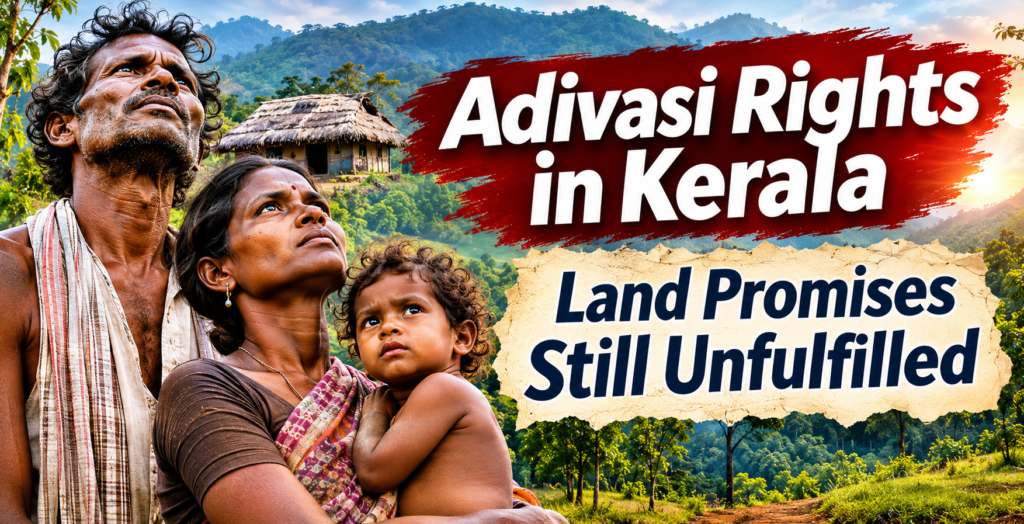
The experience of Scheduled Tribe communities presents an equally painful, if different, history of dispossession and neglect.
Adivasi communities have suffered the loss of ancestral land through settler migration, illegal transfers, encroachment, forest reservation and administrative failures.
The Kerala Scheduled Tribes (Restriction on Transfer of Lands and Restoration of Alienated Lands) Act, 1975 was enacted with the stated objective of protecting tribal land and restoring alienated properties.
However, the rules were framed only in 1986. The subsequent legislative changes in 1999 substantially altered the framework, including provisions that regularised certain earlier transfers involving up to two hectares and provided for alternative land in specified circumstances.
The Supreme Court examined this legislative history in its 2009 judgment concerning the State of Kerala and the People’s Union for Civil Liberties.
The result was that the promise of restoring ancestral land was substantially diluted, while thousands of tribal families continued to wait for meaningful rehabilitation.
The 2001 Adivasi Land Agreement: Another Unfulfilled Promise
The Adivasi agitation of 2001, led by C.K. Janu and M. Geethanandan, brought the issue back to the centre of Kerala’s political debate.
Following a 48-day struggle in front of the Secretariat, popularly known as the Kudil Ketti Samaram, the Congress-led government headed by A.K. Antony signed a seven-point agreement with the Adivasi Gothra Maha Sabha on October 16, 2001.
Its central commitment was land.
Every landless Adivasi family was promised between one and five acres of cultivable land. Families possessing less than one acre were also to be provided additional land to reach the prescribed minimum.
The agreement also envisaged financial assistance for developing the land and rehabilitation measures.
What happened to that promise?
More than two decades later, the demand for land distribution remains unresolved for many families. The establishment of the Tribal Resettlement and Development Mission did not ensure that every eligible family received cultivable land and the necessary support to establish an independent livelihood.
The Congress government made the commitment. Subsequent Congress and Communist governments had opportunities to complete it.
Yet, the historical injustice remains.
Forest Rights and Tribal Self-Governance
The Forest Rights Act, 2006, provided another important opportunity to recognise individual and community rights over forest resources.
While individual titles have been distributed in many areas, the recognition of community forest resource rights remains inadequate. Conflicts between revenue and forest records, difficulties in implementing recognised rights and the continued treatment of some traditional settlements as encroachments are serious concerns.
Another important issue is the absence of notified Scheduled Areas in Kerala.
As a result, the Panchayats (Extension to Scheduled Areas) Act, 1996, commonly known as PESA, does not apply to the State’s Adivasi-majority regions.
This limits an important institutional framework for tribal self-governance.
What is the value of passing protective legislation and signing agreements if the people for whom they were intended cannot enjoy their rights?
4. The Laksham Veedu Project: Housing Without Social Integration
The Laksham Veedu housing project, launched in 1972 under the C. Achutha Menon government, was an important initiative intended to provide shelter to economically weaker families.
Its original design included small houses, often with two families sharing a structure separated by a common wall.
The project provided shelter to many poor households, and its contribution should not be dismissed.
However, the long-term social consequences of concentrated housing colonies deserve serious examination.
Housing is not simply about constructing a roof over someone’s head. It must provide privacy, dignity, adequate living space, access to public services and opportunities for social integration.
The creation and continuation of isolated colonies, often with inadequate land and infrastructure, contributed to a pattern in which disadvantaged families remained geographically concentrated and socially separated.
In many locations, these settlements became identified by caste and economic status. The stigma associated with living in a colony continued across generations.
Even today, many families live on tiny plots where there is insufficient space for expansion, separate houses for married children or other basic family needs.
A government cannot claim to have solved homelessness merely because it has constructed a house.
A house that perpetuates overcrowding, segregation and dependency does not necessarily deliver social emancipation.
The challenge before Kerala is to move beyond the old colony-based approach and provide integrated housing with adequate land, infrastructure and opportunities for economic advancement.
5. Education: Access Is Not the Same as Equality
Kerala often celebrates its literacy achievements. But the educational experience of Scheduled Caste and Scheduled Tribe students must be examined beyond overall literacy figures.
For many families, the struggle begins with the ability to send children to school and continues through higher education.
Students from economically weaker SC/ST backgrounds face multiple disadvantages:
- Inadequate study facilities at home.
- Lack of digital access and educational resources.
- Difficulties in meeting educational expenses.
- Limited access to academic mentoring and competitive examination coaching.
- Financial difficulties in pursuing professional and higher education.
- Delays in receiving scholarships and educational assistance.
A scholarship alone cannot compensate for all these disadvantages.
The State Planning Board’s Fourteenth Five-Year Plan Working Group on Scheduled Caste Development acknowledged weaknesses in the implementation of skill-development and employment programmes. It identified shortcomings in the reach and utilisation of these schemes.
The CAG’s performance audit of pre-matric and post-matric scholarship schemes for SC, ST and minority students also demonstrates the need for closer examination of beneficiary coverage and actual delivery.
The State must ask whether students from these communities are entering professional courses, completing postgraduate education, obtaining research opportunities and competing successfully in national-level examinations.
The objective should not merely be to keep children enrolled in schools.
It must be to enable them to compete on equal terms with students from economically and socially better-positioned backgrounds.
6. Employment and Reservation: The Unfinished Agenda
Reservation in education and public employment is a constitutional safeguard against historical exclusion.
However, the existence of reservation provisions does not automatically guarantee that the prescribed representation is achieved.
The CAG’s earlier audit of special recruitment for SC/ST candidates in Kerala identified at least 739 vacancies pending selection across 136 posts as of March 31, 2016. Some selections had remained pending for as long as 21 years.
This is a serious administrative failure.
A reserved vacancy that remains unfilled for years is not merely a number in a government register. It represents an opportunity denied to a qualified young person who depends on that constitutional safeguard.
The State must publish updated, department-wise data on:
- Total reserved vacancies.
- Backlog vacancies.
- Vacancies filled through special recruitment.
- Actual SC/ST representation in different departments.
- Progress in promotions and career advancement.
There must also be greater emphasis on private-sector employment, entrepreneurship, professional skills and opportunities outside traditional occupations.
The goal must be to move these communities from a position of dependence on government assistance to one of economic strength and self-reliance.
7. Political Representation Without Real Empowerment
Both the Communist and Congress parties have had Scheduled Caste and Scheduled Tribe leaders in important political positions.
Some have served as Ministers, legislators, members of Parliament and office-bearers of major political organisations.
But representation in political institutions should not be confused with empowerment of the community as a whole.
The real test is whether these representatives have been able to influence policies, secure adequate budgetary allocations, correct historical injustices and ensure accountability within their own parties.
How many major policy decisions relating to land, education, employment and social development have been shaped by the independent voices of SC and ST representatives?
How often have these leaders been allowed to challenge their own party leadership when the interests of their communities were at stake?
There is a disturbing perception that some leaders from these communities are celebrated as symbols of inclusion while their communities continue to face structural disadvantages.
Political parties must move beyond token representation and give SC and ST leaders genuine authority, responsibility and the freedom to articulate the interests of their people.
The neglected Smrithi Mandapam of P.K. Chathan Master is a reminder that even historical leaders from these communities have not always received the recognition and respect they deserve.
8. Welfare Politics and the Neglect of the Most Disadvantaged
Kerala’s political discourse has frequently revolved around the interests of organised social and religious constituencies.
Successive governments have engaged with different community organisations, addressed their demands and introduced policies for their development.
There is nothing inherently wrong with governments addressing the needs of religious minorities or any other disadvantaged group. The welfare of Christians, Muslims and other communities should not be opposed.
But social justice cannot become a selective exercise.
The legitimate question is why the Scheduled Caste and Scheduled Tribe communities, despite their historical deprivation and constitutional protections, have not received the same sustained political attention to their fundamental problems.
Why should a landless Adivasi family have to wait for decades for a plot of land?
Why should a Dalit family remain confined to a tiny colony plot while generations of children grow up without adequate living space?
Why should a qualified SC/ST candidate wait years for a reserved government vacancy to be filled?
Why should a student abandon higher education because financial assistance is delayed or inadequate?
These questions are not directed against any religious community. They are directed against governments that have failed to make social justice universal and meaningful.
The responsibility lies with the political leadership, not with ordinary members of other communities.
Both the Communist and Congress parties must explain why the basic problems of these communities have remained unresolved despite their repeated electoral promises.
9. Government Audit Reports Expose the Failure of Governance
The neglect of Scheduled Caste and Scheduled Tribe communities is not merely a matter of political opinion.
Government and audit reports themselves have documented serious weaknesses.
The Comptroller and Auditor General’s Report No. 8 of 2025 on Kerala’s Local Self-Government Institutions, presented to the Legislature in February 2026, identified serious deficiencies in the planning and implementation of programmes for these communities.
The audit found that local bodies continued to depend on SC/ST socio-economic survey data that was more than 12 to 15 years old.
Of the 68 Panchayat Raj Institutions examined, Scheduled Caste population data had been updated in only 29, while Scheduled Tribe population data had been updated in only 35.
The audit further found that there was no comprehensive updated assessment of the extent of socio-economic deprivation in these communities as of March 2024.
The report also identified deficiencies in responding to basic demands raised by SC/ST communities through Grama Sabhas, Oorukoottams and working groups.
Among 173 demands for drinking-water facilities raised in 38 Panchayat Raj Institutions during 2020–21 to 2022–23, only 96 projects were formulated.
The audit also documented instances of eligible SC and ST beneficiaries being excluded from LIFE housing lists in the local bodies examined.
These findings expose a fundamental weakness in Kerala’s welfare administration.
The government is not even maintaining sufficiently updated information about the actual conditions of the communities it claims to serve.
How can meaningful development planning take place without reliable data?
How can the government measure progress when it does not adequately know how many families remain landless, homeless, unemployed or deprived of essential services?
The failure is not simply one of funding. It is a failure of planning, implementation, monitoring and accountability.
10. Land Reforms 2.0: Will Kerala Repeat Its Historical Injustice?
The debate over the proposed Land Reforms 2.0 has brought the historical question of landlessness back to the centre of Kerala’s political discourse.
For decades, Dalit and Adivasi organisations have demanded a second land reform that addresses the exclusion of the most disadvantaged communities from the first round of redistribution.
The demand is particularly significant in the context of plantation land.
Large areas of plantation land have been held under historical grants and leases, and the validity of certain titles and landholdings has been questioned by the State itself.
Dalit and Adivasi organisations have argued that land found to be illegally held or otherwise recoverable should be reclaimed and distributed among landless families.
The Chengara land struggle of 2007 and the Arippa land struggle of 2012 brought this demand into public consciousness.
In the Chengara struggle, landless Dalit and Adivasi families occupied a plantation estate belonging to Harrisons Malayalam. The Arippa struggle in Kollam was another expression of the demand for land and dignity.
The issue is not simply about acquiring land. It is about correcting a historical imbalance.
The present government’s proposal to amend land laws to facilitate new activities in plantations, including tourism and alternative agricultural uses, must therefore be examined carefully.
Any policy that facilitates commercial use of plantation land without first addressing the claims of landless SC/ST families would risk repeating the injustice of the original land reforms.
The government must clarify:
- Will land found to be held without valid title be recovered?
- Will expired plantation leases be examined and appropriate land resumed?
- Will landless Dalit and Adivasi families receive priority in the distribution of recoverable land?
- Will plantation workers receive ownership rights over their residential sites?
- Will the outstanding commitments under the 2001 Adivasi agreement be honoured?
- Will community forest rights and the ecological integrity of the Western Ghats be protected?
A second land reform must not become another opportunity for large landholders and commercial interests while the landless remain forgotten.
If the first land reform failed to deliver land to Dalits and Adivasis, the second must correct that injustice rather than institutionalise it.
11. Both Political Fronts Must Answer
The history of Kerala since 1957 reveals a pattern of unfulfilled commitments.
The Communist movement promised a society free from exploitation. The Congress promised social justice and inclusive development.
Both parties sought the support of SC and ST communities during elections. Both made promises of land, housing, education, employment and welfare.
But after nearly seven decades, the fundamental questions remain.
The Left cannot continue to celebrate the land reforms of the 1960s without acknowledging that a large section of landless Dalits and Adivasis never received the agricultural land that genuine redistribution should have provided.
The Congress cannot continue to speak about inclusive development without explaining why the land distribution agreement signed by the A.K. Antony government in 2001 remains incompletely implemented.
The Left cannot claim to have achieved social equality while thousands of families continue to live in isolated colonies with inadequate land and infrastructure.
The Congress cannot claim to be the champion of the oppressed while its governments have failed to complete the commitments made to Adivasi communities.
Neither party can escape accountability by pointing fingers at the other.
Their political rivalry may change the government from time to time, but the conditions of the most disadvantaged communities have not changed sufficiently.
The people of these communities deserve more than election-time assurances, occasional financial assistance and ceremonial celebrations of their leaders.
They deserve justice.
12. A New Beginning: The Need for a Genuine Social Justice Agenda
Kerala now needs a comprehensive review of the policies implemented for Scheduled Castes and Scheduled Tribes since the formation of the State.
This should not be another committee appointed to produce a report that eventually disappears into government files.
It must be a time-bound programme of corrective action with measurable targets and public accountability.
The following measures deserve immediate attention:
1. Land for the landless
Conduct a comprehensive survey of landless SC/ST families and identify government land, legally recoverable surplus land and plantation land held without valid title. Prioritise distribution to eligible families.
2. Complete Adivasi rehabilitation
Implement the outstanding commitments of the 2001 agreement, ensure restoration or lawful alternative allotment wherever required, and recognise community rights under the Forest Rights Act.
3. End residential segregation
Replace the colony-based approach with dignified, integrated housing. Families must receive adequate house sites, basic infrastructure and opportunities for economic advancement.
4. Educational empowerment
Ensure timely scholarships, quality hostels, mentoring, competitive examination coaching, digital access and assistance for professional and higher education.
5. Employment accountability
Publish an annual white paper on SC/ST reservation, backlog vacancies, recruitment and representation in government services. Introduce effective mechanisms to fill pending reserved vacancies.
6. Economic independence
Expand entrepreneurship, skill development, agricultural support, access to institutional credit and market opportunities. Welfare must lead to self-reliance rather than permanent dependency.
7. Protection of community resources
Strengthen the legal and administrative protection of Adivasi land, forest rights and traditional livelihoods.
8. Preservation of historical contributions
Properly restore and maintain the Smrithi Mandapam of P.K. Chathan Master at Nambyan Kavu. Develop it into a place of historical learning and research. Document the contributions of pioneering SC/ST leaders and introduce their history into educational and public institutions.
9. Independent monitoring
Constitute a high-level commission with substantial representation from SC/ST organisations, independent experts and community leaders to review government performance and publish annual progress reports.
10. A comprehensive development audit
Examine the actual utilisation and outcomes of Scheduled Caste Sub Plan (SCSP) and Tribal Sub Plan (TSP) allocations, including diversion, non-utilisation and ineffective implementation of funds.
Most importantly, these measures must be implemented through the meaningful participation of the communities concerned.
They should not be treated merely as beneficiaries of government generosity. They must be recognised as citizens with equal rights, dignity and the capacity to determine their own future.
Conclusion: From Vote-Bank Politics to Genuine Social Justice
As we remember P.K. Chathan Master and the generations of leaders who fought for the dignity of oppressed communities, we must ask ourselves whether we have fulfilled the dreams for which they struggled.
What is the meaning of Kerala’s social progress if hundreds of thousands of Scheduled Caste families continue to face residential and economic disadvantages?
What is the meaning of land reform if the agricultural labourers who worked on the land remained without ownership?
What is the meaning of tribal protection legislation if Adivasi families continue to wait for their ancestral land?
What is the meaning of educational advancement if talented students are unable to pursue higher education because of financial and institutional barriers?
What is the meaning of reservation if vacancies remain unfilled for years?
And what is the meaning of political representation if the communities represented by those leaders continue to suffer?
These are questions that the Communist and Congress parties must answer before seeking another mandate from these communities.
We must also recognise that the future of Scheduled Castes and Scheduled Tribes cannot be secured merely by changing the government. It requires a fundamental change in the way governments approach social justice, development and the distribution of resources.
This struggle is not against any other community. It is against historical injustice, discriminatory structures, administrative indifference and political opportunism.
Kerala must stop measuring its achievements solely through literacy rates, welfare announcements and political slogans. It must also measure its progress by the living conditions, land ownership, educational achievements, employment opportunities and economic independence of its most disadvantaged citizens.
The time has come to move from vote-bank politics to genuine social justice.
P.K. Chathan Master and the generations of leaders who fought for the dignity of oppressed communities deserve more than annual commemorations. They deserve a society that fulfils the aspirations for which they struggled.
The cleaning of the neglected Smrithi Mandapam at Nambyan Kavu on November 13, 2026, should be more than an isolated act of cleaning. It should become a reminder of the responsibility we all share in restoring the dignity of our forgotten pioneers and addressing the unfinished agenda of social justice.
The question is no longer what the Communist and Congress governments promised these communities. The question is what they have actually delivered – and how much longer these communities must wait for justice.
Kerala must wake up. Its forgotten people can wait no longer.