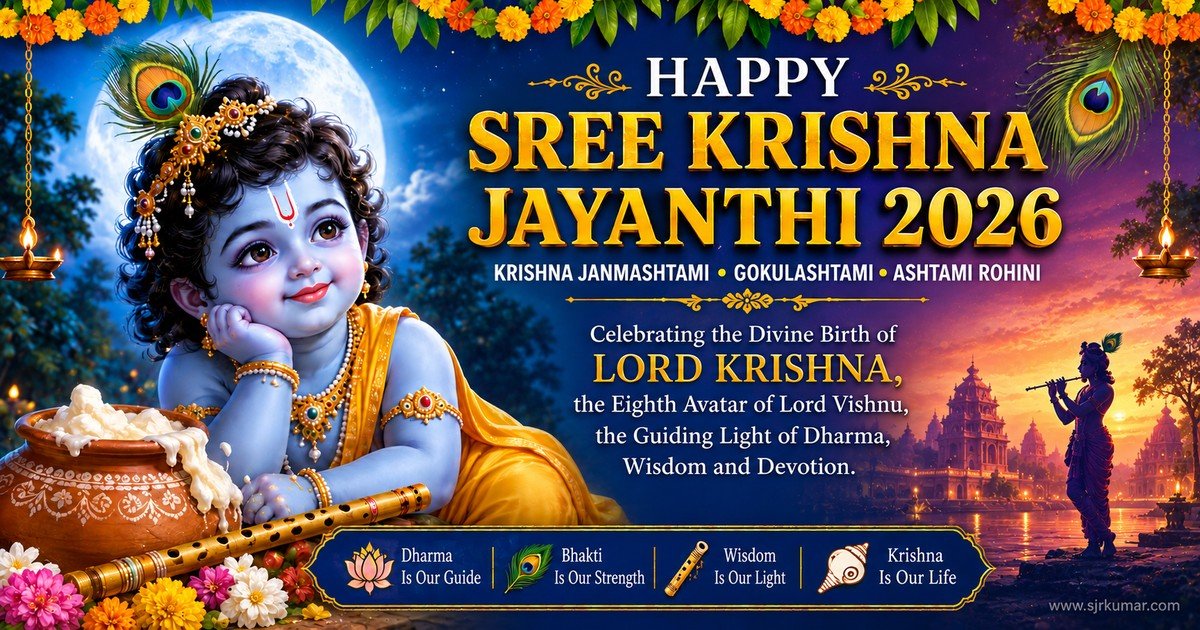
Krishna Janmashtami • Gokulashtami • Sree Jayanthi • Ashtami Rohini
By S. J. R. Kumar
4 September 2026
There are festivals that celebrate an event, and there are festivals that celebrate a divine presence.
Sree Krishna Jayanthi is both.
Today, Friday, 4 September 2026, millions of Hindus across India and around the world celebrate Sree Krishna Jayanthi, also known as Krishna Janmashtami, Gokulashtami, Krishnashtami and Sree Jayanthi—the sacred festival commemorating the birth of Lord Sri Krishna, traditionally revered as the eighth avatar of Lord Vishnu.
In Kerala, the festival has a particularly beautiful expression as Ashtami Rohini, connecting the eighth lunar day, Ashtami, with Rohini, the birth star traditionally associated with Sri Krishna. Kerala Tourism describes Sree Krishna Jayanthi as the celebration of Krishna’s birth on the eighth day of the dark fortnight of the Malayalam month of Chingam, with Rohini considered especially auspicious when it coincides with Ashtami.
But Krishna Jayanthi is much more than the remembrance of a divine birth.
It is a celebration of Dharma over Adharma, truth over tyranny, wisdom over ignorance, devotion over ego and righteousness over injustice.
It reminds us that whenever the forces of disorder become dominant, the protection of Dharma becomes the supreme responsibility of the Divine—and of humanity itself.
THE DIVINE BIRTH AT MIDNIGHT
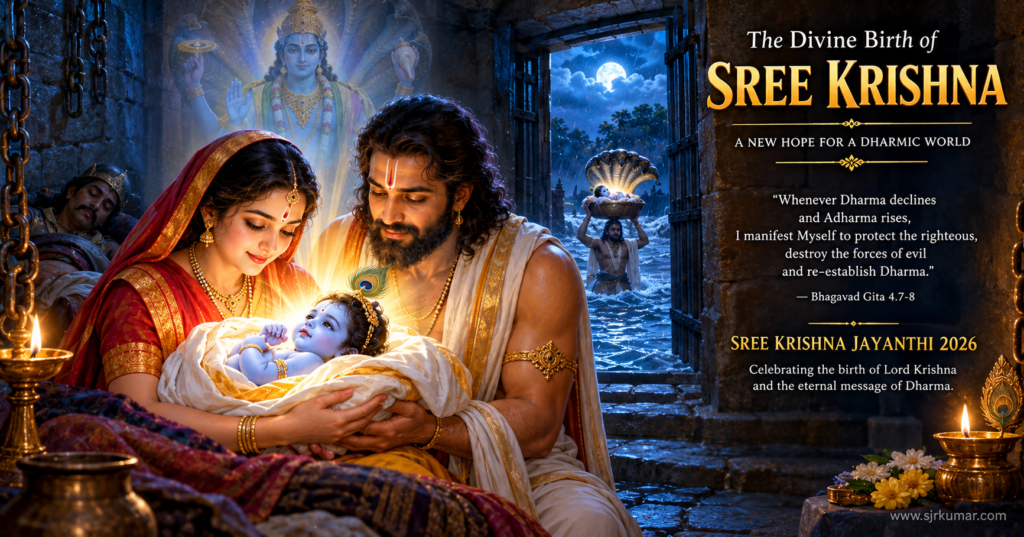
The story of Sri Krishna’s birth is among the most beloved narratives of Sanatana Dharma.
According to the Srimad Bhagavatam, Krishna was born in Mathura to Devaki and Vasudeva, at a time when the kingdom was ruled by the tyrannical King Kamsa.
A divine prophecy had foretold that the eighth child of Devaki would become the cause of Kamsa’s destruction.
Driven by fear, Kamsa imprisoned Devaki and Vasudeva and killed their children.
Yet tyranny could not prevent the unfolding of Dharma.
When the eighth child was born, the prison was transformed by divine radiance. Vasudeva carried the newborn Krishna across the Yamuna to Gokula, where he was entrusted to Nanda and Yashoda.
Thus began the earthly life of the child who would become one of the most beloved and profound manifestations of the Divine in Hindu civilisation.
The midnight birth is therefore not merely a chronological detail.
It carries profound symbolism.
The Divine appears in the darkest hour.
The darkness of midnight represents ignorance, fear, oppression and spiritual confusion. The birth of Krishna represents the arrival of light, hope, wisdom and Dharma.
That symbolism remains timeless
KRISHNA: THE CHILD, THE COWHERD, THE GUIDE AND THE TEACHER
Few figures in world religious literature embody so many dimensions of life as Sri Krishna.
He is Balakrishna, the playful divine child.
He is Gopala, the protector of cows and the beloved of the people of Gokula.
He is Govinda, the one who brings joy and protects those who seek refuge in Him.
He is the enchanting flute player of Vrindavan.
He is the friend and companion of the Pandavas.
He is the statesman and strategist of the Mahabharata.
He is the charioteer of Arjuna.
And on the battlefield of Kurukshetra, He becomes the teacher of one of humanity’s greatest spiritual texts—the Bhagavad Gita.
This extraordinary range is one of the reasons Krishna occupies such a unique place in Hindu thought.
He is simultaneously intimate and transcendent.
He can be worshipped as a child, loved as a friend, approached as a beloved, revered as a king, followed as a guide and contemplated as the Supreme Reality.
Some Vaishnava traditions go further and regard Krishna not merely as an avatar of Vishnu but as Svayam Bhagavan, the Supreme Divine Person Himself. The theological formulations differ among Hindu traditions, but Krishna’s central place in Vaishnava spirituality is beyond dispute.
THE MESSAGE OF THE BHAGAVAD GITA
If the birth of Krishna is celebrated on Janmashtami, the Bhagavad Gita represents the mature expression of His spiritual message.
On the battlefield of Kurukshetra, Arjuna faces a crisis.
He is overwhelmed by doubt, grief and moral confusion. He does not know whether he should fight or withdraw.
Krishna does not simply tell Arjuna what to do.
He teaches him how to understand Dharma, duty, action, knowledge, devotion, and the nature of the Self.
One of the most enduring teachings is
“Karmanye vadhikaraste ma phaleshu kadachana.”
One has a right to action, but not to the fruits of action.
The teaching is not an invitation to abandon responsibility.
It is precisely the opposite.
Krishna teaches us to perform our Swadharma—our rightful duty—with dedication, courage, and detachment from selfish reward.
The Gita therefore remains extraordinarily relevant in an age dominated by ambition, anxiety, competition, and materialism.
It teaches:
Act—but do not become enslaved by the result.
Perform your duty—but do not make selfish gain the measure of your duty.
Stand for Dharma—but do not allow hatred to consume you.
Seek knowledge—but combine knowledge with humility.
Cultivate devotion—but do not abandon responsibility.
“YADA YADA HI DHARMASYA…”
Perhaps the most frequently remembered teaching associated with Krishna is His declaration concerning the restoration of Dharma:
“Yada yada hi dharmasya glanir bhavati Bharata…”
Whenever Dharma declines and Adharma rises, the Divine manifests to protect the righteous, destroy destructive forces, and re-establish Dharma.
This is one of the central ideas of Hindu civilisation.
Dharma is not merely religion in the narrow sense.
It encompasses righteousness, moral order, responsibility, justice, duty and the sustaining principles of life.
The Krishna tradition therefore asks an important question of every generation:
What happens when Dharma is compromised?
The answer is not passive resignation.
Krishna’s life teaches that righteousness requires courage, action, discernment, and sacrifice.
FROM MATHURA TO GOKULA: THE DIVINE IN THE ORDINARY
The story of Krishna’s childhood in Gokula has another profound message.
The Divine does not remain distant from ordinary human life.
Krishna plays with children.
He steals butter.
He teases the Gopikas.
He is loved by Yashoda.
He grazes cows.
He plays the flute.
He dances.
He laughs.
He forms friendships.
Through these stories, Sanatana Dharma presents a remarkable understanding of the relationship between the human and the Divine.
The Divine can be approached not only through fear and ritual but also through love, affection, friendship and devotion.
This is the essence of Bhakti.
The relationship between Yashoda and Krishna represents Vatsalya Bhava—the love of a mother for her child.
The relationship between Krishna and His friends represents Sakhya Bhava—divine friendship.
The devotion of the Gopikas represents another dimension of complete surrender and love.
Thus Krishna’s childhood is not merely a collection of charming stories for children.
It represents a sophisticated spiritual understanding of how human beings can experience the Divine.
WHY KRISHNA IS CALLED GOPALA AND GOVINDA
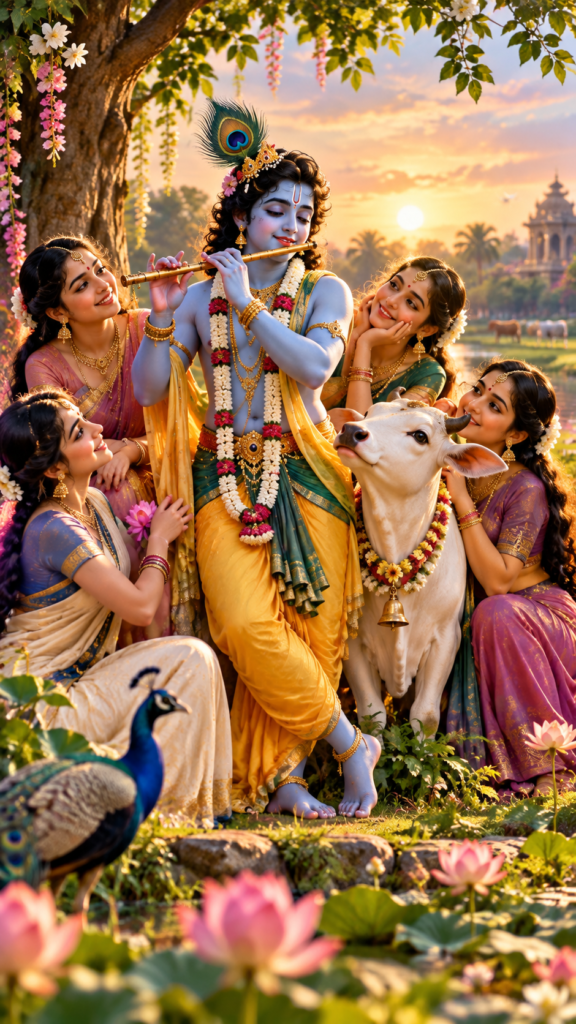
Krishna’s relationship with cows and the pastoral community of Gokula is central to His identity.
The names Gopala and Govinda reflect this association.
The cow occupies a deeply respected place in Hindu civilization—not simply as an animal but as a symbol connected with nourishment, agriculture, generosity, and the interdependence between human society and nature.
Krishna as Gopala therefore also evokes an ecological and civilisational ideal:
Humanity does not exist separately from nature.
The protection of living beings, respect for the land, and responsible stewardship of natural resources are part of the broader Dharmic vision.
THE FLUTE OF KRISHNA
The flute is perhaps the most recognisable symbol associated with Sri Krishna.
A flute produces music only when it is hollow.
That simple image has inspired generations of spiritual reflection.
The flute is often understood as a metaphor for the human being who becomes an instrument of the Divine by emptying himself of ego.
The message is profound:
When the ego becomes silent, the Divine music can flow through us.
In a world increasingly dominated by self-promotion, self-interest, and the desire for recognition, Krishna’s flute offers a very different message.
Humility creates space for the Divine.
KRISHNA AND THE DEFENCE OF DHARMA
Krishna was not merely a philosopher who preached from a distance.
His life demonstrates engagement with the challenges of his time.
He confronted Kamsa.
He protected the people of Gokula.
He challenged arrogance and tyranny.
He stood with the Pandavas when Dharma was threatened.
He attempted diplomacy before war.
And when all peaceful possibilities failed, he guided Arjuna through the moral crisis of Kurukshetra.
This distinction is important.
Dharma does not mean weakness.
Compassion does not mean surrendering to injustice.
Peace does not mean accepting Adharma.
Forgiveness does not require abandoning justice.
Krishna’s life teaches the importance of Viveka—discernment.
One must know when to forgive, when to negotiate, when to withdraw, and when to stand firmly for what is right.
That is one of the most important lessons that Krishna offers to society today.
SREE KRISHNA JAYANTHI IN KERALA
Kerala celebrates Krishna Jayanthi with its own distinctive traditions.
The festival is popularly associated with Ashtami Rohini.
Devotees visit Krishna temples, observe fasting or other forms of vrata according to their traditions, chant Krishna’s names, recite portions of the Bhagavata Purana and Bhagavad Gita, and participate in devotional programmes.
Children are often dressed as little Krishna and Radha.
Colourful processions bring the stories of Krishna into public spaces.
In temples, devotees offer fruits, butter, betel leaves, and other traditional offerings. Kerala Tourism’s 2026–27 calendar notes celebrations including Parayeduppu, Thayambaka, Sheeveli, and Aanayoottu at temples, alongside Bhagavad Gita and Gita Govindam recitations.
The sight of children dressed as Balakrishna is particularly beautiful.
For a moment, the ancient story becomes alive in the present generation.
The child Krishna is not merely remembered.
He is welcomed into the home and into the heart.
JANMASHTAMI AND THE MIDNIGHT CELEBRATION
Across India, the central moment of Janmashtami is associated with midnight—the traditional time of Krishna’s birth.
Devotees maintain vigil, sing bhajans, chant divine names, and participate in special worship.
The infant Krishna is ceremonially bathed, dressed, and placed in a cradle in many traditions.
The atmosphere changes as midnight approaches.
The lights, bells, chanting, and devotional music create a sense of sacred anticipation.
When the hour arrives, devotees celebrate the birth of Krishna with joy:
“Hare Krishna!”
“Govinda!”
“Gopala!”
“Jai Shri Krishna!”
The midnight celebration is ultimately a reminder that even in the deepest darkness, Divine light can arise.
THE SIGNIFICANCE OF FASTING
Fasting on Janmashtami is a traditional spiritual discipline observed by many devotees.
But fasting should not be reduced merely to abstaining from food.
Its deeper purpose is self-control.
The Sanskrit concept of Upavasa is often understood as drawing oneself closer to the Divine.
True fasting therefore involves more than the stomach.
It involves fasting from:
- anger,
- hatred,
- jealousy,
- greed,
- excessive attachment,
- harmful speech,
- selfishness and
- destructive thoughts.
A person may abstain from food and still remain consumed by anger.
Another person may eat according to health and circumstance but spend the day in prayer, kindness and self-discipline.
The spiritual essence of the observance lies in inner purification.
Fasting should therefore always be undertaken according to one’s health, age and circumstances. The purpose of a vrata is spiritual discipline—not physical harm.
KRISHNA JAYANTHI IS ALSO A FAMILY FESTIVAL.
One of the great strengths of Hindu festivals is their ability to bring generations together.
Grandparents tell children the story of Krishna.
Parents decorate the prayer room.
Children dress as Krishna and Radha.
Families prepare traditional offerings.
Temples become centres of collective celebration.
Songs and stories are passed from one generation to the next.
This transmission of cultural memory is extremely important.
A civilisation survives not merely through books and monuments.
It survives when its stories, values, rituals, languages and spiritual traditions are carried into the next generation.
Krishna Jayanthi provides precisely such an opportunity.
KRISHNA AND THE PRESERVATION OF DHARMIC CIVILISATION
The celebration of Krishna should also encourage us to reflect upon the broader civilisational heritage of Bharat.
The stories of Krishna have shaped Indian philosophy, literature, music, dance, painting, sculpture and devotional traditions for thousands of years.
From the Mahabharata and Bhagavata Purana to classical Sanskrit literature and regional traditions, Krishna has inspired an extraordinary cultural legacy.
In Kerala, the Krishna tradition has found expression through temple worship, devotional poetry, music, dance, storytelling and community celebrations.
The preservation of such traditions is not an exercise in nostalgia.
It is a responsibility.
A society that forgets the spiritual and cultural foundations that shaped it risks losing an important part of its identity.
WHAT KRISHNA CAN TEACH MODERN INDIA
Krishna’s teachings are not confined to ancient India.
They speak directly to the challenges of contemporary society.
1. Duty before selfishness
The Gita teaches us to perform our responsibilities without becoming slaves to personal reward.
2. Courage before fear
Krishna did not teach Arjuna to escape from responsibility merely because it was difficult.
3. Wisdom before reaction
The Gita begins with a crisis of emotion and proceeds towards clarity through knowledge.
4. Dharma before convenience
What is right cannot always be determined by what is easy.
5. Compassion without weakness
Krishna’s life combines compassion with the courage to confront injustice.
6. Humility before the Divine
The symbolism of the flute reminds us that ego must become silent if we wish to become instruments of something greater.
7. Unity in diversity
Krishna is loved in countless forms and traditions across India. This diversity itself is a defining strength of Sanatana Dharma.
THE MESSAGE FOR YOUNG INDIA
Perhaps the greatest responsibility of our generation is to ensure that the next generation knows Krishna not merely as a cartoon character, a festival costume, or a social media image.
Children should know:
Why Krishna was born.
Why Kamsa feared Him.
Why He was raised in Gokula.
Why He lifted Govardhana.
Why He stood with the Pandavas.
Why He became Arjuna’s charioteer.
Why He delivered the Bhagavad Gita.
And above all:
What Dharma means.
A young person who understands the Gita’s message of duty, self-mastery, courage and devotion possesses a moral compass that remains relevant throughout life.
THE INNER KRISHNA
Ultimately, Krishna Jayanthi is not only about remembering an event that happened thousands of years ago.
It invites us to discover the Divine within ourselves.
The prison of Mathura can be understood as the prison of fear.
Kamsa can represent tyranny and ego.
The darkness of midnight can represent ignorance.
The crossing of the Yamuna can represent the journey through life’s obstacles.
Gokula can represent the simplicity of a heart filled with devotion.
And Krishna can represent the awakening of Divine consciousness within us.
The festival therefore asks each of us:
Can we remove fear from our hearts?
Can we overcome ego?
Can we perform our duty without selfishness?
Can we stand for Dharma when it is difficult?
Can we bring compassion into our relationships?
Can we seek wisdom rather than merely information?
These questions make Krishna eternally relevant.
A FESTIVAL OF JOY—AND A CALL TO RESPONSIBILITY
Krishna is perhaps the most joyful of Hindu deities.
His smile, His flute, His childhood pranks and His playful relationship with the people of Vrindavan have made Him beloved across generations.
But behind that joy lies a profound philosophy.
Joy without Dharma becomes indulgence.
Power without Dharma becomes tyranny.
Knowledge without Dharma can become arrogance.
Wealth without Dharma can become exploitation.
Politics without Dharma can become corruption.
Freedom without Dharma can become chaos.
Krishna’s message is therefore not simply to celebrate life.
It is to live life rightly.
JANMASHTAMI 2026: LET THE BIRTH OF KRISHNA AWAKEN DHARMA WITHIN US
Today, as temples across Kerala and India celebrate Sree Krishna Jayanthi, let us look beyond the decorations, celebrations and festivities.
Let us remember the deeper message.
When darkness appears, be the light.
When injustice rises, stand for Dharma.
When confusion overwhelms you, seek wisdom.
When success comes, remain humble.
When duty calls, do not run away.
When the ego speaks loudly, listen for the silence of the flute.
And when life becomes difficult, remember Krishna’s assurance that Dharma will ultimately prevail.
The celebration of Krishna’s birth is therefore also a celebration of hope.
The Divine was born in a prison.
He grew up among cowherds.
He faced tyrants.
He navigated political conflict.
He guided warriors.
He taught the world.
And He left humanity one of its greatest spiritual inheritances—the Bhagavad Gita.
That is why Krishna remains eternally relevant.
CONCLUSION
Sree Krishna Jayanthi is not merely the celebration of the birth of a divine child.
It is a celebration of Dharma.
It is a celebration of Bhakti.
It is a celebration of wisdom.
It is a celebration of courage.
It is a celebration of hope.
And it is a reminder that the battle between Dharma and Adharma is not confined to ancient Kurukshetra.
It exists within every human heart and in every society.
The question is not whether we admire Krishna.
The greater question is:
Do we have the courage to live by His teachings?
On this sacred Sree Krishna Jayanthi, may the grace of Sri Krishna, Govinda, Gopala and Parthasarathi bring peace to our homes, strength to our minds, compassion to our hearts and the courage to uphold Dharma.
May the light of Krishna dispel the darkness of ignorance.
May Dharma prevail over Adharma.
May wisdom prevail over confusion.
May compassion prevail over hatred.
May righteousness guide our lives.
Jai Shri Krishna!
Hare Krishna!
Govinda! Govinda!
SOURCE NOTE
The traditional narrative of Krishna’s birth and childhood is principally found in the Srimad Bhagavatam, especially the Tenth Canto, while Krishna’s philosophical teachings are preserved in the Bhagavad Gita, within the Mahabharata.
For the specific 2026 Kerala observance, the Kerala Tourism 2026–27 Digital Event Calendar identifies 4 September 2026 as Sree Krishna Jayanthi and describes the Kerala traditions associated with the festival.