
By S. J. R. Kumar
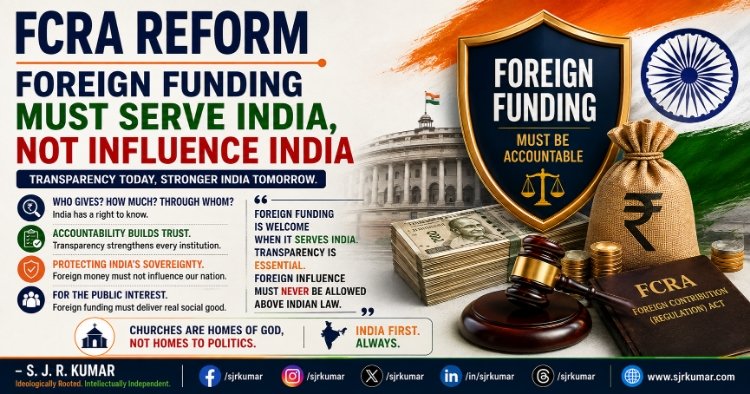
Churches are homes of God, not homes to politics.
The recent observations of senior Supreme Court advocate Harish Salve on foreign funding deserve serious public discussion—not because they target any particular religion, but because they raise a fundamental question for every democracy:
When substantial foreign money enters India, who ultimately decides where it goes, how it is used, and whether it has any influence beyond the stated charitable or religious purpose?
That is precisely why the Foreign Contribution (Regulation) Act (FCRA) matters.
Foreign Funding Is Not the Problem. Lack of Transparency Is.
Foreign contributions are not inherently wrong.
India receives legitimate foreign funding for education, healthcare, humanitarian work, poverty alleviation, research and many other socially valuable purposes. Such activities should be encouraged.
But legitimate charity does not require a lack of transparency.
The Government’s stated rationale for the FCRA framework is straightforward: foreign contributions must be received, accounted for and utilised under clear rules, while activities that could affect India’s sovereignty, security or public order remain subject to regulation.
That is not an attack on religion.
It is an assertion of national sovereignty and financial accountability.
The question is not simply who receives the money.
The more important question is:
Where does the money ultimately go?
The Questions Citizens Have a Right to Ask
In his interview, Harish Salve reportedly pointed to annual foreign funding running into tens of thousands of crores and raised questions about the purposes for which such money is ultimately deployed. He also referred to substantial sums received by churches and questioned whether adequate transparency exists regarding the balance of foreign contributions.
These questions deserve answers.
If an organisation receives foreign money, citizens should be able to know:
- Who is the ultimate donor?
- How much money was received?
- Through which organisation did it come?
- For what declared purpose was it received?
- Where was it actually spent?
- Who ultimately benefited from it?
- And, most importantly, was the money used for the purpose for which permission was granted?
These are not anti-Christian questions.
They are pro-accountability questions.
The same standards should apply to Christian institutions, Hindu organisations, Muslim organisations, secular NGOs, charitable trusts and every other entity receiving foreign contributions.
Foreign Money Must Not Become a Parallel Instrument of Influence
India is not unique in regulating foreign financial flows.
Every sovereign nation has legitimate reasons to ensure that foreign capital does not become an invisible instrument of political influence, social destabilisation or interference in domestic affairs.
This becomes especially important when organisations operating in sensitive regions—particularly tribal, border, economically vulnerable or environmentally contested areas—are simultaneously involved in social mobilisation, political agitation or campaigns affecting major economic and infrastructure projects.
That does not mean that every protest is foreign-sponsored.
Nor does it mean that every religious or community organisation involved in social work has ulterior motives.
But where substantial foreign funding exists, transparency must be strong enough to distinguish legitimate social activism from potential external influence.
That distinction is essential in a democracy.
Religion Must Not Become a Shield Against Scrutiny
One of the most troubling tendencies in the debate over FCRA reform is the attempt to portray every regulatory measure as an attack on a particular religious community.
That argument should be rejected.
A church is entitled to worship.
A mosque is entitled to worship.
A temple is entitled to worship.
A charitable institution is entitled to serve society.
But no religious identity should automatically exempt an institution from financial accountability.
If foreign donations are being used for genuine religious, charitable or humanitarian purposes, transparent regulation should actually strengthen public confidence in those institutions.
After all:
Why should anyone object to transparency if there is nothing to hide?
FCRA Reform and the Need for Accountability
The proposed reforms move in the direction of strengthening accountability.
The 2026 FCRA reform framework has sought to address several operational and accountability concerns. Among the changes highlighted by the Government are clearer specification of the purposes and geographical areas for which organisations may operate, greater traceability of foreign contributions, and mechanisms concerning assets when FCRA registration is cancelled or not restored.
The framework also provides judicial avenues of challenge against designated authorities.
These provisions deserve informed parliamentary scrutiny.
But scrutiny should not become an excuse for rejecting the principle of accountability itself.
If the law can be improved further, Parliament should improve it.
If safeguards are required, Parliament should provide them.
If legitimate charitable institutions need reasonable protection for their genuine activities, the law should ensure that.
But the answer to concerns about regulation cannot be:
“Do not ask us where the foreign money comes from.”
The answer must be:
“Here is where it came from, here is where it went, and here is what it achieved.”
India Has a Right to Know
There is nothing undemocratic about asking organisations receiving foreign money to maintain transparent accounts.
There is nothing communal about demanding disclosure of the ultimate donor.
There is nothing authoritarian about preventing foreign funds from being diverted from their declared purpose.
And there is nothing anti-religious about insisting that religious institutions comply with laws designed to protect India’s sovereignty and financial integrity.
The real issue is much larger than churches or any particular community.
It is about India’s right to know who is financing activities within India and for what purpose.
A sovereign democracy cannot permit foreign money to become an invisible force shaping domestic politics, social conflicts or public policy.
At the same time, genuine humanitarian and charitable work must be protected and encouraged.
That is the balance a mature democracy should seek.
Transparency and National Interest Must Go Together
India should welcome foreign funding when it genuinely contributes to education, healthcare, humanitarian assistance, poverty alleviation, research and other legitimate social objectives.
But welcome does not mean unconditional.
Foreign funding is welcome when it serves India.
Transparency is essential when foreign money enters India.
Foreign influence must never be allowed to operate above Indian law.
This is not about targeting a religion.
It is not about questioning legitimate charitable work.
It is about establishing a simple democratic principle:
Foreign money operating in India must remain accountable to Indian law and the Indian public interest.
Churches should indeed be homes of God—not homes to politics.
And the same principle should apply to every religious and charitable institution in India.
FCRA Reform: A Question of Sovereignty, Not Religion
FCRA reform should therefore not be viewed through the narrow lens of religion.
It should be viewed through the larger lens of:
Sovereignty.
Transparency.
Accountability.
Financial integrity.
National interest.
India has every right to protect legitimate charitable activity while ensuring that foreign financial resources do not become an invisible instrument of domestic political or social influence.
A mature democracy does not fear scrutiny.
A transparent institution does not fear accountability.
And a sovereign nation does not apologise for asking who is financing activities within its borders.
India deserves nothing less. 🇮🇳
— S. J. R. Kumar
FOR MORE INFORMATION, PLEASE WATCH THE VIDEOS BELOW