Table of Contents
- How BJP’s Strategic Miscalculation Opened the Door for Joseph Vijay’s Historic Rise in Tamil Nadu
- The Political Vacuum in Tamil Nadu
- The Rise of Annamalai and the BJP’s New Energy
- Understanding Annamalai’s Political Calculation
- The BJP’s Strategic Retreat
- Vijay Recognizes the Opportunity
- The Collapse of Traditional Political Assumptions
- Could the Outcome Have Been Different?
- The AIADMK’s Strategic Miscalculation
- The Transformation of Tamil Nadu Politics
- Lessons for the BJP
- Vijay’s Real Challenge Begins Now
- The Unfinished Story of Annamalai
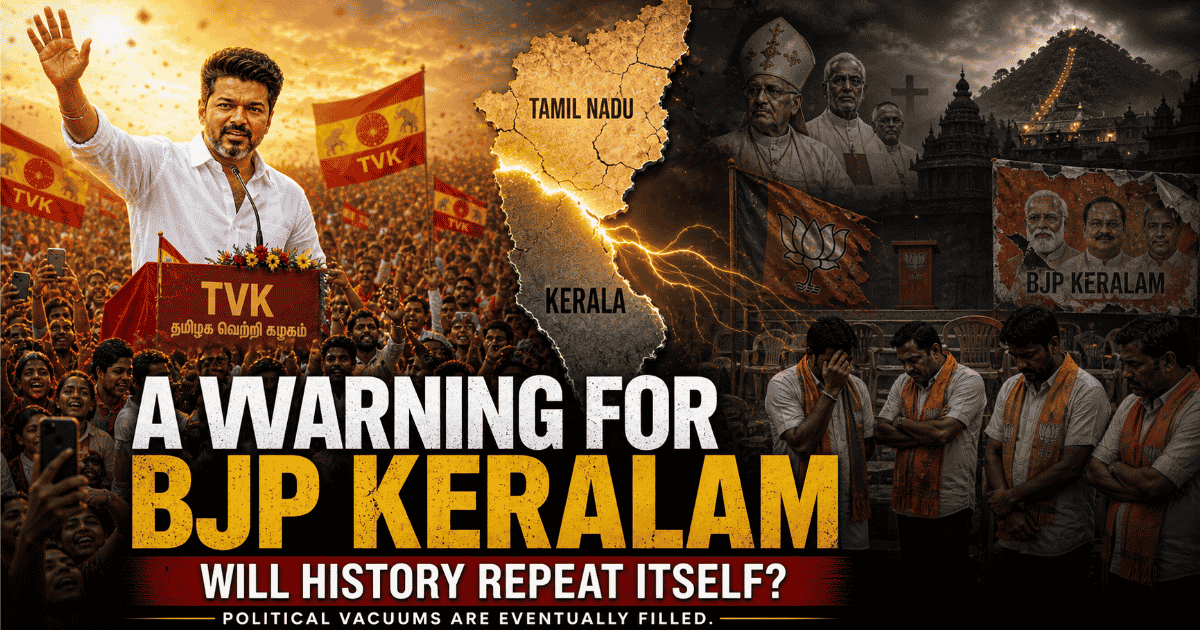
- A Warning for BJP Kerala: Will History Repeat Itself?
- For the BJP in Keralam, the warning signs are already visible.
- The BJP leadership in Keralam therefore faces a critical choice.
- Tamil Nadu Election 2026 Results – Update
- Official TVK Website
- Victory Celebrations at BJP HQ, New Delhi | Landslide Victory in Assembly Elections 2026
How BJP’s Strategic Miscalculation Opened the Door for Joseph Vijay’s Historic Rise in Tamil Nadu
The 2026 Tamil Nadu Assembly Election has fundamentally altered the political landscape of the state. For the first time in decades, the traditional Dravidian duopoly has been decisively challenged by a completely new political force. Actor-turned-politician Joseph Vijay, leading the Tamilaga Vettri Kazhagam (TVK), has emerged as the single largest political force in the Assembly, positioning himself to become the next Chief Minister of Tamil Nadu.
While much of the national media has celebrated the outcome as the result of a massive “Vijay Wave,” the deeper political reality tells a more complex story. Vijay’s rise was not merely the product of celebrity charisma or anti-incumbency sentiment. It was also the consequence of a series of strategic missteps by the Bharatiya Janata Party (BJP), particularly its decision to sideline former Tamil Nadu BJP President K. Annamalai at a crucial political moment.
In many ways, the 2026 election was not just a victory for Vijay. It was also a missed opportunity for the BJP.
The Political Vacuum in Tamil Nadu
Tamil Nadu politics has for decades revolved around the DMK and the AIADMK. Even after the passing of towering personalities like M. Karunanidhi and J. Jayalalithaa, the structure of Dravidian politics continued largely unchanged. However, beneath the surface, there was growing public fatigue.
A younger generation of voters was beginning to feel disconnected from the traditional narratives of Dravidian politics. Urban voters were increasingly frustrated with corruption allegations, personality-centric politics, dynastic structures, and the lack of transformative governance. At the same time, social media was reshaping political communication, allowing new leaders to bypass traditional political machinery.
This was the environment into which K. Annamalai entered.
The Rise of Annamalai and the BJP’s New Energy
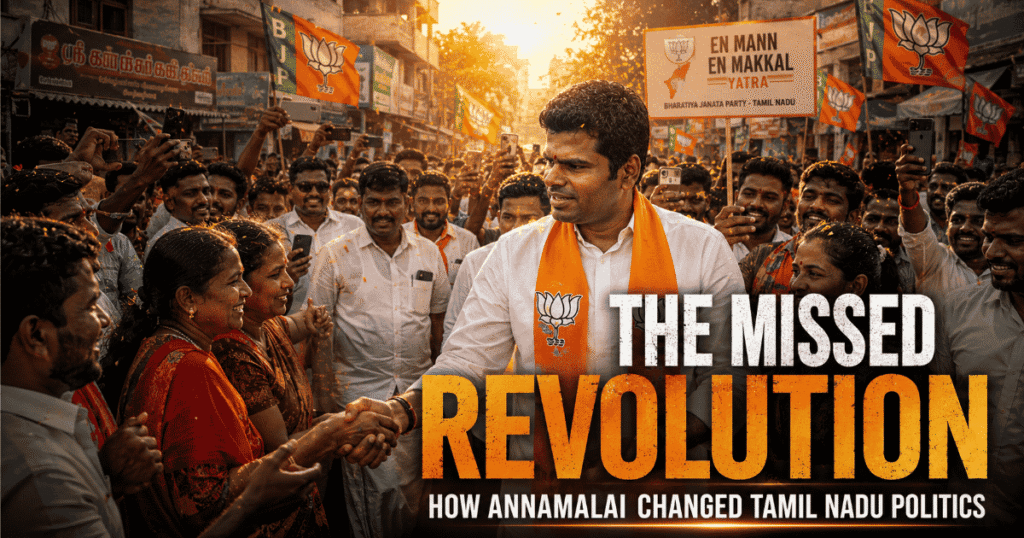
Before Annamalai’s arrival, the BJP in Tamil Nadu was widely viewed as a marginal force with limited grassroots penetration. Despite being nationally dominant, the party struggled to establish a strong independent identity in the state.
Annamalai changed that perception.
A former IPS officer with an aggressive communication style, he brought energy, confrontation, and clarity to the BJP’s Tamil Nadu strategy. More importantly, he understood that the political space in Tamil Nadu was changing. He recognized that voters were no longer satisfied with the traditional binary between the DMK and AIADMK.
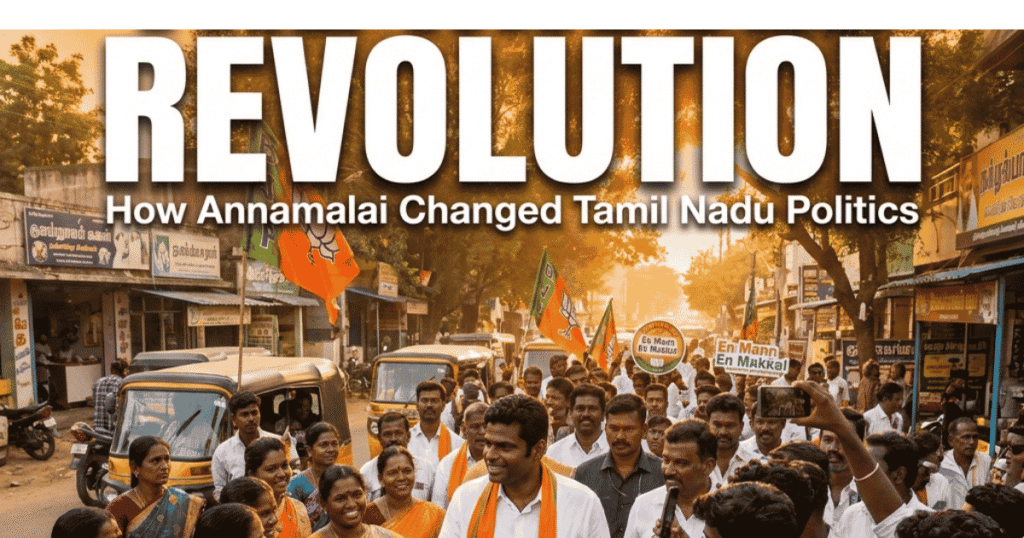
Through his “En Mann En Makkal” yatra, Annamalai connected directly with ordinary voters across the state. His speeches focused not only on attacking the DMK government but also on exposing what he described as the failures and compromises of the AIADMK leadership.
This was a significant strategic shift.
Unlike previous BJP leaders in Tamil Nadu, Annamalai was not interested in permanently remaining a junior ally under the shadow of Dravidian parties. He envisioned the BJP as an independent alternative capable of eventually replacing one of the two dominant Dravidian formations.
For the first time, sections of Tamil Nadu’s youth began viewing the BJP not merely as a “North Indian party,” but as a potential anti-establishment force within Tamil Nadu itself.
Understanding Annamalai’s Political Calculation
Many observers misunderstood Annamalai’s aggressive criticism of the AIADMK. They interpreted it as personal rivalry or unnecessary confrontation. In reality, it was part of a larger political calculation.
Annamalai believed that the BJP could never expand meaningfully in Tamil Nadu if it continued functioning as a subordinate ally of the AIADMK. Every alliance election strengthened the AIADMK while limiting the BJP’s independent growth.
His strategy was rooted in a long-term vision.
He aimed to create a three-cornered political contest in Tamil Nadu where the BJP would emerge as the primary challenger to the DMK. This required dismantling the AIADMK’s hold over anti-DMK voters and convincing the electorate that the BJP represented a new political culture.
In many ways, Annamalai’s approach resembled the BJP’s expansion strategy in states like West Bengal and Tripura, where the party gradually replaced existing regional forces rather than permanently remaining an alliance partner.
Whether or not the strategy would have succeeded immediately is open to debate. However, one thing became increasingly clear: Annamalai was generating political momentum.
The BJP cadre was energized. Social media engagement exploded. Young professionals and first-time voters began discussing the BJP more seriously than at any point in Tamil Nadu’s recent political history.
Then came the turning point.
The BJP’s Strategic Retreat
In April 2025, the BJP leadership replaced Annamalai with Nainar Nagendran as Tamil Nadu BJP President.
The decision shocked party workers and political observers alike.
Officially, the move was presented as an organizational adjustment designed to strengthen alliances and improve electoral coordination. Unofficially, however, it was widely viewed as an attempt to repair relations with the AIADMK.
The AIADMK leadership had long been uncomfortable with Annamalai’s aggressive attacks. Sections within the BJP’s national leadership reportedly believed that maintaining a stable alliance with the AIADMK was electorally safer than pursuing Annamalai’s high-risk independent strategy.
This reflected a classic political dilemma: short-term security versus long-term expansion.
The BJP leadership chose security.
But the consequences were immediate.
The aggressive anti-establishment energy that Annamalai had cultivated began fading. The BJP once again appeared to be slipping into the familiar role of a junior ally dependent on Dravidian politics for relevance.
The perception of the BJP as a rising independent force weakened dramatically.
More importantly, the political vacuum that Annamalai had attempted to occupy suddenly became available.
Vijay Recognizes the Opportunity
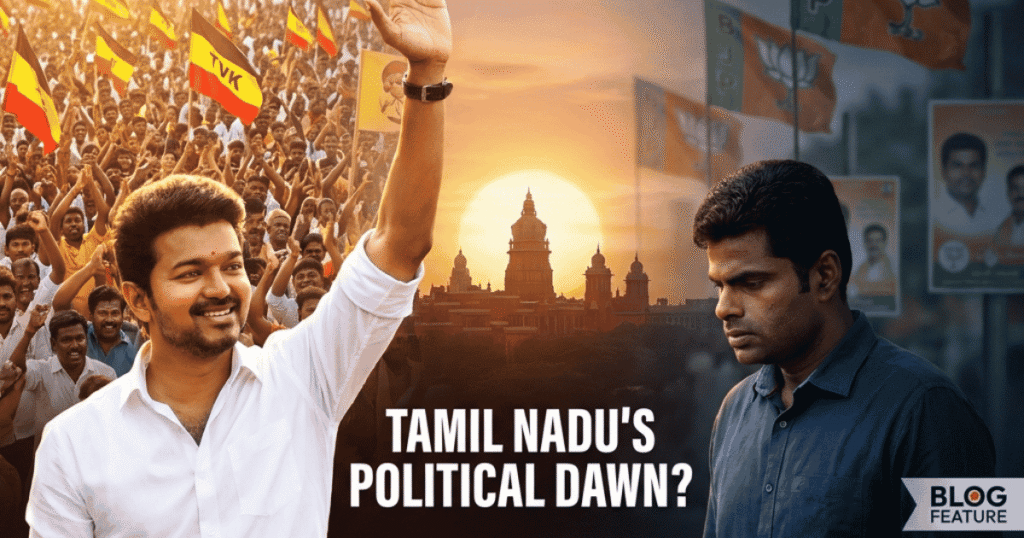
Joseph Vijay entered politics at precisely the right moment.
For years, speculation surrounded Vijay’s political ambitions. His films increasingly carried political undertones, often criticizing corruption, governance failures, and political elitism. His fan clubs had evolved into sophisticated grassroots networks capable of mobilization.
But timing matters in politics.
Had Vijay entered the political arena during a period of strong AIADMK leadership or during Annamalai’s aggressive BJP expansion phase, his rise might have been far more difficult.
Instead, he entered when Tamil Nadu voters were actively searching for a fresh alternative.
The DMK was facing anti-incumbency. The AIADMK was struggling with leadership issues. The BJP had diluted its independent positioning.
Vijay stepped directly into this vacuum.
Unlike traditional politicians, Vijay carried enormous cultural influence across caste, regional, and generational lines. His appeal extended beyond conventional party structures. He represented aspiration, celebrity power, youth appeal, and political novelty all at once.
His party, TVK, carefully positioned itself as neither aligned with the NDA nor with the INDIA bloc. This was politically crucial.
By maintaining equal distance from both national coalitions, Vijay projected himself as an entirely independent force capable of redefining Tamil Nadu politics.
The Collapse of Traditional Political Assumptions
One of the most striking aspects of the 2026 election was the collapse of several long-standing political assumptions.
For decades, analysts believed that Tamil Nadu’s political culture was structurally resistant to national parties. The BJP’s limited growth appeared to reinforce that belief.
However, the election results revealed something deeper: voters were not necessarily rejecting change—they were rejecting political irrelevance.
Annamalai had identified this transformation early.
He recognized that younger voters were increasingly issue-oriented rather than ideologically loyal to traditional Dravidian narratives. Topics like corruption, governance efficiency, transparency, employment, entrepreneurship, and leadership credibility were becoming more important.
Vijay successfully captured these sentiments.
Through carefully crafted messaging, social media outreach, youth engagement, and emotional connect, TVK transformed itself from a celebrity-led experiment into a serious political movement.
The BJP, meanwhile, appeared uncertain.
Its alliance adjustments created confusion among voters who had initially been attracted to Annamalai’s confrontational and independent politics.
In effect, the BJP abandoned the very political space it had begun to build.
Could the Outcome Have Been Different?
This question will likely haunt BJP strategists for years.
Would Vijay still have succeeded if Annamalai had remained BJP state president?
Possibly.
But the scale and direction of the election might have looked dramatically different.
Annamalai and Vijay were competing for overlapping voter segments:
- Young voters seeking change
- Urban middle-class voters frustrated with traditional politics
- First-time voters
- Anti-DMK voters looking for a credible alternative
- Politically neutral voters tired of established party structures
With Annamalai removed and the BJP appearing politically restrained, these voters gravitated toward Vijay almost uncontested.
In political terms, Vijay inherited the “alternative politics” narrative that Annamalai had spent years building.
The irony is striking.
Annamalai may have been the first major political leader in Tamil Nadu to openly challenge the inevitability of the Dravidian duopoly. Yet the political force that ultimately benefited from that challenge was not the BJP—but TVK.
The AIADMK’s Strategic Miscalculation
The AIADMK also bears responsibility for the transformation of Tamil Nadu politics.
By prioritizing short-term survival and attempting to weaken Annamalai’s rise within the BJP ecosystem, the AIADMK may have unintentionally accelerated its own decline.
The party underestimated the depth of voter dissatisfaction and overestimated the durability of traditional alliance arithmetic.
Instead of confronting a gradually expanding BJP under Annamalai, the AIADMK now faces a far more dangerous competitor in Vijay—a charismatic mass leader with enormous cultural reach and a rapidly growing political organization.
Unlike the BJP, Vijay does not carry ideological baggage in Tamil Nadu.
He is able to communicate directly with voters through the emotional language of cinema, youth identity, social justice rhetoric, and anti-establishment politics.
This makes him uniquely positioned to disrupt traditional caste and regional political calculations.
The Transformation of Tamil Nadu Politics
The 2026 election marks the beginning of a new political era.
Tamil Nadu is no longer defined solely by the DMK-AIADMK rivalry. The rise of TVK demonstrates that the electorate is willing to experiment with new leadership models when traditional parties fail to inspire confidence.
This does not necessarily mean the end of Dravidian politics overnight. The ideological and organizational structures built over decades remain powerful.
However, the monopoly of Dravidian parties over political imagination has clearly weakened.
The success of Vijay indicates that charisma, communication, digital outreach, and emotional connect can now rival traditional cadre-based politics.
It also reveals the growing importance of leadership perception in modern elections.
Voters increasingly prioritize authenticity, relatability, and decisiveness over rigid ideological frameworks.
Lessons for the BJP
For the BJP, Tamil Nadu 2026 offers several hard lessons.
First, regional political expansion requires patience and consistency. Building an independent identity in a state like Tamil Nadu cannot happen overnight, but sudden strategic reversals can destroy years of momentum.
Second, leadership matters.
Annamalai was not merely an organizational figure. He represented a psychological shift in how the BJP was perceived within Tamil Nadu. Replacing him at a critical moment disrupted that transformation.
Third, alliance politics can become a trap.
While alliances may provide short-term electoral gains, they can also prevent long-term ideological expansion and organizational independence.
Finally, political vacuums never remain empty for long.
If one political force fails to occupy a space, another inevitably will.
In this case, the BJP’s retreat created the perfect conditions for Vijay’s rise.
Vijay’s Real Challenge Begins Now
Winning an election is one thing. Governance is another.
As Vijay prepares to lead Tamil Nadu, expectations will be enormous. His supporters see him not merely as a politician but as the symbol of generational change.
That creates both opportunity and risk.
TVK must now transition from emotional mobilization to administrative delivery. The party will need to demonstrate competence in governance, economic management, welfare administration, industrial growth, law and order, and coalition-building.
Tamil Nadu’s political culture is highly sophisticated and politically aware. Charisma alone cannot sustain long-term power.
Still, Vijay has already achieved something historic.
He has shattered the assumption that only traditional Dravidian parties can dominate Tamil Nadu politics.
The Unfinished Story of Annamalai
Even in defeat, Annamalai’s political legacy remains significant.
He fundamentally altered the political conversation in Tamil Nadu. He demonstrated that voters were open to alternatives beyond the traditional Dravidian framework. He energised the BJP’s grassroots network and forced both allies and opponents to rethink their strategies.
Ironically, the success of Vijay may ultimately validate Annamalai’s original analysis.
Tamil Nadu was ready for change.
The BJP simply lost the political nerve to lead that transformation.
As the state enters a new chapter under Vijay’s leadership, political observers across India will closely study the events that led to this moment.
For many within the BJP, the central question will remain painfully simple:
What if Annamalai had been allowed to continue?
That question may define Tamil Nadu politics for years to come.
A Warning for BJP Kerala: Will History Repeat Itself?
The political lessons emerging from Tamil Nadu carry an even deeper warning for the BJP’s Keralam unit.
The just-concluded 2026 election cycle in Kerala has exposed a series of strategic blunders that have left many traditional BJP supporters deeply disappointed and politically confused. Much like the BJP leadership in Tamil Nadu failed to understand Annamalai’s long-term vision of building an independent ideological and political identity, sections of the BJP leadership in Keralam appear to have drifted into a strategy built excessively around short-term optics, artificial alliances, and confused messaging.
One of the most controversial aspects of the Keralam strategy was the so-called “Christian Outreach” campaign. While outreach to every community is a legitimate political exercise, many core BJP supporters in Kerala felt that the exercise crossed the line from outreach into political dependency and appeasement. The perception that the party leadership had become excessively aligned with sections of influential Christian bishops created unease among many Hindu voters who had long viewed the BJP as the only political platform willing to openly articulate Hindu concerns in Keralam.
This perception became even more damaging when combined with the BJP’s unexpected alliance with the T20 formation. The alliance puzzled even committed BJP workers.
T20 was not an established statewide political force. It was essentially a local-level organisation with influence restricted primarily to a couple of panchayats in Ernakulam district. Yet, despite lacking meaningful statewide political structure, ideological clarity, electoral history, or proven grassroots machinery, the alliance was elevated far beyond its actual political weight.
The allocation of 19 Assembly seats to such a formation was widely viewed by many BJP supporters as politically irrational and strategically disproportionate.
The criticism was not merely about seat-sharing arithmetic.
The deeper concern was symbolic.
Many BJP workers and Hindu voters began asking a fundamental question: why was the BJP compromising its political identity and organizational confidence in favor of alliances with groups lacking ideological commitment, electoral credibility, or statewide influence?
The comparison with Tamil Nadu becomes unavoidable here.
In Tamil Nadu, at least the BJP’s alliance calculations revolved around the AIADMK — a historically powerful and deeply entrenched Dravidian political force with decades of governance experience and a massive voter base.
In Keralam, however, the BJP leadership moved toward an alliance with a group that many observers argue could barely even be described as a conventional political party.
This is why many political observers believe that the strategic error committed in Kerala may actually have been greater than the one committed in Tamil Nadu.
The dissatisfaction among sections of Hindu voters in Keralam was also intensified by the BJP’s inability to effectively project issues that emotionally resonated with Hindu society. One major example frequently cited was the Sabarimala gold irregularity controversy and related allegations concerning the handling of temple assets and administration.
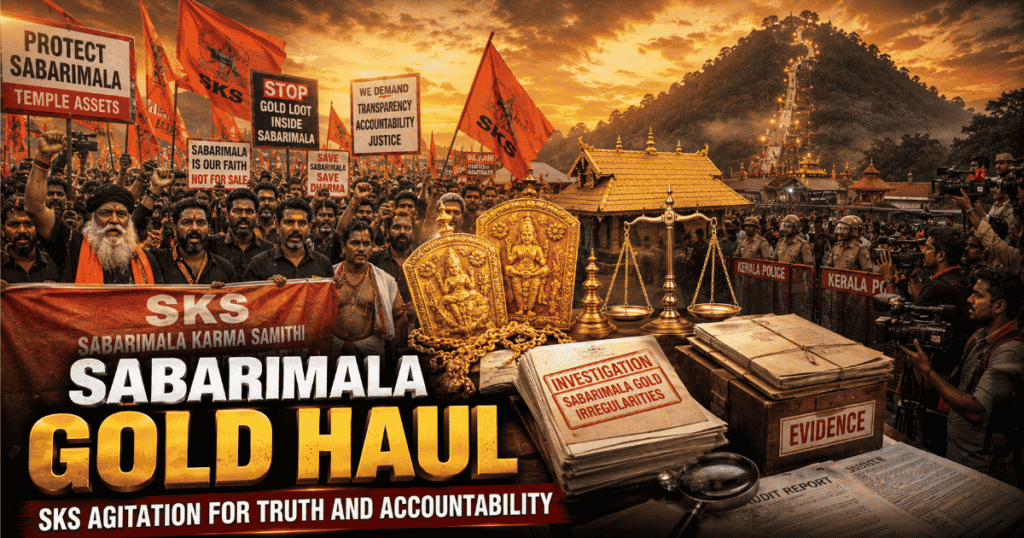
Many BJP supporters expected the party to aggressively raise such issues against the ruling CPI(M)-led government and position itself as the strongest political defender of temple interests, faith traditions, and Hindu concerns.
Instead, critics argue that the issue was not projected with the intensity, clarity, and consistency that many supporters expected.
This created a vacuum.
And political vacuums rarely remain empty.
The larger concern emerging from both Tamil Nadu and Keralam is therefore much bigger than a single election result.
It is about political representation.
In Tamil Nadu, the inability of the BJP leadership to trust Annamalai’s independent expansion strategy created the conditions for Vijay and TVK to emerge as the principal alternative force.
The question now being quietly asked in Keralam political circles is whether a similar situation could eventually emerge there as well.
If sections of Hindu society in Keralam increasingly begin to feel politically unrepresented, ideologically neglected, or strategically abandoned, will they eventually start looking for a completely new political platform capable of articulating their concerns more directly and confidently?
That question, once considered unthinkable, is now slowly entering mainstream political discussion.
The rise of Vijay in Tamil Nadu demonstrates that when established political parties fail to understand changing public sentiment, entirely new political forces can emerge with astonishing speed.
For the BJP in Keralam, the warning signs are already visible.
The party still possesses organizational strength, committed cadre support, and ideological presence in the state. But unless it clearly defines its independent political identity, rebuilds trust among its traditional support base, and avoids strategic confusion driven by opportunistic alliances, it risks repeating the very mistakes that altered the political landscape in Tamil Nadu.
The lesson from 2026 is therefore not merely about Vijay’s victory.
It is about what happens when political leadership fails to recognise the aspirations, emotions, and expectations of its own natural support base.
Tamil Nadu has already witnessed the consequences.
Keralam may now be approaching a similar crossroads.
There is also a deeper and more direct political warning that cannot be ignored.
When the aspirations, emotions, and expectations of the majority support base of a political party are repeatedly neglected, and when that party begins reshaping its political strategies primarily around appeasing other opposing groups or communities, a dangerous political vacuum begins to emerge.
History shows that committed ideological supporters may tolerate temporary compromises, tactical alliances, and electoral adjustments for some time. But when they increasingly begin to feel politically alienated, ignored, or taken for granted, frustration gradually transforms into the search for a new political voice.
That is precisely the political process that unfolded in Tamil Nadu.
A large section of voters who were looking for an assertive, independent alternative eventually shifted toward a completely new political formation because they believed the existing political structures were no longer reflecting their aspirations.
The BJP in Keralam must therefore recognise that political loyalty cannot be sustained indefinitely without emotional and ideological confidence.
If the party’s core support base increasingly feels that its concerns are being diluted, sidelined, or sacrificed for temporary alliance politics and community appeasement strategies, there is every possibility that Kerala too may eventually witness the rise of a completely new political formation with mass support.
The emergence of Vijay and TVK in Tamil Nadu should not merely be viewed as an isolated regional development. It should be studied as a political warning.
Political vacuums are eventually filled.
When established parties fail to represent the sentiments of their natural support base with clarity and confidence, new movements and new leaders inevitably emerge to occupy that space.
The BJP leadership in Keralam therefore faces a critical choice.
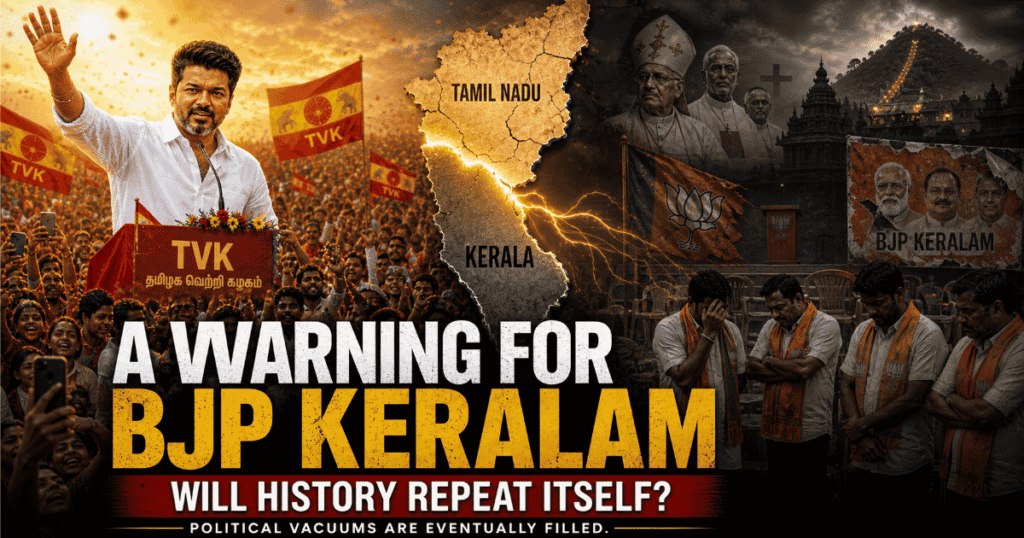
It can either reconnect with the concerns, sentiments, and ideological expectations of its primary support base and recalibrate its political strategy accordingly, or continue down a path that risks deeper alienation and long-term political consequences.
Tamil Nadu has already demonstrated what can happen when strategic miscalculations collide with public dissatisfaction.
Kerala would be wise not to ignore that lesson.
Read more: Vijay’s Victory: The Price of Sidelining Annamalai