Introduction
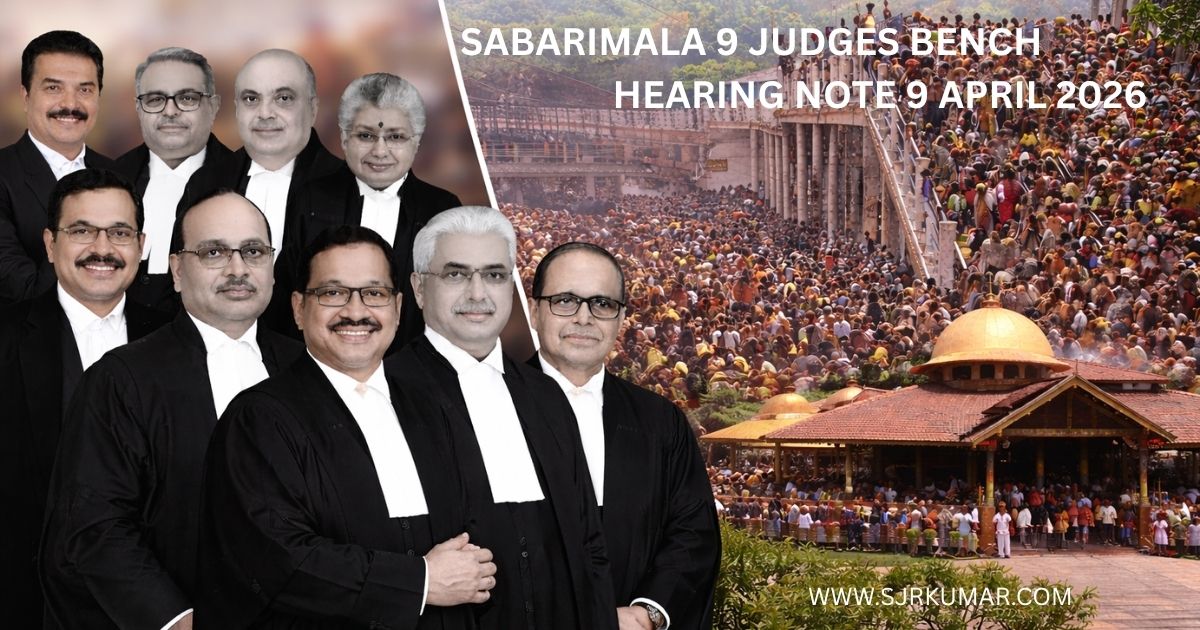
The proceedings before the nine-Judge Constitution Bench of the Supreme Court of India on April 9, 2026, continued the extensive hearing in the Sabarimala Review Petition. The case raises fundamental constitutional questions regarding the entry of women into the Sabarimala Temple and the interpretation of religious freedom under Articles 25 and 26 of the Constitution of India.
At the core of the debate lies the delicate balance between individual rights and denominational autonomy, alongside broader questions concerning judicial review, essential religious practices, and the meaning of morality within the constitutional framework. The submissions made on this day by the Union of India and senior advocates for the review petitioners explored these issues in depth.
Background of the Hearing
Continuation of the Sabarimala Review Proceedings
The nine-Judge Constitution Bench continued hearing the matter concerning:
- Entry of women into the Sabarimala Temple
- Interpretation of Articles 25 and 26
Central Constitutional Issue
The key issue before the Court is:
- Balancing individual rights under Article 25(1)
- With denominational autonomy under Article 26
- Including whether Sabarimala qualifies as a religious denomination
Counsel Appearing
Submissions were advanced by:
- K.M. Nataraj
- Vikramjit Banerjee (for the Union of India)
- Senior Advocates including C.S. Vaidyanathan (for review petitioners)
Core Constitutional Framework: Articles 25 and 26
Interconnected Nature of Rights
It was submitted that the controversy stems from a misunderstanding of the relationship between Articles 25 and 26.
Key Arguments
- These provisions are not competing
- They are structurally interconnected
- They must be harmoniously construed
Scope of Each Provision
Article 25(1)
- Protects individual freedom of conscience
- Guarantees right to profess, practice, and propagate religion
Article 26
- Protects collective rights of religious denominations
Article 25(2)
- Enables State intervention in:
- Secular aspects of religion
- Social reform
Three-Tier Constitutional Structure
The Additional Solicitor General described a three-tier mechanism:
First Tier
- Article 25(1): Individual freedom
Second Tier
- Article 26: Denominational autonomy
Third Tier
- Article 25(2): State regulation and reform
This structure ensures a balance between:
- Individual rights
- Collective rights
- State authority
Judicial Interpretation and Bench Observations
Is Article 26 a Subset of Article 25?
The Court raised whether Article 26(b) is a subset of Article 25(1).
Response
- Article 26 is not a subset
- It is an offshoot of collective exercise of individual rights
Bench Observation
- Article 25 is broader
- Article 26 is narrower and focused on management
Both were described as:
- Two facets of the same constitutional guarantee
Scope of Religious Freedom
Internal and External Dimensions
It was argued that Article 25(1) protects:
- Internal belief
- External manifestation
Includes
- Rituals
- Customs
- Modes of worship
Judicial Restraint
Courts must:
- Avoid imposing external standards
- Exercise restraint in determining essential practices
Relationship Between Individual and Collective Rights
“Atomic Molecules” Analogy
The Additional Solicitor General described:
- Individuals as “atomic molecules”
- Which form a Sampradaya
Key Argument
- Once formed, collective rights gain importance
- Individual dissent cannot dismantle denominational practices
Recognition in Constitution
- Collective rights exist in:
- Religious minorities
- Linguistic groups
Conflict Resolution Framework
Types of Conflicts
- Between believers and denominations
- Between believers and non-believers
- Between State and religion
Suggested Approach
- Use harmonious construction
- Prefer evidentiary adjudication over abstract constitutional rulings
Autonomy Under Article 26(b)
Distinct Constitutional Position
It was emphasized that:
- Article 26(b) is not expressly subject to other provisions
- Unlike Article 25(1)
Implication
- Denominational autonomy must carry substantial weight
Scope of Autonomy
- Determination of essential religious practices
- Management of religious affairs
Limits on Judicial and Legislative Interference
Core Submission
- Courts and legislature cannot determine essential practices
Exception
- Only allowed on grounds of:
- Public order
- Morality
- Health
Concept of Sampradaya and Denomination
Indian Context of “Denomination”
It was argued that:
- “Denomination” should be understood as Dharma Sampradaya
Characteristics
- Tradition
- Customs
- Teachings
- Lineage
No Need for Formal Structure
- Even small groups can qualify
“Any Section Thereof”
- Protects smaller segments within broader traditions
Critique of the Triple Test
Judicial Tests Challenged
The “triple test” from:
- Shirur Mutt case
- S.P. Mittal case
Key Criticism
- Based on Abrahamic frameworks
- Inapplicable to Indian plural traditions
Hinduism Characterised As
- Non-monolithic
- Collection of multiple Sampradayas
Illustrative Examples of Sampradayas
Examples cited:
- Varkari Sampradaya
- Ramanandi Sampradaya
Key Point
- Lack centralized structure
- Still possess distinct identities
Judicial Inconsistency Highlighted
- Lingayats
- Jains
- Ramakrishna Mission
Fundamental Nature of Denominational Rights
Reliance on Ratilal Case
It was argued that:
- Denominational rights are fundamental
- Cannot be taken away by the State
Authority to Determine Practices
- Lies with the religious community
- Not with courts
Scope of Article 25(2)(b)
Nature of the Provision
- Enabling provision
- Not a fundamental right
Limitations
- Cannot override Article 26
Purpose
- Address caste-based exclusion
- Linked to Article 17
Key Argument
- Not intended for gender-based reform
Constitutional Scheme of Equality vs Religion
Anti-Discrimination Provisions
- Articles 14, 15, 16
Religious Freedom Provisions
- Articles 25 to 28
Key Distinction
- Article 25 lacks explicit anti-discrimination language
Additional Points
- Article 15(2) does not mention temples
- Article 16(5) allows religious qualifications
Religious Institutions and Secularism
Reliance on Seshammal Case
It was argued that:
- Religious institutions are not purely secular
- Religious functions require religious criteria
Meaning of Morality
Public Morality vs Constitutional Morality
Submission
- “Morality” in Articles 25 and 26 means:
- Public morality
Not
- Constitutional morality
Basis
- Constituent Assembly Debates
Illustrations on Limits of Individual Rights
Examples Provided
Temple Practices
- Cannot demand non-vegetarian food in vegetarian temples
- Cannot object to liquor as prasadam
Key Argument
- Individual rights cannot alter denominational practices
Gender-Based Religious Practices
Examples Cited
- Temples where men are not permitted
- Temples requiring men to wash women’s feet
- Temples where men dress as women
Conclusion
- Differentiation ≠ discrimination
Critique of 2018 Judgment
Main Argument
- Based on incorrect assumption of gender superiority
Correct Basis
- Rooted in:
- Naishtika Brahmachari nature of the deity
Arguments by Senior Advocate C.S. Vaidyanathan
Guruvayur Temple Example
- Men must remove shirts before entry
Bench Observation (Justice B.V. Nagarathna)
- Not comparable to Sabarimala restriction
Response
- Must consider:
- Purpose
- Manifestation of the deity
Impact of Broad Interpretation of Article 25(2)(b)
Warning
- Would render Article 26 redundant
Key Argument
- Would destroy denominational autonomy
Judicial Restraint in Religious Matters
Examples from Christian Disputes
- Orthodox vs Jacobite conflicts
Submission
- Courts should avoid theological adjudication
Conclusion of Submissions
The submissions emphasized that:
- Religious freedom is intrinsic to life and liberty
- Indian secularism means non-interference
- Denominational autonomy must be preserved
- Articles 25 and 26 must be harmoniously interpreted
- Public morality is the governing standard
- Courts must adopt restraint in religious matters
Final Thought
The April 9, 2026 hearing further deepens the constitutional dialogue on the intersection of faith, autonomy, and rights. By advocating a harmonized interpretation of Articles 25 and 26 and emphasizing the primacy of denominational autonomy, the submissions challenge the judiciary to reconsider the limits of its role in religious matters.
As the Constitution Bench continues its deliberations, the outcome of this case is poised to redefine the contours of religious freedom and secularism in India for generations to come.