Table of Contents
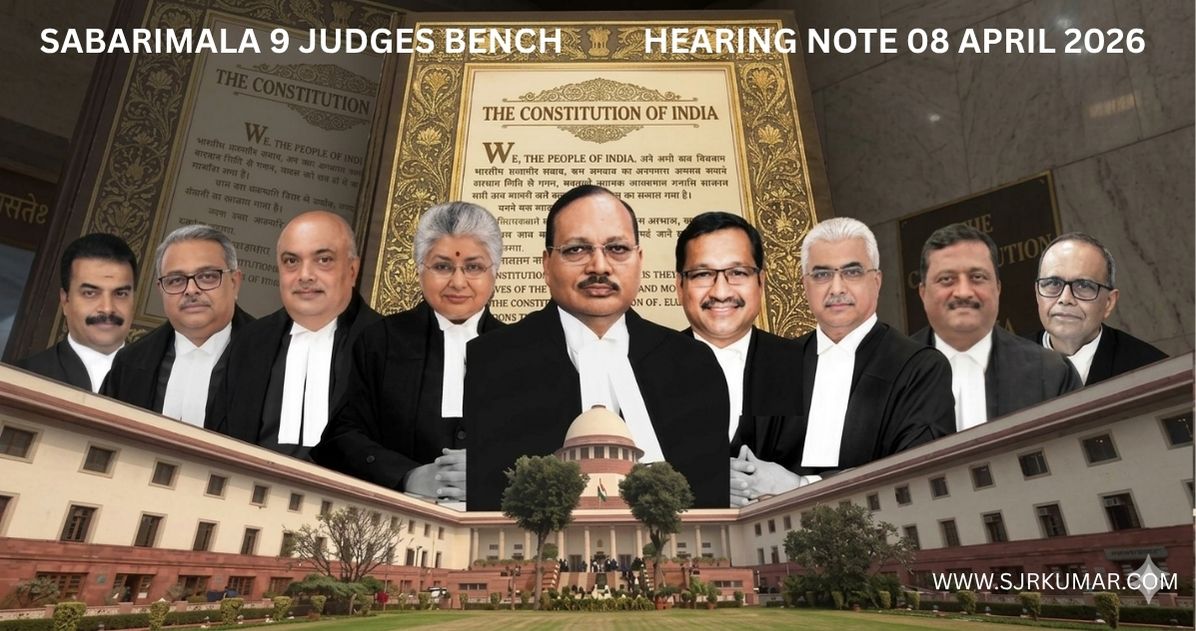
- Sabarimala Case 2026 – Members of the 9-Judge Bench
- The Sabarimala Hearing: A Critique of the Essential Religious Practices Doctrine
- The Judicial Role: Theological Arbiter or Legal Interpreter?
- Protecting Denominational Autonomy Under Article 26
- Temple Administration: The Role of Agamas and Priesthood
- Defining a “Religious Denomination”
- Constitutional Morality vs. Public Morality
- The Danger of Judicial Overreach and Foreign Frameworks
- A New Standard: “Sincerity of Belief”
- Final Thoughts: Balancing Tradition and the Constitution
- Sabarimala Case—Supreme Court Recorded Live Streaming – 8 April 2026
Sabarimala Case 2026 – Members of the 9-Judge Bench
- The bench consists of the following justices:
- Chief Justice Surya Kant (Presiding)
- Justice B.V. Nagarathna
- Justice M.M. Sundresh
- Justice Ahsanuddin Amanullah
- Justice Aravind Kumar
- Justice Augustine George Masih
- Justice Prasanna B. Varale
- Justice R. Mahadevan
- Justice Joymalya Bagchi
The Sabarimala Hearing: A Critique of the Essential Religious Practices Doctrine
On 8th April 2026, the nine-judge Constitution Bench of the Supreme Court of India convened for a landmark hearing on the Sabarimala case. Solicitor General Tushar Mehta presented a comprehensive critique of the Essential Religious Practices (ERP) doctrine, arguing for a significant shift in how the judiciary engages with matters of faith under Articles 25 and 26 of the Constitution (p. 1).
The Judicial Role: Theological Arbiter or Legal Interpreter?
The Solicitor General opened by tracing the evolution of the ERP doctrine. He identified a “pivotal departure” in the Durgah Committee Ajmer case, where the Court began distinguishing between “genuine” practices and “superstitious accretions” (p. 1).
Mehta argued that secular courts lack the institutional competence to determine what is “superstitious.” He emphasized that a practice appearing as superstition to one person may be a core belief for another, and judicial scrutiny based on modern sensibilities forces courts to act as “theological arbiters”—a role they are not constitutionally mandated to fill (p. 1).
Protecting Denominational Autonomy Under Article 26
A central pillar of the submissions was the independence of Article 26(b), which grants religious denominations the right to manage their own affairs (p. 2). Mehta contended that:
- This is a standalone right subject only to public order, morality, and health (p. 2).
- It should not be automatically overridden by the social reform provisions of Article 25(2)(b) (p. 2).
- While advocating for harmonious construction to avoid “fragmentation of religion,” the autonomy of the denomination must remain meaningful (p. 2).
Temple Administration: The Role of Agamas and Priesthood
The hearing delved into the nature of priesthood, specifically the appointment of Archakas. The Solicitor General challenged the distinction between the “office” of a priest (as secular) and their “service” (as religious) (p. 2).
- Agamic Prescriptions: He argued that the appointment of priests is a religious matter governed by Agamas (temple manuals).
- Defilement of the Deity: Mehta warned that state intervention in these appointments could result in the “defilement” of the deity according to religious laws and risks eroding the autonomy of religious heads like Shankaracharyas (pp. 2-3).
Defining a “Religious Denomination”
The Solicitor General critiqued the rigid “triple test” from the S.P. Mittal case, which requires a common faith, organization, and name (p. 3). He argued:
- This framework ignores the fluid nature of Indian devotion, citing inclusive spaces like the Dargah of Nizamuddin Auliya (p. 3).
- Ayyappa Devotees: He asserted that Sabarimala devotees constitute a denomination because of their shared belief in the Naishtika Brahmachari (celibate) nature of the deity, regardless of formal organizational structures (p. 3).
Constitutional Morality vs. Public Morality
A major point of contention was the use of “constitutional morality” to invalidate religious traditions (p. 3).
- Mehta argued that “morality” in Article 25 refers to public morality, not an abstract, evolving judicial standard (p. 4).
- He cautioned that constitutional morality should be a “shield for pluralism” rather than a tool to enforce secular uniformity over diverse traditions (p. 4).
- He specifically noted that the exclusion of women at Sabarimala is based on the nature of the deity, not on birth-based “untouchability” covered under Article 17 (pp. 3-4).
The Danger of Judicial Overreach and Foreign Frameworks
The Solicitor General criticized the court’s reliance on academic writings (e.g., Catherine MacKinnon) and foreign jurisprudence (p. 5).
- He argued that substituting indigenous legal reasoning with theoretical frameworks risks destabilizing cultural foundations (p. 5).
- He urged the Court to resist the temptation to act as social reformers, a role the Constitution explicitly assigns to the legislature under Article 25(2)(b) (pp. 5-6).
A New Standard: “Sincerity of Belief”
In his concluding remarks, the Solicitor General proposed a procedural shift (p. 6):
- Replace ERP with “Sincerity of Belief”: Courts should only assess if a belief is genuinely held, not its doctrinal correctness (p. 6).
- Evidentiary Determination: Religious essentiality should be decided in civil suits with expert testimony, not through Article 32 writ proceedings (pp. 5-6).
- PIL Restraint: He questioned the maintainability of PILs filed by “strangers” to a denomination, arguing they undermine religious autonomy (p. 6).
Final Thoughts: Balancing Tradition and the Constitution
The April 2026 hearing in the Sabarimala case highlights a profound tension at the heart of Indian constitutional law: How does a modern, secular state respect ancient religious autonomy?
The Solicitor General’s arguments signal a push for judicial restraint. By advocating for a shift from the “Essential Religious Practices” doctrine toward a “Sincerity of Belief” standard, the government is essentially asking the Courts to step back from being “theological arbiters.” If the Court adopts this view, it would represent a major victory for denominational autonomy, suggesting that the power to reform religion belongs to the legislature and the community, rather than the bench.
However, the challenge remains—can a practice that conflicts with modern standards of gender equality be protected under the banner of “pluralism”? As the nine-judge bench deliberates, the outcome will not just decide the rules for one temple, but will redefine the very meaning of secularism and “constitutional morality” in 21st-century India.
What are your thoughts? Should the courts have the power to “purify” religious traditions, or should the “sincerity of belief” be the ultimate shield? Let us know your valuable comments.
Sabarimala Case—Supreme Court Recorded Live Streaming – 8 April 2026
Know More About Sabarimala Customs, Rituals & Practices…