Introduction: A Lifetime of Vigilance
The term “Love Jihad” has often been dismissed by critics as a conspiracy theory, yet the mounting evidence from both rural heartlands and high-tech corporate corridors tells a far more harrowing story. For those of us who have stood by grieving parents and navigated the labyrinth of stalled investigations, it is not a theory—it is a systematic reality that demands immediate national attention.
For decades, I have stood at the crossroads of a silent crisis that has torn apart the fabric of countless families across India. My journey into the heart of this issue began not with statistics, but with the faces of grieving parents—parents like Mr. Ashokan and Ponnamma and Ms. Bindu, whose daughters Akhila and Nimisha became the human faces of a phenomenon that many in power chose to ignore.
During my tenure as the State President of the Vishva Hindu Parishad (VHP), I witnessed firsthand the “Love Jihad” mechanism—a systematic targeting of our daughters that transcends simple faith and enters the realm of organized crime and radicalization. Despite my best efforts to initiate action, the greatest hurdle was always the same: a state administration and police force in Kerala that appeared paralyzed by political interests, often providing a shield for fundamentalists rather than justice for victims.
But the battle has shifted. No longer confined to the rural heartlands, this predatory cycle has now breached the gates of our most prestigious institutions. The recent, shocking revelations concerning a “grooming gang” within a corporate giant like TCS in Nashik prove that the threat is evolving, infiltrating even the high-tech workspaces of our youth.
In this article, I will connect these dots—from the hard-fought cases in Kerala to the new corporate frontier in Nashik. I will share insights from my years on the front lines, expose the “saviours” who secretly betray our cause, and lay out a clear mandate for the Union Government to enact the stringent national laws we so desperately need.
The time for silence is over; the time for national accountability has arrived.
Understanding the New Frontier: The TCS Nashik Case
Recent reports have sent shockwaves through the corporate world, highlighting a grooming gang operating within a branch of Tata Consultancy Services (TCS) in Nashik. This incident serves as a wake-up call, proving that no environment, regardless of its “POSH” (Prevention of Sexual Harassment) policies or corporate prestige, is immune to radicalization.
The Modus Operandi of Corporate Love Jihad
In the Nashik case, the pattern is eerily familiar to those of us who have studied these incidents for decades. Vulnerable women—often from financially weaker backgrounds or facing personal hardships—are targeted by individuals in positions of supervisory authority.
- Exploitation of Authority: Predators use their corporate standing to coerce victims.
- Systematic Radicalization: The goal extends beyond harassment to forced religious conversion through trauma and exploitation.
- Failed Safeguards: Despite being India’s largest software firm, the internal checks and balances at TCS failed to protect these women until the situation reached a breaking point.
A Legacy of Struggle: The Cases of Nimisha and Akhila
My journey with this issue began long before it reached the corporate offices of Nashik. I recall the heart-wrenching cases of Nimisha from Thiruvananthapuram and Akhila from Vaikkam.
Nimisha, the daughter of Ms. Bindu, and Akhila (later known as Hadiya), the daughter of Mr. Ashokan, represent the human face of this crisis. In both instances, I witnessed firsthand the agony of parents who felt helpless as their daughters were drawn into webs of radicalization. These families didn’t just lose their daughters to a different faith; they lost them to ideologies that often lead to further exploitation and, in some cases, international conflict zones.
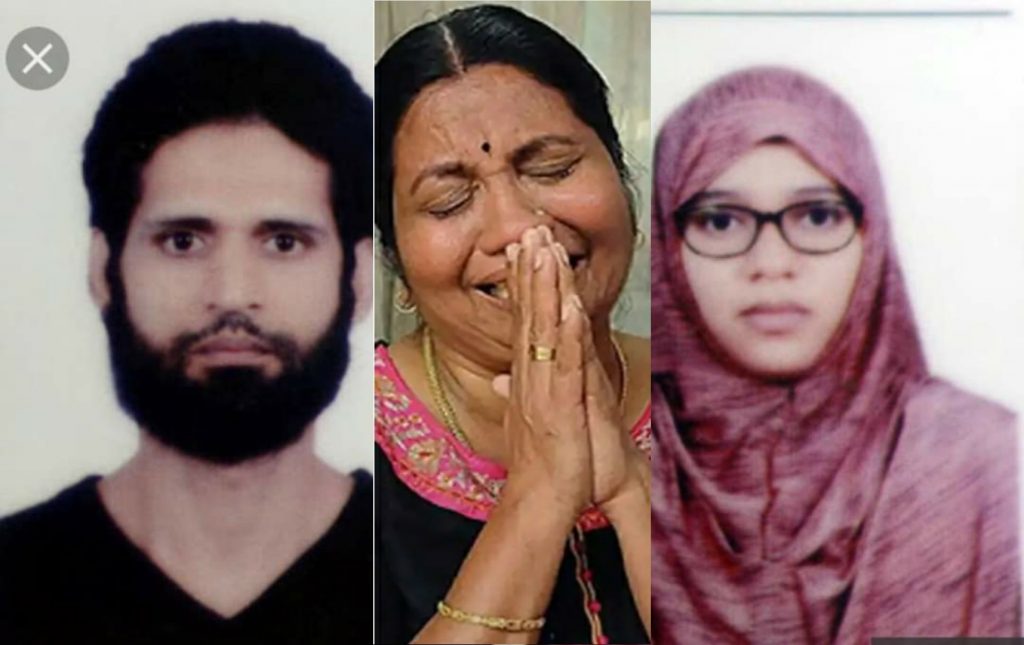
From Kerala to Kabul: How “Love Jihad” Led Nimisha Fathima into the Heart of ISIS
Nimisha Fathima (also known as Fatima), an Indian woman from Kerala who joined ISIS, was released from an Afghan jail following the Taliban’s takeover of Kabul in August 2021. Since her release, her exact whereabouts remain unknown, and she is currently considered untraceable.
Background and Detention
- Surrender: Nimisha and her young daughter surrendered to Afghan forces in 2019 along with a group of 400 others after her husband, an ISIS fighter, was killed in a US airstrike.
- Imprisonment: She was held in a Kabul prison for several years. During this time, the Afghan government offered to deport her and other Indian women back to India.
Current Status
- Release: On August 15, 2021, during the chaotic Taliban takeover, prisoners were released from Afghan jails. Nimisha and her daughter were among those freed.
- Safety Concerns: Her mother has expressed deep fears that Nimisha and her granddaughter may have fallen into the hands of the Taliban or other radical groups.
- Latest Reports: As of mid-2024, there are no verified official reports confirming her current location or safety.
Lured, Converted, and Isolated: The Persistent Tragedy of Akhila’s Radicalisation
As of 2026, the status of Akhila Ashokan (known as Hadiya) remains a subject of ongoing legal and family disputes, primarily driven by her father’s persistent claims that she remains under the influence of extremist elements.
Current Legal Status and Disappearance Claims
- Missing Person Case: In late 2023, her father, K.M. Ashokan, filed a fresh habeas corpus petition in the Kerala High Court, claiming he could not trace or contact her for over a month.
- Remarriage and Separation: Hadiya reportedly released a video statement confirming she has divorced her first husband, Shafin Jahan, and has remarried. She accused her father of using legal mechanisms to harass her and maintained that she is living her life by her own choice.
Historical Context of the “Love Jihad” Case
- Supreme Court Ruling (2018): The Supreme Court of India famously overturned the Kerala High Court’s annulment of her marriage, stating that as a 24-year-old adult, Hadiya had the absolute right to choose her religion and spouse.
- NIA Investigation: While the court restored her marriage, it allowed the National Investigation Agency (NIA) to continue probing the “criminal dimensions” of the conversion, though the final court judgment did not find evidence of forced recruitment in her specific case.
While Hadiya herself asserts her independence and religious choice, her family and certain organizations continue to frame her situation as a prime example of a woman trapped by radicalisation.
The Administrative Hurdle: The Kerala Context
During my tenure as State President of the VHP, the greatest obstacle was not a lack of evidence, but a lack of political will. In Kerala, the police force often appears hamstrung by the policies of state governments that cater to fundamentalist interests.
Investigations into these crimes are frequently downplayed or categorized as “isolated incidents” to maintain a veneer of secularism. This systemic apathy emboldens perpetrators, creating a “safe haven” for those who wish to carry out these heinous acts under the guise of romantic freedom.
The Need for Stringent Central Legislation
The time for state-level debate has passed; we need a unified, stringent central law to eliminate Love Jihad.
Proposed Legislative Framework
- Mandatory Reporting: Any organization, including corporate entities, must report allegations of grooming or forced conversion to a central agency.
- Special Courts: Expedited trials for cases involving organized grooming gangs to ensure victims see justice within months, not decades.
- Severe Penalties: Life imprisonment for perpetrators and significant financial penalties for institutions that fail to maintain oversight.
- Protection for Families: Legal and financial support for the parents of victims, ensuring they are not silenced by expensive legal battles.
A Warning to the “Saviours”
To the Hindu community, I must issue a word of caution. Not everyone who claims to be a “saviour” of our cause is acting in our best interests. I have observed certain individuals who talk loudly about Hindu rights while quietly providing cover for these very criminals.
The betrayal from within is often more dangerous than the threat from without. I will be making specific, surprising disclosures regarding these “double agents” in the near future. Accountability must begin at home.
Final Thoughts on Corporate Love Jihad
The incidents we see today, from the quiet villages of Kerala to the bustling BPO centres of Nashik, are part of a larger, coordinated effort to destabilise our social fabric. We cannot afford to remain in denial. As a society, we must demand that the Union Government take decisive action. We owe it to the Nimishas and Akhilas of the world to ensure that no more daughters are lost to this predatory cycle. Justice is not a request; it is a necessity for national security.