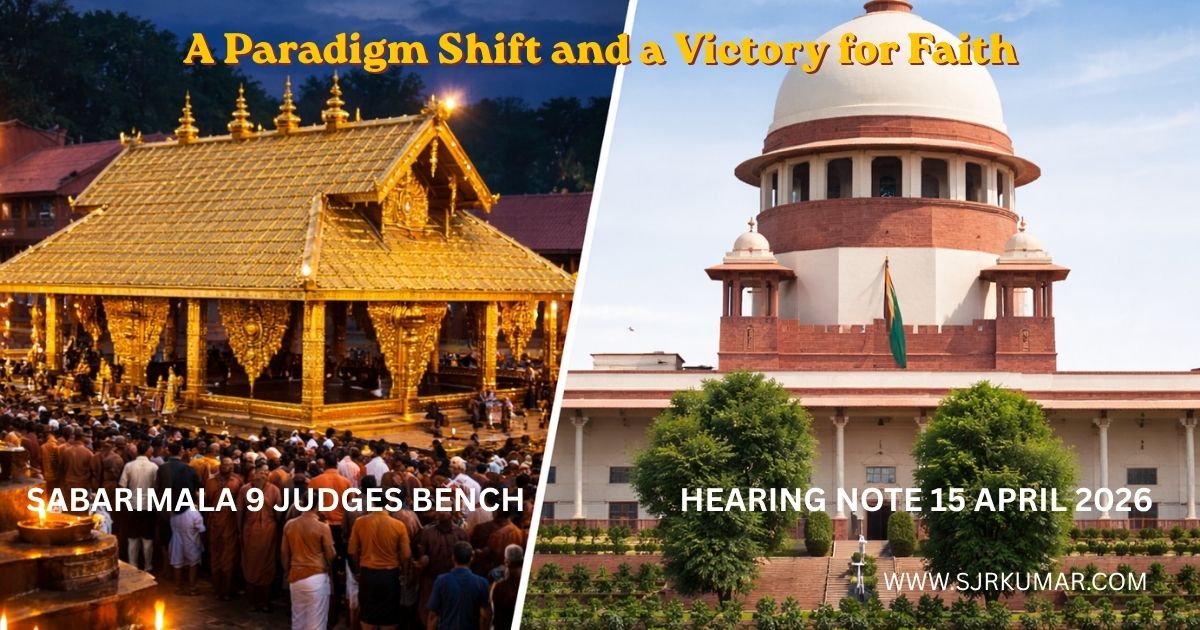
Introduction: A Paradigm Shift and a Victory for Faith
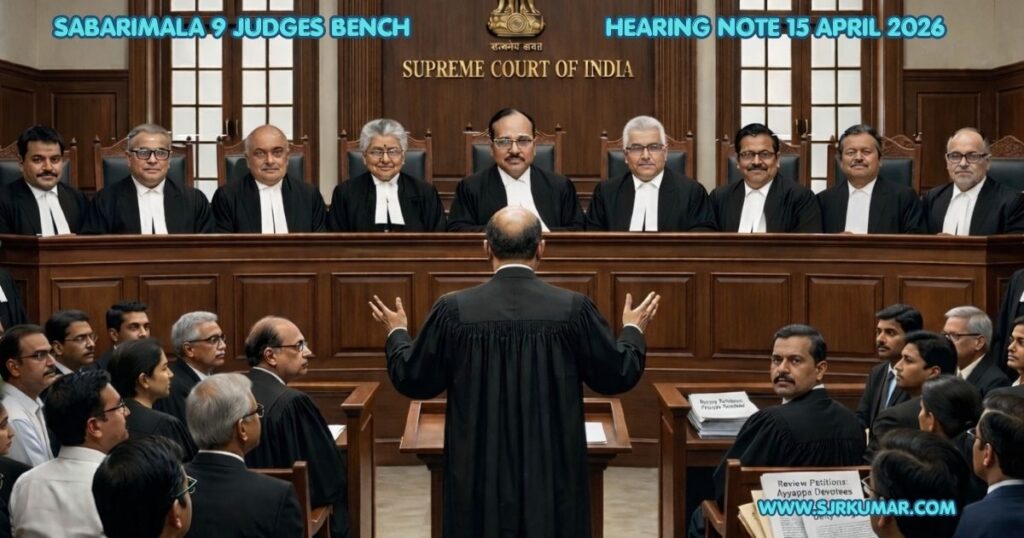
The proceedings before the Hon’ble 9-judge bench of the Supreme Court of India on April 15, 2026, marked a watershed moment in the legal history of religious freedom in India. In a dramatic and welcome reversal of its previous stance, the Travancore Devaswom Board, represented by the eminent Senior Advocate Dr. Abhishek Singhvi, moved to robustly defend the ancient Sabarimala temple traditions.
This shift is not merely a legal maneuver; it is a profound recognition of the “mass of rights” held by the devotees of Lord Ayyappa. Following the 2018 judgment, the landscape of Kerala was transformed by a massive, unprecedented agitation led by the Sabarimala Karma Samithi (SKS), who stood as the vanguard for preserving the temple’s sanctity against forced intrusions. The Board’s current arguments—prioritizing the subjective belief of the community and the unique Naishtika Brahmacharya character of the deity—serve as a complete vindication of the stand taken by the Sabarimala Karma Samithi from the very beginning. It is a victory for the millions of Ayyappa devotees who believe that Sabarimala temple traditions are protected by the true spirit of the Constitution.
I. The Five Foundational Propositions of Religious Freedom
Dr. Singhvi opened his submissions by laying down five pillars that define the scope of Article 25, arguing that Sabarimala temple traditions must be viewed through these constitutional lenses.
While Article 25 guarantees the right to an individual to profess and practice religion, this right is not an absolute license to destroy the identity of a denomination. Dr. Singhvi argued that an individual’s exercise of right cannot be allowed to “obliterate” the collective rights of the entire religious community. In the context of Sabarimala, the individual’s desire to enter must be balanced against the collective right of the devotees to maintain the specific character of their pilgrimage.
1. The Balance of Individual and Collective Rights
While Article 25 guarantees the right to an individual to profess and practice religion, this right is not an absolute license to destroy the identity of a denomination. Dr. Singhvi argued that an individual’s exercise of right cannot be allowed to “obliterate” the collective rights of the entire religious community. In the context of Sabarimala, the individual’s desire to enter must be balanced against the collective right of the devotees to maintain the specific character of their pilgrimage.
2. The Supremacy of Subjective Belief
The learned Senior Counsel contended that the only valid test for a religious practice is the subjective belief of the community itself. If a community genuinely believes a practice to be religious, the Court is bound to accept it. He insisted that judges cannot act as “theological censors” or apply external standards of logic to matters of faith.
3. Rejecting the “Essential Religious Practices” Doctrine
In a significant move, Dr. Singhvi launched a sustained attack on the “Essential Religious Practices” (ERP) doctrine. He argued that this doctrine, born from the Durgah Committee case, essentially adds a “fifth limitation” to Article 25 that the framers never intended. He urged the 9-judge bench to discard this test in favor of the community’s own doctrines.
4. Limits of Judicial Intervention
He cautioned the Court against “judicial rewriting” of the Constitution. The four textual limitations—public order, morality, health, and other Part III provisions—are exhaustive. Adding further judicial restrictions would breakdown the “delicate and intricate system of checks and balances” envisioned by the founding fathers.
5. Harmonious Construction of Rights
The final proposition emphasized that Article 25 must be read in harmony with Articles 14, 15, 16, and 26. One right should not be interpreted to reduce another to a “vanishing point”. This supports the view that Sabarimala temple traditions and denominational rights under Article 26 must be reconciled with general equality.
II. The Secular-Religious Divide and Article 16(5)
Dr. Singhvi meticulously separated the administrative functions of a temple from its core religious rituals to show how Sabarimala temple traditions remain insulated from certain types of State interference.
The Scope of Article 16(5)
Addressing public employment in religious institutions, he noted that while a temple can mandate that a priest be a Hindu under Article 16(5), it cannot use this as a shield for “intra-denominational discrimination” such as caste-based exclusion. This nuance ensures that while the religious identity of the office is protected, constitutional fairness is maintained.
The Functional Dissection
To clarify the State’s reach, Dr. Singhvi used the “Disaggregated Approach”.
- The Ledger vs. The Offering: The State may regulate the purchase of materials (like ghee) or the auditing of accounts, as these are secular. However, the act of offering these to the deity is a purely religious practice protected from State intervention.
- The Bus vs. The Vow: Using a hypothetical bus for pilgrims, he argued the State can regulate the vehicle’s safety, but it cannot interfere with the religious “vow” (vratham) of the pilgrims, such as walking barefoot.
This distinction is vital for Sabarimala temple traditions, as it protects the 41-day vratham and the specific customs associated with the Naishtika Brahmacharya deity from being classified as mere administrative “details”.
III. The Historical and Social Context of Article 25(2)(b)
A key part of the defense of Sabarimala temple traditions involved a deep dive into the Constituent Assembly Debates to define the true intent of the “throwing open” clause.
The Anti-Untouchability Mandate
Dr. Singhvi argued that the phrase “throwing open Hindu religious institutions” in Article 25(2)(b) was specifically designed to eradicate caste-based discrimination and untouchability. He referred to the efforts of women leaders like Rajkumari Amrit Kaur and Renuka Ray, who sought to ensure that Dalits and lower castes were never again excluded from worship.
Inapplicability to Sabarimala
Critically, he submitted that the exclusion at Sabarimala is not based on caste or social “sections” of Hindus but on a specific religious doctrine related to the deity’s celibate nature. Because Sabarimala is egalitarian and welcomes all castes, the historical mischief that Article 25(2)(b) sought to remedy—untouchability—simply does not exist here. Therefore, using this clause to uproot Sabarimala temple traditions is a textual and historical error.
IV. The “Hollowing Out” Test and Religious Identity
Dr. Singhvi introduced the “Hollowing Out” test to warn against the dangers of “reform” that destroys the very soul of a religion.
| Concept | Definition/Application |
|---|---|
| Social Reform | Legitimate State action to wipe out social evils (e.g., Sati, Child Marriage) |
| Religious Reform | Impermissible State action that “reforms a religion out of existence” |
| Hollowing Out | A test to see if a measure strips a religion of its defining, core features. |
He argued that the unique character of Lord Ayyappa at Sabarimala is the “defining feature” of the temple. To force a change in these Sabarimala temple traditions under the guise of social reform would be to “hollow out” the denomination’s identity.
V. The Critique of “Constitutional Morality”
One of the most powerful segments of the submission was the critique of “Constitutional Morality” as a tool to override Sabarimala temple traditions.
The “Bull in a China Shop”
Dr. Singhvi described the delicate protections for religious plurality as the “China Shop”. He warned that an open-ended, subjective doctrine like Constitutional Morality acts as a “Bull” that could destroy these ancient protections. Since this term was never used in the constitutional text for Articles 25 and 26, its “backdoor entry” is an “egregious engraftment”.
The “Chancellor’s Foot”
Relying on the legal maxim of the “Chancellor’s Foot,” he argued that this brand of morality is too subjective. What one judge finds “moral” might differ from another, leading to a “sea of subjectivity” that threatens Sabarimala temple traditions. He insisted that Dr. Ambedkar himself preferred the specificity of the constitutional text over such “undecipherable” concepts.
VI. The Misuse of PILs in Religious Matters
Dr. Singhvi also questioned the maintainability of Public Interest Litigations (PILs) filed by “non-adherents” to challenge Sabarimala temple traditions.
- Injury to Sentiments: Allowing a non-adherent to use a PIL “permits one member of society to hurt the religious sentiments of many others”.
- External Standards: A person who does not follow the faith cannot understand the “matter of faith” and should not be allowed to impose external standards.
- The Proper Forum: He argued that questions of religious denomination are “mixed questions of law and fact” that should be decided in civil suits with rigorous evidence, not through the “anecdotal” and “hearsay” nature of many PILs.
This submission strikes at the heart of the 2018 litigation, suggesting that the entire process of bringing Sabarimala temple traditions to court via a PIL was conceptually flawed from the start.
Final Thoughts: Restoring the Sacred Balance
The submissions of Dr. Abhishek Singhvi on April 15, 2026, represent a monumental shift in the legal defense of Hindu traditions. By moving away from the State’s earlier interventionist stand and aligning with the sentiments of the devotees, the Travancore Devaswom Board has finally prioritized the preservation of Sabarimala temple traditions.
This is not just a legal victory; it is a cultural restoration. It validates the struggles of the Sabarimala Karma Samithi and confirms that the protection of the Naishtika Brahmacharya of Lord Ayyappa is a constitutional imperative, not a social ill. As the 9-judge bench deliberates, the message is clear: the Constitution of India is a shield for diversity and plurality, meant to protect the unique Sabarimala temple traditions from being hollowed out by the winds of subjective reform. We look forward to a judgment that honors the faith of millions and secures the future of our sacred heritage.
OTHER SUBMISSIONS BEFORE THE 9 JUDGES BENCH
- Sabarimala 9 Judges Bench – Hearing Note 07 April 2026
- Sabarimala 9 Judges Bench – Hearing Note 08 April 2026
- Sabarimala 9 Judges Bench – Hearing Note 09 April 2026